



Disputes over negotiations, economic measures, and growing public anger are exposing the regime’s inability to contain its deepening internal crisis through appeals for unity.
The internal power struggle at the top of Iran’s regime is entering an increasingly confrontational phase, with disputes over negotiations, economic policy, and the handling of public discontent becoming increasingly difficult to contain.
Factional conflict is not new to Iran’s ruling establishment. What distinguishes the current situation, however, is the extent to which these disputes appear to reflect deeper crises confronting the regime rather than ordinary competition between political factions.
The growing confrontation also raises questions about the effectiveness of repeated appeals from Supreme Leader Mojtaba Khamenei for internal cohesion. Calls to avoid public disputes and maintain unity have done little to resolve disagreements that are rooted in fundamental strategic and economic dilemmas.
Negotiation or confrontation?
One of the clearest sources of friction is the regime’s uncertainty over how to respond to its external challenges.
Different factions and officials have been sending conflicting signals over negotiations and confrontation. While President Masoud Pezeshkian and figures around his administration have promoted a return to an understanding with Washington, other elements of the regime have rejected the notion that meaningful accommodation is possible.
The dispute is therefore not simply about personalities or competing political styles. It reflects a fundamental question facing the regime: whether it can afford to retreat and make concessions or whether confrontation remains essential to preserving its position.
The contradictory positions have become increasingly visible in public statements and political gatherings. Rather than presenting a unified strategy, officials have increasingly attacked one another over the appropriate response to the external crisis.
This uncertainty is particularly damaging because the regime cannot easily separate its foreign-policy decisions from its domestic vulnerabilities. Any major retreat could expose political weaknesses, while continued confrontation carries its own economic and security costs.
Economic decisions deepen the political dilemma
The regime faces a similar trap on the economic front.
The proposed increase of gasoline prices by 10,000 tomans illustrates the dilemma. Officials recognize that delaying difficult economic measures could make the underlying problems more severe. At the same time, they are aware that raising fuel prices can trigger widespread public dissatisfaction.
The regime therefore faces a choice between worsening economic pressures and the political consequences of trying to address them.
The experience of previous fuel-price increases remains a powerful warning. Fuel prices affect transportation and the cost of goods and services throughout the economy, making them particularly sensitive in a society already struggling with inflation, declining purchasing power, and widespread poverty.
The contradiction is consequently stark: measures that the regime considers necessary to manage its economic crisis can themselves intensify the social crisis that threatens its stability.
This helps explain why economic policy has become another arena for factional conflict. Different factions can use unpopular measures to attack their rivals while simultaneously avoiding responsibility for the consequences.
Calls for unity fail to contain factional attacks
Against this backdrop, appeals from Mojtaba Khamenei for regime cohesion increasingly appear unable to resolve the disputes.
The problem is that the conflicts are not merely the product of personal disagreements. They are generated by pressures that the regime itself cannot easily control: economic deterioration, social discontent, external confrontation, and the question of how far it can compromise without creating new political vulnerabilities.
As these pressures intensify, factional disputes have spilled into increasingly aggressive public confrontations.
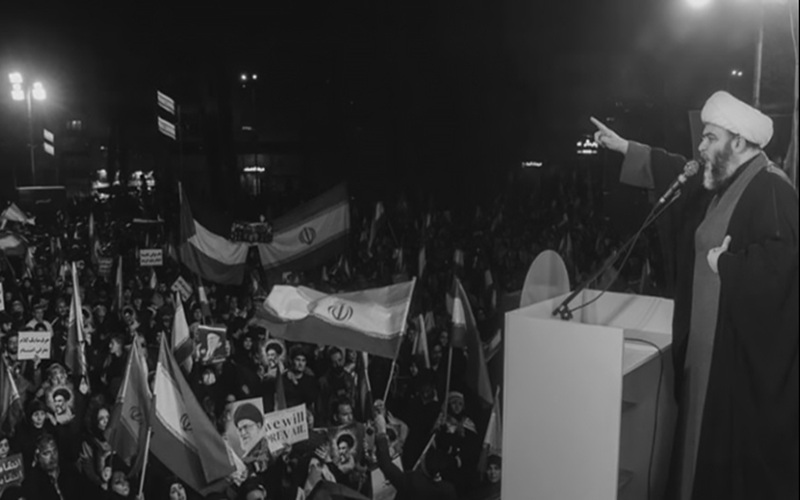
Nighttime gatherings and other political activities have reportedly included calls for the execution of former President Hassan Rouhani. Such demands illustrate the extent to which internal political attacks have moved beyond ordinary criticism.
The attacks also have a broader political dimension. While Rouhani may be the immediate target, criticism directed at him can also serve as an indirect attack on Pezeshkian and the political current associated with negotiation and accommodation.
In this environment, even seemingly limited factional disputes can quickly become battles over the regime’s overall direction.
A crisis that cannot be settled by “don’t fight”
The deeper significance of the current infighting lies in the fact that the regime’s traditional mechanisms for managing internal disputes are becoming less effective.
For years, competing factions could engage in fierce political struggles while remaining within a framework ultimately controlled by the supreme leader. The leadership could intervene, impose limits, or invoke the need for unity when conflicts threatened the broader interests of the ruling establishment.
The current circumstances are more difficult.
The regime is simultaneously confronting external pressure, economic deterioration, and a society marked by deep and persistent dissatisfaction. Decisions in one area immediately affect the others. A decision on negotiations has implications for internal legitimacy; an economic reform can trigger social anger; and repression designed to prevent unrest can further deepen the regime’s isolation.
This convergence of crises makes it increasingly difficult to compartmentalize disputes.
The growing factional warfare therefore points to more than political rivalry. It reflects the narrowing room for maneuver available to the regime’s leadership. When every major policy choice carries serious political costs, appeals to simply stop fighting cannot resolve the underlying contradictions.
The intensifying disputes at the top of the regime are consequently a reflection of a broader structural crisis: the leadership is struggling to find a course that can simultaneously address its economic problems, manage external confrontation, and prevent renewed domestic unrest.
Rather than resolving these contradictions, escalating factional attacks increasingly expose them.