


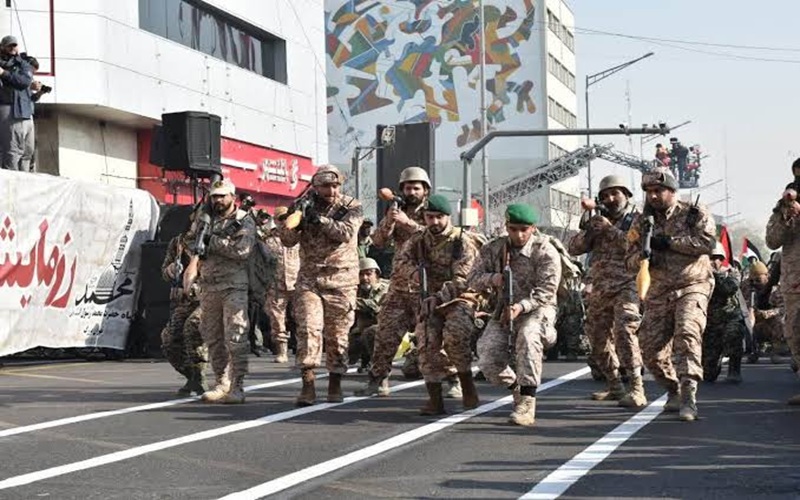

The regime’s planned mass mobilization in Tehran comes as economic hardship, social discontent, and memories of the 2022 uprising continue to shape its security calculations.
As the anniversary of Iran’s 2022 nationwide uprising approaches, the regime is preparing one of its largest-ever Basij mobilizations in Tehran. The scale and timing of the exercise have drawn attention because they come amid persistent economic hardship, widespread social grievances, and repeated warnings from regime officials about the possibility of renewed unrest.
On September 15, Tehran Province IRGC commander Hassan-Zadeh announced plans for a major Basij exercise in the capital on September 18, with regime-linked reports putting the number of participants at as many as 330,000. Other official statements have cited different figures, reflecting the inconsistent numbers frequently associated with such regime mobilization campaigns.
Whatever the exact number, the timing is significant.
The exercise is being presented by the authorities as a demonstration of readiness and organizational strength. But the concentration of such a large security-related mobilization in the capital, immediately around the anniversary of the 2022 uprising, also provides an indication of how seriously the regime is monitoring the possibility of renewed protests.
A Security Response to a Political Anniversary
The 2022 uprising remains one of the most consequential challenges faced by Iran’s ruling establishment in recent years. Beginning in September 2022, protests spread across the country and developed into a nationwide movement challenging the regime.
Four years later, the anniversary itself has become a politically sensitive moment for the authorities.
In recent days, officials from Iran’s security and law-enforcement apparatus have repeatedly emphasized preparedness, warned against attempts to create insecurity, and highlighted the need for security forces to maintain control.
The Basij exercise fits into this broader pattern.
Although the regime describes the event in terms of public mobilization and preparedness, the emphasis on the capital is particularly noteworthy. Tehran is the country’s political and administrative center and has historically played an important role in nationwide protest movements. Any large-scale mobilization there therefore carries a significance beyond a routine military or organizational exercise.
The regime is effectively placing its security apparatus on public display at the very moment when memories of the 2022 uprising are being revisited.
Why Tehran Matters
The mobilization is not limited to Tehran. The Basij and other regime-affiliated security structures maintain a presence throughout Iran. But the capital receives particular attention because of its political importance and the concentration of government institutions there.
The exercise therefore has both an operational and symbolic dimension.
On one level, it demonstrates that the authorities are preparing their forces and organizational structures for potential unrest. On another, it is intended to project an image of control to a society in which dissatisfaction remains visible.
The scale of the announced mobilization is itself part of that message.
The regime wants to show that it can put hundreds of thousands of people into the streets under its organizational umbrella. At the same time, however, the need for such a conspicuous display raises questions about the concerns driving it.
Economic Pressure Is the Other Part of the Equation
The anniversary of the 2022 uprising is not occurring in isolation from Iran’s economic crisis.
For years, Iranian households have faced declining purchasing power, inflation, rising housing costs, unemployment, and increasing difficulties in meeting basic expenses. These pressures have generated a continuous stream of protests by workers, retirees, teachers, drivers, pensioners, and other social groups.
The current concerns extend beyond the immediate impact of inflation.
Recent discussions in regime media and official press conferences have repeatedly focused on issues such as rising gasoline prices, increases in foreign-exchange and gold prices, and the declining economic capacity of households.
Even when officials promise advance notification before major economic decisions, the fact that such questions are repeatedly raised reflects the level of concern surrounding the economy.
Economic pressure also creates a particular challenge for the regime because it is difficult to contain through security measures alone.
A security force can disperse a demonstration, but it cannot restore the purchasing power of a pensioner. It cannot resolve a worker’s unpaid wages or provide affordable housing to families waiting for delayed projects. Nor can a military exercise eliminate the effects of inflation and unemployment.
This is why economic grievances and political discontent can become mutually reinforcing.
The Regime’s Own Warnings Reveal Its Concerns
The authorities’ rhetoric provides another indication of the calculations behind the current mobilization.
Officials have repeatedly warned about attempts to create “insecurity” and have emphasized the need for security forces to remain prepared. Such statements portray potential unrest primarily as a security problem rather than addressing the underlying causes of public dissatisfaction.
The same pattern was visible before and during the 2022 uprising, when demonstrations rooted in social and political grievances were increasingly treated by the authorities as a security threat.
Today, the regime is preparing before the anniversary arrives.
Its strategy appears to combine surveillance, warnings, security preparations, and highly visible displays of force. The objective is to deter potential protests and demonstrate that the authorities remain capable of rapidly mobilizing their forces.
A Display of Strength—or an Admission of Concern?
The enormous Basij exercise is designed to project strength. Yet its political meaning can also be read through the concerns that prompted it.
A government preparing for a potentially sensitive anniversary must take into account not only organized political opposition but also spontaneous demonstrations triggered by economic or social grievances.
This is particularly relevant in Iran, where protests over pensions, wages, prices, employment, and living conditions have continued across different sectors and cities.
The central question is therefore not simply how many people the regime can mobilize for a single exercise. It is whether such displays can address the underlying conditions producing social discontent.
The answer depends on developments far beyond the parade ground.
If economic pressures continue to intensify, if wages and pensions fail to keep pace with living costs, and if unresolved grievances continue accumulating, security displays cannot by themselves remove the causes of dissatisfaction.
The anniversary of the 2022 uprising thus arrives under circumstances in which the regime is simultaneously seeking to demonstrate control and preparing for the possibility of renewed unrest.
The scale of the Basij mobilization in Tehran is consequently more than a number. It is a visible indication of the importance the authorities attach to security preparations at a politically sensitive moment—and of their continuing concern about what might happen when accumulated social grievances find an opening to reach the streets.