


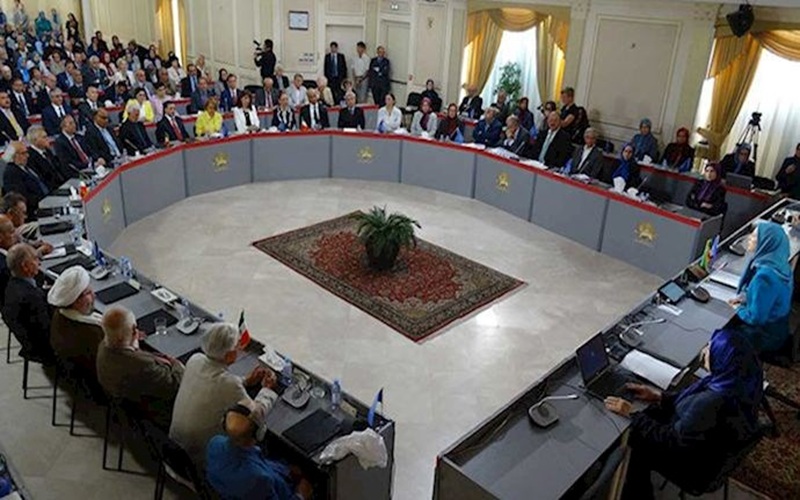

The National Council of Resistance of Iran was established not only as an opposition coalition but as a political framework for linking the struggle to overthrow dictatorship with a defined plan for transferring sovereignty to the Iranian people.
When a political movement seeks the complete overthrow of an entrenched political system, the question of what follows the regime cannot be postponed until the moment of victory. A movement that lacks a clear concept for political transition and the establishment of a democratic order risks leaving both its future and its present strategy unresolved.
For Iran’s resistance movement, this question has been central to the political project of the National Council of Resistance of Iran (NCRI) since its establishment in 1981.
The argument underlying the NCRI’s formation is that resistance to dictatorship must connect two tasks: dismantling the existing system and creating the political mechanisms through which sovereignty can be transferred to the Iranian people. In this view, the transition period is not an undefined interval between two political systems, but a crucial stage in establishing the foundations of a democratic future.
From Resistance to a Political Project
A resistance movement must ultimately answer two questions: What is it fighting against, and what political order does it seek to establish afterward?
For Iran’s opposition movement, the second question has been presented as inseparable from the first. The objective is not simply to remove the ruling regime but to establish the conditions under which the Iranian people can determine their own political future.
This approach also places responsibility on those participating in the resistance. Leadership, organization, political activity, and the development of resistance structures are presented not as instruments for personal power but as responsibilities toward the Iranian people and the country’s future.
Over the decades, the movement has adapted its organizational forms to changing circumstances—from the early formation of resistance networks and political coalitions to the establishment of the National Council of Resistance, the National Liberation Army, and, more recently, Resistance Units inside Iran.
The underlying argument has remained that tactics and organizational methods can change according to circumstances without abandoning the strategic objective.
A Broad Coalition in the Early Post-Revolution Period
The question of political pluralism was already visible in the period immediately following the 1979 revolution.
When Massoud Rajavi was a candidate in Iran’s first presidential election after the overthrow of the monarchy, his candidacy received support from a wide range of political and social organizations, according to accounts of the period. These included the National Democratic Front of Iran, the Organization of Iranian People’s Fedaian Guerrillas, the Society of Iranian Socialists, the Democratic Party of Iranian Kurdistan, Komala, the Turkmen People’s Political Center, and several Muslim organizations.
Support also came from members of Iran’s Armenian, Zoroastrian, Jewish, and Assyrian communities, as well as Kurdish, Turkmen, and Arab organizations, women’s and mothers’ associations, teachers’ organizations, publishers, researchers, student groups, labor organizations, and university faculty members.
The breadth of this support was politically significant because it extended beyond a single ideological current or community.
During his presidential campaign, Rajavi argued that voting should not be understood as simply endorsing an individual or organization. After Ruhollah Khomeini effectively barred him from the election because he had not voted for the newly imposed constitution establishing the system of velayat-e faqih, Rajavi continued to frame political legitimacy around a program rather than an individual.
He said that he understood the confidence placed in him to be directed not merely toward an individual or group, but toward a program capable of delivering prosperity, dignity, and justice.
The Founding of the NCRI
The confrontation between the emerging clerical regime and its opponents escalated dramatically in 1981. On June 20, 1981, the People’s Mojahedin Organization of Iran (PMOI/MEK) began armed resistance against the regime following the failure of peaceful political opposition.
One month later, on July 20, 1981, the National Council of Resistance of Iran was established.
The creation of the NCRI addressed a fundamental political problem confronting the resistance: an armed or underground struggle alone could not provide a political framework for the future of Iran.
The resistance therefore sought to establish an opposition coalition capable of articulating a political alternative while resistance organizations continued their struggle against the regime.
The NCRI presented itself as such a framework. Its stated purpose was to bring together political forces opposed to the ruling system and provide a platform for developing plans for Iran’s political future.
This distinction is important. A resistance movement can challenge a dictatorship without necessarily having a coherent political project for the period after its removal. The NCRI’s founding represented an attempt to combine resistance with an institutional and political vision for transition.
Why the Transition Period Matters
For the NCRI and its supporters, the transition following the fall of Iran’s current regime is not intended to establish another permanent concentration of power.
Instead, the transition is conceived as a mechanism for creating the conditions necessary for the Iranian people to exercise sovereignty.
This requires addressing questions that would arise immediately after regime change: how political authority would be organized, how institutions would function during the transition, how public participation would be established, and how the country would move toward a system in which the people determine their political future.
The NCRI has therefore developed a body of political documents, plans, programs, and resolutions intended to define its approach to these questions.
Its Ten-Point Plan for the Future of Iran, presented by Maryam Rajavi, is part of this broader political framework and calls for a democratic republic, separation of religion and state, gender equality, protection of minority rights, an independent judiciary, and a non-nuclear Iran.
An Alliance Designed to Survive Political Differences
The NCRI’s concept of coalition politics also rests on the recognition that opposition to dictatorship does not require complete ideological uniformity.
Political forces can maintain differences over economic, social, or ideological questions while cooperating around fundamental objectives such as ending authoritarian rule and establishing a democratic political process.
In this sense, the longevity of the NCRI is presented by its supporters as evidence that a political coalition can maintain a common strategic framework despite differences among its constituent forces.
Its proponents further argue that political ideas and institutions can outlast attempts to physically suppress the organizations that created them. Repression can target individuals, organizations, and networks, but eliminating an established political project requires confronting the ideas, programs, and institutional structures that sustain it.
Linking Iran’s Democratic Struggle to Its Future
The NCRI’s political significance, from this perspective, lies not simply in its opposition to Iran’s ruling regime but in its attempt to connect resistance with a defined political destination.
Iran’s modern history has included repeated struggles over constitutional government, national sovereignty, political representation, and democracy. The NCRI presents its project as part of this longer historical trajectory while seeking to provide the current resistance with a concrete political framework.
The central proposition is straightforward: overthrowing a dictatorship and establishing democracy are two connected but distinct political tasks. The first removes the existing system; the second requires institutions, a transition framework, and a mechanism for transferring sovereignty to the people.
For its supporters, the National Council of Resistance of Iran was created to address precisely this challenge. Its continuing political role is therefore presented as part of a broader effort to ensure that the struggle against dictatorship is linked from the outset to the establishment of a democratic future in Iran.