


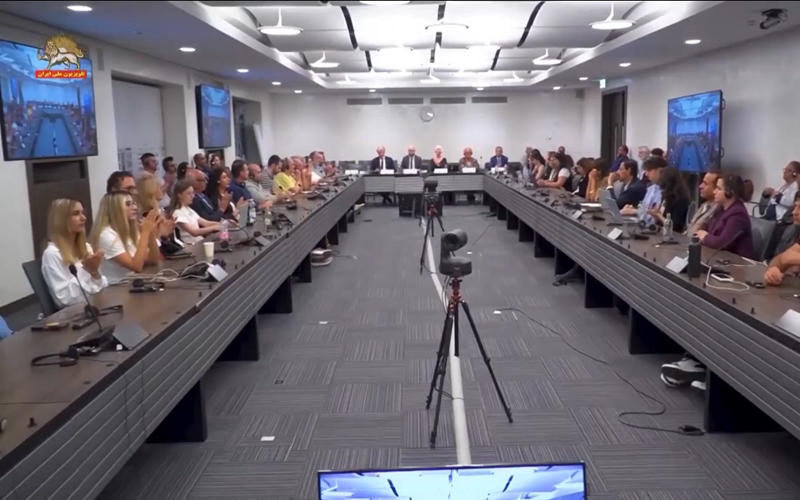

Political figures, legal experts, and human-rights advocates at the UN European headquarters warn of escalating executions, restrictions on civil society, and renewed repression of political prisoners in Iran.
A conference at the European headquarters of the United Nations in Geneva brought together political figures, legal experts, and human-rights advocates to address the deteriorating human-rights situation in Iran and the escalating wave of executions.
Speakers highlighted the growing restrictions on civil society, the use of broad security charges against political opponents, the denial of fair trials, and the increasing targeting of lawyers, journalists, activists, students, and other critics of Iran’s regime.
Henrik Hermansson: Civil Society Under Increasing Pressure
Dr. Henrik Hermansson, a political scientist, said Iranian citizens face severe penalties for communicating with foreign journalists, nongovernmental organizations, or UN-affiliated bodies and sharing information considered sensitive by the authorities, including information about human-rights violations.
He also referred to legislation being pursued in Iran under the title of a bill to counter foreign influence. According to Hermansson, the proposed measures would require prior authorization from the Intelligence Ministry for contacts with NGOs, UN special mandate holders, and international organizations. Failure to obtain such authorization could result in lengthy prison sentences.
Hermansson said these restrictions have further narrowed an already severely constrained space for civil society in Iran. He stressed that the ability of civil-society representatives to gather at the UN and speak openly about conditions in Iran is therefore particularly significant.
He also warned that political executions are increasing rapidly, while the overall number of executions is approaching historic highs. Lawyers, trade unions, journalists, medical personnel, and other defenders of civil rights are increasingly being targeted, he said, making it more difficult for critical voices to be heard.
Hermansson added that the regional war has further accelerated the regime’s domestic repression. With expressing dissent inside Iran becoming increasingly dangerous, he called on the international community to make greater efforts to ensure that the voices of the Iranian people are heard and that their fundamental rights are protected.
Christina Blacklaws: “The World Must Not Repeat Its Failure”
Christina Blacklaws, former president of the Law Society of England and Wales, focused on the growing use of the death penalty against political prisoners.
She said that since March, Iranian authorities have employed executions on a scale and with a deliberate pattern that should concern governments represented at the conference. She described the current wave as the most extensive and sustained use of the death penalty in Iran since the mass killings of political prisoners in 1988.
According to Blacklaws, these are not ordinary criminal proceedings. Vague charges such as moharebeh (waging war against God), baghi (rebellion), and efsad fel-arz (corruption on earth) are being used to criminalize political opposition, organizing, and alleged political affiliation.
She said defendants are routinely denied fair-trial guarantees, independent lawyers are prevented from properly representing them, confessions are extracted under torture, and families are left without reliable information about the fate of their relatives. In her assessment, the purpose is intimidation rather than justice.
Blacklaws highlighted the secret execution of six political prisoners from Qezel Hesar Prison between March 30 and April 4. She referred to footage that reportedly emerged from inside the prison showing prisoners singing resistance songs before their executions.
She also discussed the case of Arghavan Falahi, a 25-year-old woman who was first arrested during the 2022 uprising and later detained again in January 2025. According to Blacklaws, Falahi spent months in solitary confinement and under interrogation. Blacklaws said she joined hundreds of women from around the world in calling for urgent action to prevent her execution.
Warning of a Repeat of the 1988 Massacre
Blacklaws drew a connection between the current executions and the 1988 massacre of political prisoners in Iran.
She said more than 30,000 political prisoners were killed following a religious decree that designated prisoners who remained supporters of the People’s Mojahedin Organization of Iran (PMOI/MEK) as enemies who should be executed.
Blacklaws noted that the decree has never been formally revoked. She also pointed to a resolution adopted by the UN General Assembly’s Third Committee last year that referred to the 1988 executions, describing that recognition as important but insufficient.
She argued that similarities between the current situation and the period preceding the 1988 massacre include the use of similar charges and the intensified domestic crackdown following periods of external conflict.
Blacklaws also referred to a 2025 editorial published by a media outlet affiliated with the Islamic Revolutionary Guard Corps (IRGC) that called for the 1988 executions to be repeated and described the massacre as a successful historical experience.
She cited the findings of the former UN Special Rapporteur on Iran, who after years of investigation concluded that the extrajudicial executions and enforced disappearances of 1988 constituted crimes against humanity and genocide.
Blacklaws attributed the possibility of renewed atrocities in part to the lack of accountability for the 1988 killings. She warned that allowing perpetrators to escape justice creates conditions in which similar violations can recur.
Addressing political prisoners and their families in Iran, she said their names and actions had been heard internationally, including the prison songs, hunger strikes, and protests associated with the No to Execution Tuesdays campaign.
She concluded by calling for governments not to repeat what she described as the international community’s failure to act in 1988.
Alfred de Zayas Calls for Democratic Change
Alfred de Zayas, former UN Independent Expert on the promotion of a democratic and equitable international order, recalled his visit to Ashraf 3 and meetings with survivors of the 1988 massacre.
He expressed solidarity with the people of Iran and voiced his support for Maryam Rajavi’s Ten-Point Plan. He said he hoped Iran would soon have a democratic system in which people enjoy freedom of expression, freedom of assembly, freedom of association, and other fundamental liberties.
Rémy Pagani: Calls for International Action
Rémy Pagani, a former three-term mayor of Geneva and current member of the Geneva City Council, said Iran’s regime is responding to economic difficulties and widespread social dissatisfaction with intensified repression rather than dialogue or reform.
Pagani pointed to what he described as increasingly aggressive measures by the judiciary against people labeled by authorities as “mercenaries” or “disruptors.” He said such broadly defined labels can be used against journalists, students, civil-society activists, and ordinary citizens.
He also raised concerns over the regime’s enforcement of its so-called “hijab and chastity” laws at universities. According to Pagani, new regulations are being used to increase security controls on campuses and restrict the civic space available to women and students.
Pagani called for international institutions to investigate alleged forced confessions, arbitrary detention, and judicial threats against Iranian citizens.
He urged the UN Special Rapporteur on the human-rights situation in Iran, the Special Rapporteur on freedom of expression, and the UN Working Group on Arbitrary Detention to investigate these cases.
He further called on the UN Human Rights Council to document the roles of officials and institutions involved in repression and urged the use of universal jurisdiction and targeted sanctions against individuals responsible for torture and other serious violations.
Pagani emphasized that civil and political rights are fundamental human rights rather than privileges granted by governments. He called for greater international attention to the voices of Iranians demanding freedom and justice.