


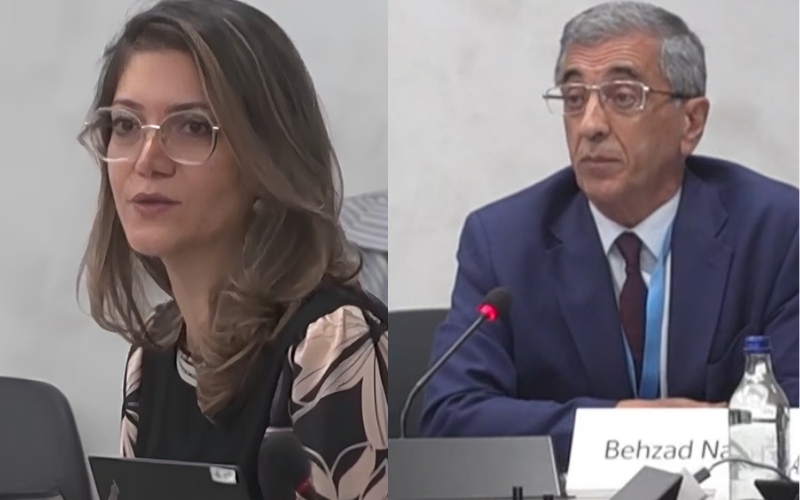

Former political prisoner Behzad Naziri linked the regime’s accelerating executions to its fear of renewed unrest, while women’s rights advocate Azadeh Alami described Iranian women’s resistance as a fundamental challenge to the theocratic system.
A conference at the European headquarters of the United Nations in Geneva examined Iran’s deteriorating human rights situation and the accelerating wave of executions, with speakers warning that the regime is using capital punishment and repression to confront a society it fears could again erupt in nationwide protest.
Among the speakers were Behzad Naziri, a former political prisoner who experienced detention in Evin and Gohardasht prisons, and Azadeh Alami, representing the Association of Iranian Women in France. Their interventions focused on two interconnected dimensions of the crisis: the regime’s use of executions as an instrument of political repression and the increasingly prominent role of Iranian women in challenging the system.
Naziri: Executions Reflect the Regime’s Fear of the People
Drawing on his own experience as a political prisoner, Naziri argued that international attention to Iran’s human rights crisis can have a direct impact on prisoners inside the country. He stressed that the voices raised in Geneva can reach Iranian prisons and strengthen those facing repression.
He identified two central conclusions regarding the dramatic increase in executions.
First, he argued that the executions should be understood primarily in the context of the regime’s fear of the Iranian population. In his assessment, the authorities are confronting a threat to their survival from a society whose underlying grievances remain unresolved. Executions therefore serve not simply as punishment, but as a mechanism intended to intimidate a population that the regime fears could once again take to the streets.
Second, Naziri warned that the international community has repeatedly been slow to recognize the scale and significance of Iran’s human rights crisis.
He pointed to the 1988 massacre of political prisoners as a particularly stark example. The killings of thousands of political prisoners took place over a matter of months, yet international recognition and accountability for the crime took decades. Naziri warned against allowing a similar delay to occur while executions are again accelerating.
The Causes of Iran’s Uprisings Remain
Naziri also connected the current wave of repression to the social and economic conditions that fueled Iran’s January 2026 uprising.
He argued that the factors behind that uprising have not disappeared. Economic hardship, social grievances and political repression remain embedded in Iranian society, and subsequent developments—including the war in February 2026—did not resolve those underlying problems.
In his view, the absence of a new nationwide uprising at any given moment should therefore not be interpreted as the disappearance of the forces driving popular discontent. Rather, he characterized the situation as unresolved pressure beneath the surface.
Naziri further argued that the regime itself understands the potential for renewed unrest and has responded with extensive security preparations.
According to information released by the National Council of Resistance of Iran, 51,000 security and paramilitary personnel were deployed across Greater Tehran during a recent period of heightened alert, including approximately 21,000 State Security Force personnel and 30,000 members of the IRGC and Basij. Independent reporting has also cited the NCRI figures while noting that the deployment figures themselves have not been independently verified.
For Naziri, the scale of these preparations raises a fundamental question: what does the regime fear most? His argument was that the security buildup should be viewed not only through the lens of external military threats, but also through the authorities’ concern about internal unrest.
A Critical Moment for Iran’s Human Rights Crisis
Naziri described the current period as a critical juncture for Iran, arguing that the international focus on geopolitical developments should not obscure the worsening human rights situation inside the country.
He called for greater recognition of what he described as the Iranian people’s right to resist oppression. He linked this principle to the broader concept of resistance to tyranny reflected in international human rights traditions and referenced constitutional provisions in countries including France and Portugal.
His appeal to the international community was therefore not limited to condemning individual executions. He urged governments and international institutions to recognize the broader political context in which executions and repression are taking place and to support the Iranian people’s struggle for fundamental political change.
Alami: Iranian Women Are Challenging the Foundations of the Regime
Azadeh Alami focused on another central dimension of Iran’s struggle: the role of women.
Speaking on behalf of the Association of Iranian Women in France, she argued that the reality of Iranian women cannot be reduced to the issue of compulsory hijab or individual restrictions on dress. In her assessment, women’s resistance represents a much broader political and social challenge to the ruling system.
Alami traced this role back to the 1979 revolution, emphasizing that women—particularly students and young activists—had already been involved in political opposition before the establishment of the current regime. Many women who participated in political resistance were subsequently imprisoned and executed after the regime consolidated power.
She portrayed the current generation as continuing that long-running struggle, with demands extending well beyond limited reforms.
According to Alami, Iranian women are demanding full legal equality, social justice, accountability for perpetrators of torture and repression, and the right to determine their own future. Their demands, she argued, challenge the foundations of a system that combines religious rule with institutionalized discrimination against women.
“The Wall of Fear Has Fallen”
Alami also emphasized the significance of continued resistance despite the regime’s extensive use of executions, surveillance and repression.
She argued that Iranian women have increasingly refused to allow fear to determine their political choices. By placing women’s freedom at the center of their democratic demands, they are not simply seeking changes to individual regulations but challenging the broader political structure that enforces those restrictions.
In this context, Alami described executions as one of the regime’s ultimate instruments of repression. The continued use of the death penalty against opponents and activists is intended to intimidate a society that has increasingly demonstrated its willingness to challenge the authorities.
She called on the international community to respond with concrete measures rather than limiting its role to observation or statements of concern.
A Call for International Action
Alami urged governments and international institutions to maintain maximum diplomatic pressure on the Iranian regime, demand an immediate halt to executions, and strengthen protections for Iranian women human rights defenders.
Her message was that international actors have a responsibility to ensure that the voices of Iranian women and other victims of repression are heard beyond Iran’s borders and that those responsible for abuses face meaningful consequences.
The two interventions in Geneva thus converged on a broader warning: the execution crisis in Iran cannot be separated from the regime’s fear of renewed popular resistance.
Naziri emphasized the political and security dimensions of the crackdown and called for recognition of the Iranian people’s right to resist dictatorship. Alami highlighted the role of women whose demands for equality and freedom challenge the foundations of the theocratic system.
Together, their messages underscored that the human rights crisis in Iran is not an isolated series of abuses. It is intertwined with the country’s unresolved political crisis and with a population that continues to demand fundamental change.