


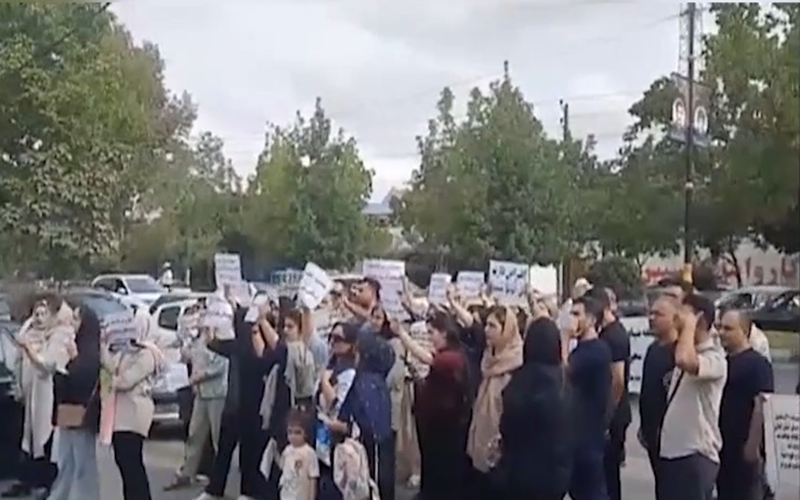

From retirees and workers to drivers, farmers, homebuyers, and university students, protests across Iran are increasingly linking economic grievances to opposition to the regime’s broader policies.
Iran’s economic crisis is increasingly spilling into the streets, with workers, retirees, drivers, farmers, students, homebuyers, and other social groups staging protests across the country over unpaid or inadequate wages, soaring living costs, insecure employment, and what they describe as institutionalized corruption and exploitation.
The latest wave of protests shows how demands that initially center on wages, pensions, insurance, housing, or delayed deliveries are increasingly intersecting with broader anger over the policies and institutions of Iran’s regime.
In Tehran, Ahvaz, Shush, Rasht, Isfahan, Kermanshah, Sanandaj, Khorramabad, Tabriz, Arak and other cities, different groups have taken to the streets in recent days, each confronting a different manifestation of the same economic crisis.
Wages Fall Far Behind the Cost of Living
At the center of the labor protests is the widening gap between official wages and the actual cost of maintaining a household.
The regime had previously promised adjustments to workers’ wages, but the issue remained unresolved as the summer ended. A September 19 meeting of the Supreme Labor Council that was expected to address wage restoration ended without a final decision, leaving workers once again facing delays and promises rather than meaningful increases.
The proposals under discussion would have increased certain benefits, including the marriage allowance and food allowance, but would not have represented a substantial restoration of workers’ purchasing power.
That gap has become increasingly stark.
The minimum monthly wage for Iranian workers in 2026 was set at roughly 16.6 million tomans, while the minimum total income including benefits is around 23 million tomans. At the same time, estimates of the cost of a basic household living basket have risen dramatically, with labor activists placing current monthly costs at approximately 80–90 million tomans and some economic analysts putting the figure above 100 million tomans.
The result is a massive structural gap between income and basic household expenditure.
Inflation has compounded the problem. Point-to-point inflation reached 84.4 percent in August, while the Iranian rial has continued to lose value against the U.S. dollar.
Measured in dollars, the erosion of wages becomes even clearer. A monthly wage of around 16 million tomans that was worth approximately $109 at the beginning of the year has fallen to roughly $60–65 as the rial depreciated. In real purchasing-power terms, workers have therefore experienced a dramatic decline rather than a meaningful improvement in their incomes.
The consequences extend far beyond individual workers. With an estimated 16 million workers and an average household size of approximately 3.4 people, the deterioration in workers’ living standards directly affects more than 50 million Iranians.
Retirees: “Our Table Is Empty”
Retirees have been among the most persistent groups protesting across Iran.
On September 28, Social Security retirees demonstrated in Tehran, Ahvaz, Shush and Rasht, while steel retirees in Isfahan also protested over their deteriorating living conditions.
Their slogans have increasingly gone beyond demands for higher pensions.
Messages such as “Enough of oppression, our table is empty” and “Our pension lasts only one week” reflect the inability of retirees to cover basic necessities after decades of work.
Other slogans directly blamed government institutions, including:
“The bankrupt government is the enemy of retirees.”
In the following days, telecommunications retirees demonstrated in Isfahan, Kermanshah, Sanandaj, Ahvaz and Bijar, demanding implementation of their employment and pension regulations and warning that they would continue weekly protests until their demands were addressed.
The persistence of these demonstrations indicates that the pension crisis is no longer confined to isolated disputes between retirees and individual institutions. It has become part of a nationwide confrontation over purchasing power, corruption and the distribution of public resources.
Drivers, Workers and Homebuyers Join the Protests
The same economic pressure is visible among other groups.
Motorcycle delivery drivers in Khorramabad went on strike over low earnings and rising operating costs. Contract drivers working for Tabriz Municipality gathered outside the city council, protesting inadequate wages, lack of insurance and insecure employment.
For drivers, the problem is particularly acute because income must cover not only household expenses but also fuel, repairs, insurance and vehicle depreciation.
Workers at the HEPCO industrial company in Arak also protested over their wages and employment conditions.
Elsewhere, purchasers of Saipa Shahin vehicles gathered outside the Ministry of Industry, Mine and Trade in Tehran. Despite having paid the required amounts, they said their vehicles had not been delivered and their repeated demands had gone unanswered.
In Rasht, applicants for a 624-unit housing project in Lakan demonstrated outside the provincial Housing Foundation, protesting prolonged delays and the failure to deliver promised housing.
These protests differ in their immediate demands, but they share a common feature: people have paid, worked, or contributed, yet cannot obtain what they were promised.
Protest Slogans Turn Toward the Regime
The evolution of protest slogans provides an important indication of how economic grievances are broadening.
Retirees have demanded their pensions and basic living rights, but their slogans increasingly identify government institutions and political structures as responsible for their hardship.
Telecommunications retirees, for example, have accused institutions linked to the Supreme Leader and the Islamic Revolutionary Guard Corps of taking control of their assets and resources. Their slogans specifically targeted the Executive Headquarters of Imam Khomeini, Mobile Telecommunications Company and IRGC-affiliated institutions.
Other protesters have adopted broader slogans such as:
“Our rights can only be won in the streets.”
“Street by street, the workers’ trenches.”
“Incompetent government, powerless parliament—we don’t want them.”
And:
“Their slogan is Hussein, Hussein; their work is lies and theft.”
The progression is significant. A protest may begin with a demand for a pension adjustment or unpaid wages, but the grievances increasingly point toward the institutions responsible for economic policymaking and control over Iran’s wealth.
Universities Join the Growing Protest Wave
The reopening of universities has added another dimension to the protests.
Less than a week after universities reopened, students at Allameh Tabataba’i University in Tehran demonstrated against rising education costs and measures imposed by campus security authorities, particularly restrictions and pressure targeting female students.
Their slogans included:
“Free the imprisoned student.”
“Commercialized university—we don’t want it.”
“Don’t think it’s for one day; our commitment is every day.”
Students also protested at Khajeh Nasir al-Din Tusi University, raising demands that connected educational conditions with broader social and political grievances.
The slogan “No barracks, no business—long live the university” reflected opposition to the increasing securitization and commercialization of higher education.
Other slogans directly challenged the ruling system, demonstrating that student protests are not confined to tuition, campus regulations, or university administration.
The emergence of student protests alongside demonstrations by retirees, workers and drivers creates a broader social picture: different generations and occupational groups are confronting the regime over different manifestations of the same crisis.
A Common Crisis Behind Different Demands
The protests of the past week reveal a common pattern.
A worker faces wages that no longer cover food and housing. A retiree cannot afford medicine and utilities. A driver struggles with fuel and vehicle-maintenance costs. A farmer faces increasing production expenses. A homebuyer waits years for a promised apartment. A car buyer pays in full but does not receive the vehicle. A student faces rising educational costs while confronting intensified campus restrictions.
Each group has its own immediate grievance, but the underlying economic pressures are increasingly interconnected.
For millions of families, the issue is no longer simply whether their income will rise. It is whether their income can provide food, housing, medicine, transportation and education at all.
That is why economic protests are increasingly acquiring a political character.
From Economic Grievances to Broader Opposition
The regime has traditionally attempted to contain social protests by treating each dispute as an isolated economic or administrative problem. But the growing frequency and geographic spread of demonstrations make that approach increasingly difficult.
Workers and retirees are not protesting in only one city. Students are returning to the streets. Drivers, homebuyers and other groups are raising their own grievances. Their slogans increasingly identify government institutions and political structures as part of the problem.
At the same time, the regime continues to rely on security measures, arrests, executions and pressure on universities to contain dissent.
The result is an increasingly visible connection between economic deprivation, political repression and social resistance.
The protests do not represent a single coordinated movement, and their immediate demands vary considerably. But their expansion across occupational and generational lines demonstrates the depth of the grievances confronting Iran’s regime.
What begins with a demand for wages, pensions, insurance or housing can increasingly develop into a challenge to the policies and institutions that protesters hold responsible for their deteriorating lives.
For a regime already confronting profound economic pressures and widespread social discontent, the persistence of these protests presents a continuing challenge: promises and temporary concessions cannot easily resolve grievances rooted in a much deeper crisis of living standards and political repression.