


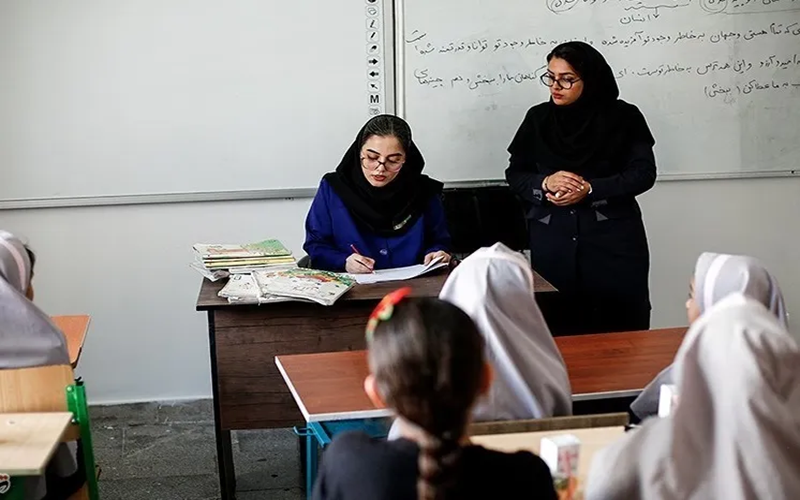

On World Teachers’ Day, Iranian teachers are confronting poverty, job insecurity, overcrowded classrooms, repression, and an increasingly privatized education system.
World Teachers’ Day is meant to recognize the central role educators play in shaping the future of society. In Iran, however, the occasion has highlighted a starkly different reality: teachers are increasingly speaking of resignation and leaving their profession rather than celebrating their status.
The reports of teachers submitting resignations have become sufficiently widespread that even regime-linked media have been forced to acknowledge the issue, while officials have attempted to dismiss the reports as rumors. Yet images and documents showing teachers’ resignations have circulated publicly, exposing the growing gap between official claims and conditions inside Iran’s schools.
The crisis is not simply about salaries. It reflects the cumulative impact of economic hardship, insecurity, repression, overcrowded classrooms, inadequate facilities, and the transformation of education into an increasingly class-based system.
A profession stripped of job security
The international standards concerning teachers emphasize the importance of professional dignity and employment security. The 1966 UNESCO Recommendation concerning the Status of Teachers specifically recognizes permanent employment and job security as essential to encouraging teachers to devote themselves to education.
The reality facing Iranian teachers is increasingly the opposite.
Teachers’ salaries reportedly range from roughly 170 million to 270 million rials per month, while the poverty line for a four-person household has reached approximately 750 million rials. In other words, even the upper end of a teacher’s salary remains far below the cost of a basic life for a family.
At the same time, inflation has approached 90 percent, continuously eroding purchasing power. Teachers who entered the profession expecting to contribute to the country’s future are finding themselves unable to sustain their own families.
Economic hardship is compounded by administrative mismanagement and corruption. The result is a profession under pressure from virtually every direction.
An increasingly securitized school environment
The crisis also extends beyond teachers’ paychecks.
Teachers have repeatedly faced pressure and punishment for raising professional and social demands. Those who protest working conditions or demand their basic rights can face detention, prosecution, and imprisonment.
At least 60 teachers are reportedly imprisoned or facing imprisonment. Among them is Hashem Khastar, a prominent teacher and advocate who has spent years behind bars.
The broader effect is the creation of a heavily securitized educational environment. Teachers face restrictions not only over what they demand as workers but also over their ability to perform their professional responsibilities freely.
This atmosphere undermines the very purpose of education. A teacher who is expected to inspire students while being subjected to surveillance, intimidation, and punishment cannot perform that role normally.
The pressure is intensified by the growing number of students per classroom and the expanding workload placed on teachers. Insufficient educational space and inadequate facilities further compound the problem.
What has emerged is not an isolated labor dispute but a systemic crisis in Iran’s education sector.
Privatization and the deepening of educational inequality
Rather than addressing these structural problems, policies pursued under the regime have increasingly pushed education toward privatization and commercialization.
The result is a sharply class-based education system. Families with financial means can turn to private schools, while millions of others remain dependent on increasingly underfunded public schools.
Private-school tuition can reach hundreds of millions of tomans and, in some cases, around one billion tomans or more. Such costs place quality education beyond the reach of ordinary families.
At the same time, public schools frequently lack basic resources, including adequate educational space, recreational facilities, laboratories, and reliable internet access.
This creates a widening divide between students based on their families’ economic status. Access to quality education increasingly depends not on ability or potential, but on the ability to pay.
The consequences are visible in university admissions as well. The overwhelming majority of students gaining access to Iran’s most competitive universities come from better-resourced educational backgrounds, while students from ordinary public schools face substantially greater barriers.
Education turned into another channel for extraction
The expansion of private education has therefore raised fundamental questions about who benefits from the system.
Instead of treating education as a public responsibility, the regime has allowed it to become another field for profiteering and rent-seeking. Schools charging enormous tuition fees coexist with public schools struggling to provide basic services, while teachers themselves remain among the economically vulnerable sections of society.
This contradiction is central to the education crisis: those responsible for educating Iran’s future generations are struggling to survive, while education itself is increasingly commercialized.
The consequences extend far beyond teachers.
When educators leave their profession because their salaries cannot cover basic living costs, when classrooms become overcrowded, when public schools lack essential resources, and when families must pay enormous sums to access better education, the damage is transferred directly to the next generation.
A crisis that reaches beyond the classroom
Teachers’ resignations are therefore a symptom rather than the cause of the crisis.
The deeper problem is a system that has failed to provide teachers with economic security, professional dignity, and freedom from political and security pressure, while simultaneously allowing education to become increasingly unequal and commercialized.
On World Teachers’ Day, the contrast could hardly be sharper. International standards emphasize the dignity, independence, and security of teachers. In Iran, teachers are confronting poverty, repression, overcrowded classrooms, inadequate resources, and the threat of losing their livelihoods.
When educators begin leaving the profession because they can no longer afford to remain in it, the consequences are not confined to the teachers themselves. It signals the erosion of an institution on which every society depends.
The growing wave of teacher resignations is thus another warning sign of a system in which the regime’s economic mismanagement, corruption, repression, and profiteering are increasingly undermining the most basic foundations of social life—including the education of Iran’s children.