


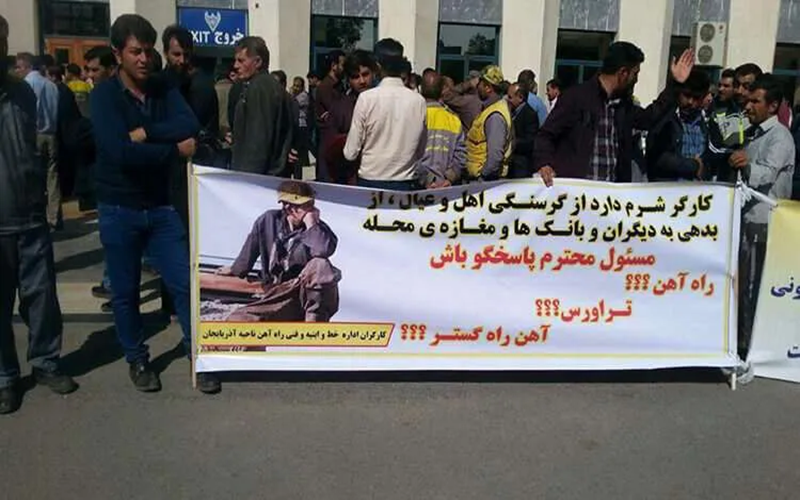

From retirees and workers to students, nurses, farmers, and defrauded investors, protests are spreading across Iran as inflation approaches 90 percent and the regime intensifies its security mobilization.
Iran is witnessing a sustained expansion of social protests as economic pressure continues to erode living standards and the regime responds with greater security mobilization.
According to a compilation of protest activities over the past month, 201 protest actions were recorded across different sectors of Iranian society. The largest share came from retirees, with 79 actions, followed by workers with 51, other social groups with 41, bazaar merchants with 16, nurses with five, and students with four.
The breadth of these protests is significant. They involve people whose grievances arise from different circumstances, but whose demands increasingly converge around the same underlying problems: poverty, inflation, unpaid or inadequate benefits, corruption, economic mismanagement, and the absence of meaningful responses from the regime.
Retirees lead a growing wave of protests
Retirees accounted for the largest number of recorded protest actions, including pensioners from the Social Security Organization, telecommunications sector, and steel industry.
Their demands include wages that remain far below the poverty line, pensions that fail to keep pace with inflation, the failure to implement the third stage of pension equalization, unresolved employment regulations, outdated food allowances, and deductions from pensions for supplementary insurance.
For many retirees, income has effectively become insufficient even for basic household expenses. Their protests repeatedly expose the widening gap between official promises and the reality of everyday life.
The protests extend beyond traditional labor and pension grievances. During the same period, people who had paid for housing projects, automobiles, foreign currency, and financial products also took to the streets.
Among them were applicants for housing projects in Rasht, Kermanshah, Shiraz, Kashan, Hamedan, and Baharestan; owners of residential land in Yazdanshahr; purchasers of shares and investment products; cryptocurrency exchange customers; and car buyers in Tehran.
Many of these projects and companies are connected to state or quasi-state institutions, further reinforcing a common perception among protesters that the regime’s economic system provides neither security nor accountability.
Inflation is turning economic hardship into social pressure
The expansion of protests is taking place against a dramatic deterioration in purchasing power.
Point-to-point inflation has reached 89.8 percent, meaning households are paying roughly 90 percent more for the same basket of goods than they did a year earlier. Annual inflation has also risen from 69.9 percent to 73.6 percent.
Meanwhile, the value of foreign currency has climbed beyond 268,000 tomans per dollar, further eroding the rial’s purchasing power and driving up the cost of imported goods and essential household necessities.
These figures help explain why grievances that initially appear to be sectoral are increasingly converging. A retiree demanding a pension increase, a worker demanding wages, a nurse demanding fair compensation, or a housing applicant demanding delivery of a promised home is confronting different manifestations of the same economic crisis.
The regime’s “martyr” mobilization and fear of unrest
At the same time that these protests continue, the regime has intensified organized gatherings involving its loyalist forces, presented as gatherings of “devotees” or “martyrs.”
The parallel is revealing.
The regime faces a population under mounting economic pressure while knowing that unresolved grievances can potentially connect with broader political discontent. Its response has increasingly involved strengthening its security presence and mobilizing loyalist forces.
These organized displays serve not only as demonstrations of regime support but also as a mechanism for reinforcing a climate of intimidation at a time when social dissatisfaction is spreading.
In the first 13 days of the Iranian month of Mehr alone, approximately 16 protest actions were recorded in 31 cities, involving workers, retirees, students, farmers, nurses, and other sections of society.
The geographic spread is as important as the number of protests. Grievances are no longer concentrated in one profession, city, or region.
When economic protests become political
The regime has repeatedly attempted to portray labor and pension protests as limited “professional” or economic disputes. But the slogans heard in these gatherings increasingly go beyond individual demands.
Retirees and workers have called for freedom and justice, condemned corruption and repression, rejected empty promises, and demanded accountability from officials. Slogans such as “Freedom, justice, our right,” “The streets are the battleground of the working people,” and “We have heard enough promises and lies; we have seen no justice” reflect a broader loss of confidence in the governing system.
Other slogans directly connect economic hardship with the regime’s political and administrative structure, including denunciations of corruption, state mismanagement, and the erosion of pensions and social protections.
The message is increasingly clear: economic demands cannot be separated indefinitely from the political structures that determine how national resources are allocated.
A structural contradiction
The regime faces a fundamental contradiction.
Meeting the population’s demands for adequate wages, pensions, healthcare, housing, and social security would require redirecting resources away from entrenched networks of corruption, rent-seeking, repression, and military spending.
Yet these networks are deeply embedded in the regime’s structure.
This helps explain why repeated promises have failed to resolve the underlying grievances. Temporary concessions may postpone a confrontation, but they cannot address the structural causes of poverty and inequality.
For protesters, the issue is therefore increasingly about more than the size of a pension check or the delivery date of a housing project. It is about a system in which economic resources are controlled through opaque networks while ordinary people are left to absorb the consequences of inflation and declining purchasing power.
The 201 protest actions recorded in a single month demonstrate the breadth of this pressure. Retirees, workers, nurses, students, farmers, merchants, and defrauded citizens are appearing in different places with different immediate demands, but their protests increasingly reveal a common reality.
The regime can increase security measures and organize loyalist demonstrations, but the underlying economic grievances remain.
As inflation approaches 90 percent and the rial continues to lose value, the widening protest movement shows that economic hardship is no longer confined to household budgets. It is increasingly becoming a source of sustained social confrontation across Iran.