


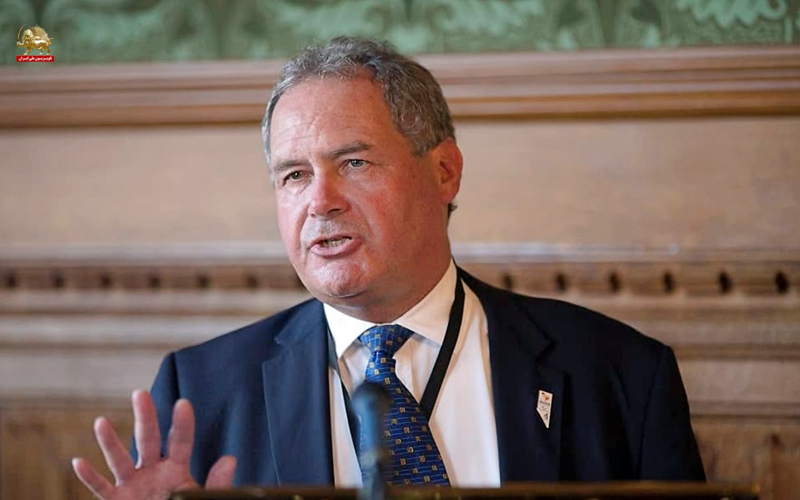

Speaking at a conference marking the World Day Against the Death Penalty, the British parliamentarian called for an end to Western appeasement, international prosecution of Iranian regime officials, and recognition of a democratic alternative based on the Iranian people’s aspirations.
Blackman, chair of the British Committee for Iran Freedom and co-chair of the International Parliamentary Committee for a Democratic Iran, stressed that international attention to military confrontations and maritime security must not overshadow the regime’s continuing campaign of repression against the Iranian population.
He argued that the central conflict over Iran’s future is between the Iranian people and their organized resistance on one side and the ruling establishment, the Islamic Revolutionary Guard Corps (IRGC), and its regional proxies on the other. Executions, he said, have become one of the regime’s principal instruments for suppressing dissent and maintaining control.
Western Appeasement Has Failed to Curb Repression
Blackman criticized decades of Western policy that, in his assessment, allowed Tehran to escape accountability for serious human rights violations, crimes against humanity, and terrorism. Such policies, he argued, have helped preserve the regime’s capacity to target opponents and dissidents both inside Iran and abroad.
Rather than moderating the regime’s conduct, he said, Western concessions had failed to prevent further conflict and terrorism. He urged European governments and the United Kingdom to abandon this approach and adopt a policy that places accountability and support for the Iranian people at its center.
Blackman cited the reported disruption of approximately 24 alleged Iran-backed plots in the United Kingdom, as well as concerns about possible regime involvement in a reported terrorist plot targeting RAF Fairford, as reasons for heightened vigilance. He used these examples to argue that the threat posed by Tehran extends beyond Iran’s borders.
Criticism of the German Think Tank’s Pahlavi Invitation
Blackman also addressed the controversy surrounding a German think tank’s decision to invite Reza Pahlavi, son of Iran’s former shah, to receive a Freedom Prize dedicated to the Iranian people.
He characterized the decision as regrettable and counterproductive, arguing that elevating a figure associated with the former monarchy risks undermining the struggle for a democratic future that rejects both the shah’s dictatorship and the current religious dictatorship.
For Blackman, Iran’s future should not be determined by the restoration of a former ruling system or by the continuation of the present one. Instead, he argued, the Iranian people must be able to determine their own political future through a democratic process.
His criticism reflects the position that neither hereditary monarchy nor religious authoritarianism offers a democratic solution to Iran’s political crisis.
Call for International Prosecution of Regime Officials
On the occasion of the World Day Against the Death Penalty, Blackman called on European leaders to unite behind an international accountability initiative targeting Iranian regime officials responsible for crimes against humanity.
He urged European governments to publicly commit to pursuing accountability at the United Nations, including efforts to bring senior regime officials before appropriate international judicial mechanisms. He also called on the British government to take a leading role in advancing these efforts internationally.
Blackman maintained that confronting the regime’s human rights record requires more than statements of condemnation. In his view, governments must pursue concrete measures to end impunity and ensure that those responsible for grave crimes face justice.
A Democratic Republic Based on the Iranian People’s Choice
Blackman reaffirmed his support for the National Council of Resistance of Iran (NCRI) and its proposed democratic alternative, associated with Maryam Rajavi’s Ten-Point Plan. He described the plan as a framework for a democratic republic in which the separation of religion and state, free elections, and individual freedoms would be guaranteed.
He emphasized that Iran’s future must be determined by its people, who should have the right to choose their government through free and fair elections. He also called for an orderly transfer of power from the current regime to the Iranian people.
Blackman argued that the NCRI’s platform provides a route toward elections and political change that depends on the participation and agency of the Iranian population. He also criticized the British government’s engagement with Tehran, saying that diplomatic gestures toward the regime underscore the need for a fundamental reassessment of London’s approach.
Concluding his remarks, Blackman called for a free, democratic, and secular Iran in which every individual can express their views, choose their government freely, and live without repression.
His message at the conference was that international policy toward Iran must move beyond appeasement and focus on accountability, human rights, and the Iranian people’s right to determine their country’s future.
The original video of Bob Blackman’s speech is embedded below.