


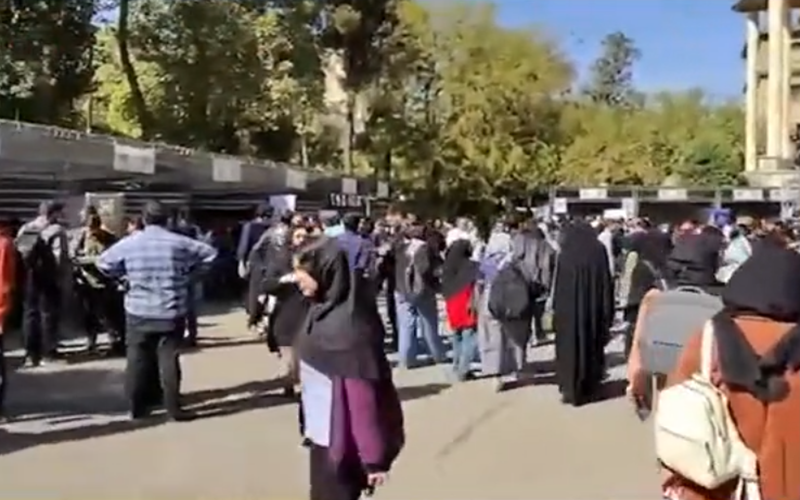

A 230 percent tuition increase at one medical university, rising dormitory costs, deteriorating food services, and mounting living expenses are making higher education increasingly inaccessible to students from low-income families.
Iran’s universities are facing a deepening affordability crisis as soaring tuition fees, rising accommodation costs, and deteriorating student services place higher education beyond the reach of growing numbers of families. What was once widely regarded as a path to professional advancement and social mobility is increasingly becoming a financial burden that forces students to choose between continuing their education and meeting basic living expenses.
The crisis extends across tuition, student housing, and university food services. Reports from campuses point to sharply increased accommodation charges, deteriorating dormitory conditions, reduced food portions, and the elimination of meals at some universities. Meanwhile, tuition increases of as much as 230 percent at one medical university have intensified concerns over the growing commercialization of higher education under Iran’s ruling regime.
The consequences reach beyond individual students. As access to education becomes increasingly dependent on family income, the university system risks reinforcing the very class divisions that education is supposed to help overcome.
Rising Dormitory Costs and Deteriorating Living Conditions
The new academic year has brought a fresh wave of cost increases for students, including accommodation expenses that many families already struggle to afford.
According to reporting by the state-run Shargh newspaper, student accommodation costs have nearly doubled. Students at the University of Tehran have reported that dormitory fees rose from 700,000 tomans to 1.3 million tomans per semester.
Higher charges have not necessarily brought better living conditions. Reports describe deteriorating dormitories with faulty sewage systems, leaking ceilings, and unsanitary facilities. Students are being asked to pay more while continuing to live in conditions that raise serious questions about basic maintenance and student welfare.
Food services have become another source of frustration. Students have repeatedly protested poor food quality and unhygienic conditions. At Allameh Tabataba’i University, students have reported that food portions have been reduced by half compared with the previous academic year. At another university, meals have reportedly been eliminated altogether amid budget shortages.
The regime’s parliamentary research center has acknowledged a budget shortfall of 37.7 trillion tomans in the Ministry of Science’s funding for student meals. The shortfall highlights the financial pressures facing university services at a time when students are struggling to cover even their most basic needs.
For students living away from home, the combination of expensive housing, inadequate food services, and rising daily expenses makes university attendance increasingly difficult.
Tuition Increases of 230 Percent Put Higher Education Further Out of Reach
Tuition fees have added another layer of pressure.
At Ahvaz Jundishapur University of Medical Sciences, students entering in the Iranian academic year beginning in 2025 reportedly faced a sudden tuition increase of 230 percent. Semester fees rose from approximately 15 million tomans to between 45 million and 50 million tomans.
Reports concerning Islamic Azad University indicate that tuition fees have increased by as much as threefold in some cases, with semester charges reaching 90 million tomans for certain medical programs.
Such increases can fundamentally alter a family’s ability to finance a university education. For households already struggling with inflation and declining purchasing power, paying tens of millions of tomans per semester may be impossible without borrowing or sacrificing essential expenditures.
The pressure is particularly severe for students from working-class families, whose parents may earn monthly wages that are insufficient to cover both ordinary household expenses and the costs of supporting a child at university.
As a result, access to higher education increasingly depends not only on academic performance but also on the financial resources available to students and their families.
Student Protests Challenge the Commercialization of Education
The deterioration of university conditions has prompted students to speak out against rising costs and growing inequality.
Students from Allameh Tabataba’i, Tehran, National, Iran University of Science and Technology, and Tarbiat Modares universities issued a joint statement criticizing poverty, inequality, and gender-based pressures. They also called for broader public participation in protests.
At Allameh Tabataba’i University, students voiced their opposition to the transformation of education into a service available primarily to those who can afford it. Their slogan, “We don’t want a pay-to-enter university,” expressed resistance to a system in which financial considerations increasingly determine access to educational opportunities.
The controversy goes beyond the immediate question of tuition levels. It concerns the direction of higher education and the extent to which the state should guarantee access to education as a social right.
Officials have presented the outsourcing of services and the reduction of universities’ dependence on government funding as part of their approach. Yet the reported consequences include higher costs for students and reduced access to essential services.
When universities pass a growing share of their expenses directly to students, those from wealthier households are better positioned to continue their studies, while students from disadvantaged backgrounds face greater risks of interruption or exclusion.
This creates a widening divide between those who can purchase educational opportunities and those whose academic prospects are constrained by their family’s economic circumstances.
The True Cost of University Is More Than Tuition
The financial burden does not end with semester fees.
The cost of the least expensive student lifestyle in Tehran has reportedly exceeded 20 million tomans per month when living expenses are taken into account. For families whose main earners are workers, teachers, or nurses earning around 20 million tomans a month, supporting a student in the capital can consume an entire monthly income or more.
Parents are consequently forced into difficult choices between paying for their children’s education and covering essential household needs. Some families resort to borrowing to meet tuition and accommodation costs.
Students themselves increasingly face pressure to work alongside their studies. For some, employment after classes and late into the night becomes necessary to pay for housing, food, transportation, and other daily expenses.
These demands can undermine academic performance, reduce the time available for study, and place additional strain on young people who are already navigating an uncertain economic future.
The result is a system in which students from wealthier families can devote more time and resources to their education, while their less affluent peers must overcome financial obstacles unrelated to their academic abilities.
A University System Reinforcing Social Inequality
The crisis in Iranian higher education raises fundamental questions about social mobility and equal opportunity.
Universities are generally expected to help young people develop their abilities, acquire professional skills, and improve their economic prospects. But when tuition, housing, and basic food expenses become prohibitively expensive, education can instead reinforce existing inequalities.
Students from low-income households may be discouraged from pursuing certain fields, forced to delay their studies, or compelled to abandon university altogether. Even those who remain enrolled may graduate under substantial financial pressure.
The consequences extend into the labor market and society as a whole. When access to education depends increasingly on wealth, the opportunities available to young people become more closely tied to their family background than to their talents and ambitions.
The reported tuition increases, dormitory problems, food shortages, and student protests point to a structural problem that cannot be resolved by addressing any single expense in isolation. Affordable tuition means little if students cannot pay for accommodation; access to university offers limited security if students cannot afford food or the cost of living.
For Iran’s younger generation, the erosion of educational affordability threatens one of the principal routes traditionally associated with professional advancement and social mobility.
The central issue is therefore not simply how much students must pay. It is whether higher education can remain a realistic opportunity for young people regardless of their family’s income—or whether economic hardship will increasingly determine who can afford to pursue a future through university.