


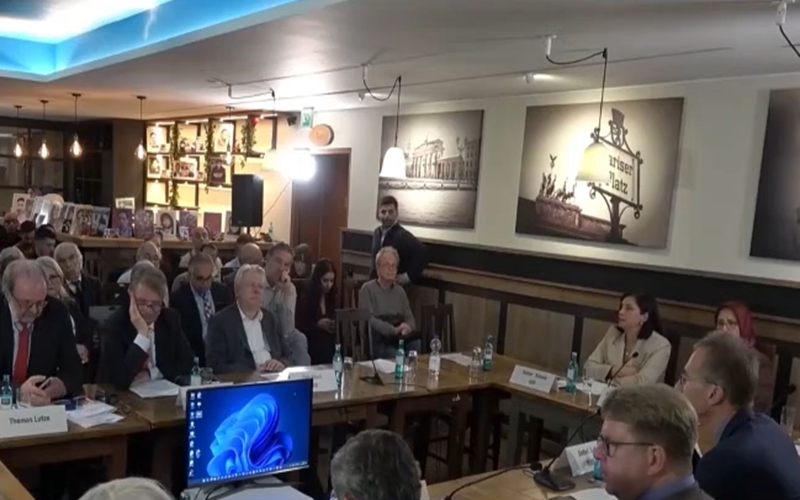

At a conference in Germany, political and social representatives challenged Berlin and the EU’s approach to Tehran, arguing that neither negotiations nor foreign military intervention can deliver democratic change without the Iranian people and an organized opposition.
Europe’s Iran Policy Needs a Fundamental Rethink
Germany and the European Union must fundamentally reassess their approach to Iran, moving beyond crisis management and negotiations with Tehran toward a strategy that recognizes the country’s political realities and the Iranian people’s demand for democratic change. This was one of the central messages highlighted at a conference in Germany titled “Crisis in Iran and the Democratic Solution.”
In a discussion of the conference, engineer Mohammad Ali Mehrabi highlighted a speech by Dr. Hans-Ulrich Seidt, who examined the shortcomings of Germany’s and the EU’s policies toward Iran and outlined the need for a different strategic approach.
According to Mehrabi’s account, European policy has largely focused on three issues: Iran’s nuclear program, its missile capabilities, and its destabilizing regional activities. Although these issues have dominated diplomatic discussions for years, the underlying problem has been the tendency to prioritize agreements with Tehran over a deeper assessment of the regime’s political and ideological objectives.
The critical question, as presented in the speech, is not simply what agreement Europe might reach with Tehran, but whether the regime is prepared to abandon the fundamental policies that drive its domestic repression and external conduct.
This distinction matters. A policy designed primarily to manage recurring crises can leave their underlying causes untouched. Without confronting the nature and strategic objectives of the ruling system, diplomatic agreements risk becoming temporary instruments for containing individual disputes rather than a means of addressing the broader crisis.
For Berlin and other European capitals, the challenge is therefore to develop a policy that goes beyond negotiating over specific security concerns and takes account of the political future of Iran itself.
Why Negotiations and Military Intervention Are Not Solutions
A second major theme of the conference was the failure of two approaches frequently presented as responses to the Iranian crisis: negotiations with the ruling regime and foreign military intervention.
As Mehrabi recounted, Seidt drew on the experiences of Iraq and Afghanistan to illustrate the limitations and consequences of military interventions. He also assessed the US and Israeli military operations against Iran in 2026 as limited in their ability to bring about fundamental political change.
The broader argument was that neither negotiations nor external military action has demonstrated an ability to transform the regime’s underlying domestic and foreign policies.
This does not mean diplomatic pressure or international engagement has no role. Rather, it highlights the limits of treating agreements with Tehran or military force as substitutes for a political process capable of producing lasting change inside Iran.
Negotiations may address particular disputes, while military operations may damage specific capabilities. Neither, by itself, establishes a democratic political system, guarantees citizens’ freedoms, or provides a legitimate alternative to the existing government.
The central question, therefore, remains: if neither a policy centered on negotiations nor foreign military intervention can deliver democratic change, what can?
The answer presented at the conference was to focus on the Iranian people and the organized forces capable of turning popular opposition into a sustained political transition.
The Iranian People and the Need for Organized Resistance
Mehrabi emphasized that the conference discussion placed particular importance on the protests and uprisings that have challenged the Iranian regime since 2017, including the nationwide uprising of December 2017 and January 2018.
These waves of protest have demonstrated that opposition to the ruling system is not confined to diplomatic circles or political debates abroad. It is rooted in Iranian society, where demands for freedom and a different political future have repeatedly brought people into confrontation with the authorities.
However, popular discontent alone does not automatically produce a successful democratic transition.
As Mehrabi explained, the argument advanced in Seidt’s speech was that sustained political change requires an organized resistance, active networks inside the country, a functioning organizational structure, and a clear political program for the future.
Without these elements, even widespread protests can struggle to overcome the regime’s repressive apparatus or translate public opposition into a durable alternative.
The question of what follows the current government is equally important. A credible transition requires more than opposition to the existing system; it requires a political framework capable of guiding the country through a transfer of power and establishing institutions that reflect the people’s democratic aspirations.
This is a crucial distinction in discussions about Iran’s future. The ability to mobilize opposition and the ability to organize a transition are related but separate challenges. Any serious democratic strategy must address both.
The NCRI and the PMOI as Strategic Factors
The most explicit point highlighted by Mehrabi was Seidt’s reference to the National Council of Resistance of Iran (NCRI) and the People’s Mojahedin Organization of Iran (PMOI/MEK).
According to Mehrabi, Seidt argued that Germany and the European Union should take the NCRI and the PMOI into account as strategic factors when formulating their future policy toward Iran.
The significance of this position lies in its challenge to an approach that treats Tehran primarily as a diplomatic counterpart while giving insufficient attention to the organized opposition seeking to replace the current system.
Recognizing the role of an organized opposition also brings the question of political alternatives into the center of European policymaking. If the objective is a democratic Iran rather than the indefinite management of confrontation with the existing regime, European governments need to consider which forces have an organizational structure and a political vision for a transition.
For the NCRI and the PMOI, the emphasis on organized resistance reflects their longstanding position that democratic change must be achieved through the Iranian people’s struggle and the capacity to organize that struggle—not imposed from abroad.
The conference discussion, as presented by Mehrabi, therefore raised a challenge for European policymakers: a reassessment of Iran policy must extend beyond the nuclear file, missile capabilities, and regional security to include the forces and political structures relevant to the country’s future.
A Democratic Solution Must Center on Iran’s Future
The arguments highlighted at the German conference point to a broader debate over how Europe should respond to the crisis in Iran.
A policy focused exclusively on negotiations risks leaving the regime’s fundamental conduct unchanged. Foreign military intervention, meanwhile, cannot substitute for the domestic political forces and institutions required to build a democratic system.
The alternative discussed at the conference centers on the Iranian people’s struggle, the role of organized resistance, and the need for a defined political program for the transition beyond the current regime.
For Germany and the EU, the practical implication is that a meaningful reassessment of policy requires taking the democratic question seriously: not merely how to manage relations with Tehran, but how to respond to the Iranian people’s demand for political change and what role an organized opposition can play in that process.
As Mehrabi’s account of Seidt’s speech makes clear, the future of Iran cannot be understood solely through the prism of diplomacy or military confrontation. It must also be considered in terms of the forces capable of challenging the existing system and establishing a democratic alternative.
The central issue is no longer simply which policy can contain the next crisis. It is whether Europe is prepared to adopt an approach that recognizes the importance of organized resistance and a democratic transition led by the Iranian people.