


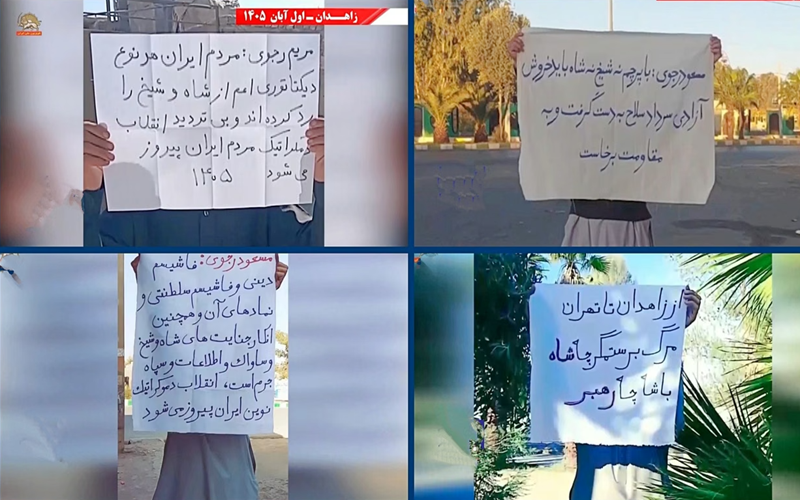

Banners displayed in Zahedan carry messages from Maryam Rajavi and Massoud Rajavi, reaffirming the Iranian Resistance’s opposition to both monarchical and clerical rule and its call for a democratic republic based on popular sovereignty.
Zahedan Campaign Reaffirms “Neither Shah Nor Mullahs”
Resistance Units in Zahedan displayed banners featuring messages from Iranian Resistance leaders Maryam Rajavi and Massoud Rajavi, emphasizing the rejection of dictatorship in all forms and calling for the establishment of a democratic republic in Iran.
The messages draw a clear distinction between the Iranian people’s aspirations for freedom and the restoration of either the former monarchy or the current clerical system. They present popular sovereignty, democratic elections, and the separation of religion and state as central elements of an alternative to authoritarian rule.
The displays also addressed the regime’s reliance on executions to suppress political opposition and criticized efforts to promote Reza Pahlavi as an alternative to the ruling establishment.
Maryam Rajavi’s Messages Emphasize Democracy and Popular Sovereignty
Several banners carried messages attributed to Maryam Rajavi, the president-elect of the National Council of Resistance of Iran (NCRI) for the transition of sovereignty to the Iranian people.
One message recalled the anti-monarchical revolution and the Resistance’s stated commitment to democracy and independence:
“The Iranian Resistance, relying on the immense force unleashed by the anti-monarchical revolution, embarked on the path of Iran’s progress, democracy, and independence.”
Another highlighted the NCRI’s political objective of establishing a democratic republic through elections and the separation of religion and state.
Other messages focused on the regime’s use of executions against political prisoners and participants in uprisings. One stated that Mojtaba Khamenei, the current supreme leader, sees the execution of political prisoners and uprising participants as the regime’s only solution.
The banners also reiterated the Resistance’s rejection of both monarchical and clerical dictatorship. One message declared:
“The Iranian people have rejected every form of dictatorship, whether Shah or Sheikh, and the democratic revolution of the Iranian people will undoubtedly triumph.”
Another criticized Reza Pahlavi, describing him as a false alternative that damages Iran’s protest movement and effectively assists the ruling regime.
Together, the messages presented the Resistance’s position that replacing one authoritarian system with another would not meet the Iranian people’s demand for fundamental political change.
Massoud Rajavi’s Message: Draw a Clear Line Against Dictatorship
Other banners carried messages attributed to Massoud Rajavi, emphasizing the need to maintain a firm distinction between the struggle for freedom and any form of authoritarianism or political dependency.
One message stated:
“One must recognize and uphold the red-hot line separating oneself from dictatorship and dependence, and be prepared to pay the price for it.”
Another banner drew on what the Resistance described as the lessons of two wars and an uprising over four decades, declaring that a return to a foreign-dependent monarchical fascism was an illusion.
The slogans condensed this political position into a direct statement: “A dictatorship is a dictatorship, whether it wears a turban or a crown.”
Another message condemned both the Shah and the clerical ruler, declaring that history and the Iranian people would curse both forms of bloodshed and repression.
A Democratic Republic as the Alternative
The activities in Zahedan reinforce the Iranian Resistance’s longstanding position that Iran’s political future must be determined by its people, rather than by hereditary monarchy or clerical rule.
The NCRI’s proposed alternative centers on a democratic republic, free elections, separation of religion and state, and an end to dictatorship. Its Ten-Point Plan also outlines commitments to gender equality, individual freedoms, and the abolition of the death penalty.
By displaying messages rejecting both the Shah and the mullahs, the Resistance Units sought to underline the distinction between changing the political leadership and fundamentally transforming the system of government.
The Zahedan campaign thus carried a message extending beyond opposition to the current regime: Iran’s future, the banners declared, must be built on freedom, democracy, and the sovereignty of its people.