
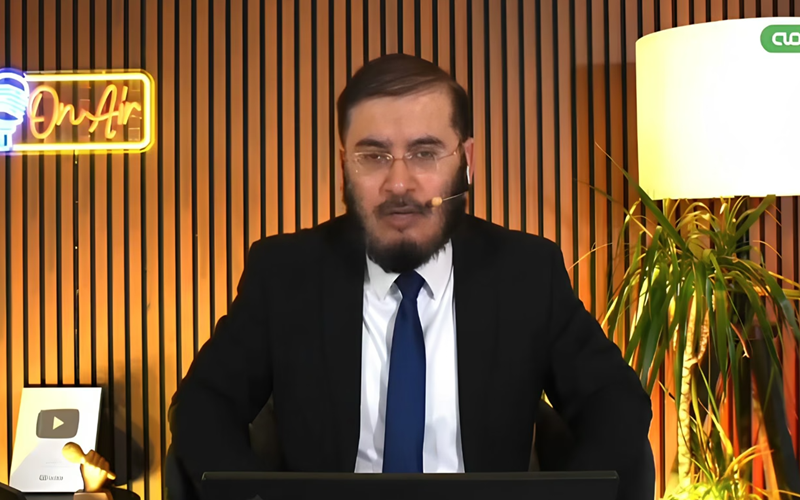

Seyed Aqil Hashemi reveals how pressure over sponsorship, programming, and political loyalty allegedly derailed a human-rights broadcast, exposing the dangers of demanding allegiance to a future ruler before he has even taken power.
Hashemi directly named Abdol Fattah Khedmati, accusing him of pressuring the network’s control-room staff and employees and threatening their salaries through sponsorship funds if the program was broadcast.
The program, organized by Massoud Akhtarani, was to feature three experts discussing human rights and executions in Iran. Hashemi said he had given those involved ample time to resolve the dispute but could no longer accept the suppression of a program devoted to people facing execution.
“People are being executed. The blood of our compatriots is being shed in Iran,” he emphasized, questioning why defending human lives had become secondary to promoting a particular political figure.
The confrontation has exposed a fundamental issue: whether support for Reza Pahlavi is becoming an unwritten requirement for participation in parts of the Iranian opposition’s media environment, even when the subject under discussion is the defense of human rights.
Political loyalty as a condition for speaking
Hashemi described a pattern of excluding commentators who had criticized Pahlavi. According to his account, individuals who refused to endorse Pahlavi were being denied access to the network, while pressure was applied to prevent programs featuring them from being broadcast.
He challenged the contradiction between such practices and the demands for freedom of expression routinely directed at Iran’s ruling regime.
“You criticized Khamenei over freedom of expression. What happened to that freedom of expression now?” was the substance of his pointed question.
Pahlavi has not held political power in Iran, yet Hashemi described an environment in which criticism of him was already being treated as grounds for exclusion. His account highlights a troubling political dynamic: a movement seeking to shape Iran’s future can begin restricting debate around its preferred leader before that leader has assumed any official authority.
Hashemi made clear that his objection was not to individuals expressing support for Pahlavi. He said supporters were free to praise him, but rejected the demand that critics be silenced.
The distinction is essential. Political advocacy does not require the exclusion of opposing views. When media access depends on praising a particular figure, the issue extends beyond editorial disagreement to the fundamental right to question those seeking political leadership.
Sponsorship, influence, and the struggle over editorial independence
Hashemi traced the conflict to the network’s internal history. He said he founded Kalemeh Network in 2010 and, approximately six months later, accepted colleagues’ recommendation to bring Khedmati into the organization. Hashemi said he subsequently assigned him responsibilities and introduced him to sponsors who had supported the network.
He described an increasingly difficult relationship and said he had attempted to resolve the matter privately over an extended period. He also recounted a meeting in which Khedmati reportedly argued that without supporting Pahlavi, the network would lose the backing of certain business interests.
Hashemi rejected the idea that political positions should be determined by the financial preferences of sponsors or commercial groups.
He argued that a broadcaster established to serve the Sunni community had a responsibility to defend its audience’s interests and preserve its independence, rather than allow financial considerations to dictate its political direction.
The dispute therefore raises an important question about the relationship between money and political influence. When sponsorship becomes a means of determining which voices can be heard, editorial independence is placed at risk. Hashemi’s account illustrates how financial pressure, political advocacy, and control over programming can intersect to restrict debate.
“Long Live the Shah” versus a temporary transition
Hashemi’s sharpest criticism concerned what he sees as a contradiction at the heart of the political campaign surrounding Pahlavi: the simultaneous promotion of a temporary transition and a permanent monarchy.
“They say this is a transitional period. On the other hand, they say, ‘Long Live the Shah!’ Well, which is it?” he asked.
His argument is straightforward. A transition is temporary, while the slogan “Long Live the Shah” expresses support for a lasting monarchical institution. Presenting both as compatible without explaining the intended political arrangement leaves a fundamental question unanswered: what system of government is actually being proposed for Iran?
Hashemi warned against allowing the promotion of an individual to replace a serious discussion about political institutions, accountability, and the rights of citizens.
He also challenged the assumption that professional achievements automatically qualify someone for political leadership. Political leadership, he argued, requires distinct qualifications and cannot simply be inferred from a person’s occupation or public profile.
Drawing a parallel with the concentration of power under Ruhollah Khomeini after the 1979 revolution, Hashemi warned against repeating a political model in which the fate of an entire country becomes tied to one individual. Replacing the current ruling structure with another system centered on personal authority, he argued, would leave the underlying problem unresolved.
He also warned that members of Iran’s Sunni community who now support Pahlavi could themselves face imprisonment if a future government refused to tolerate dissent. His concern was that political loyalty offered today would provide no guarantee of protection tomorrow.
A warning to Iran’s future generations
Hashemi said he had remained silent for years in the hope that those involved would reconsider their approach. He described his decision to speak publicly as a matter of conscience and responsibility toward future generations.
“I do not want future generations to curse us a hundred or two hundred years from now,” he said.
He argued that political support should not be traded for personal financial security, public praise, or organizational positions. The decisions made during a period of political upheaval, he warned, could shape the lives and freedoms of generations who would have no opportunity to reverse them.
His message extends beyond the internal dispute at Kalemeh Network. Iran’s political future cannot be reduced to choosing a new individual to occupy the highest position of power. The decisive question is whether the country will develop a system that protects freedom of expression, political pluralism, and the rights of all citizens.
The episode also exposes the contradiction in demanding freedom from the ruling regime while seeking to restrict criticism of a preferred alternative. Opposition to the current regime and support for a particular political figure are not interchangeable, and neither should exempt a prospective leader or movement from public scrutiny.
Iran’s future requires more than replacing one center of personal authority with another. A genuine political transition must allow Iranians to debate their country’s future freely, including the choice between a republic and a monarchy, without being pressured to demonstrate loyalty to a predetermined leader.
Hashemi’s intervention puts that principle squarely before the Iranian opposition: the right to criticize a political figure must be respected before that figure acquires power, not granted or withdrawn at the discretion of those who support him.