


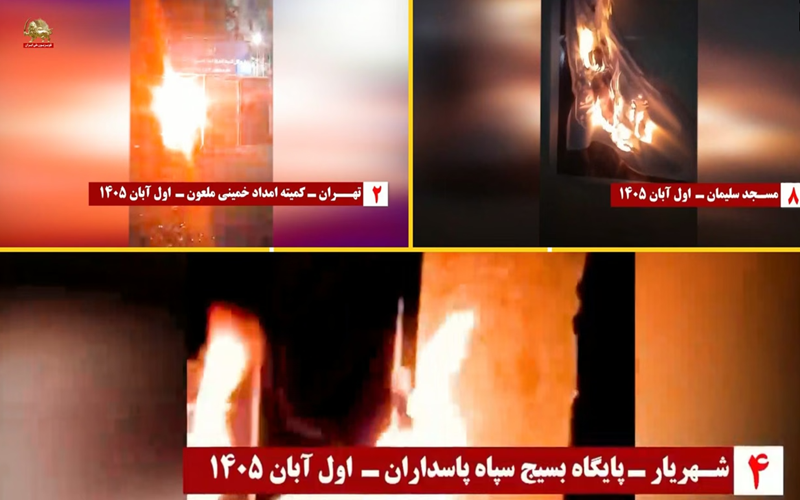

The Iranian Resistance reports a series of retaliatory actions in Tehran and several other cities following an attack by regime forces on market vendors, with incidents targeting Basij facilities, regime banners, and other institutions associated with the ruling establishment.
Resistance Responds to Attack on Tehran Market Vendors
A series of actions attributed to Iran’s Resistance Units targeted regime-linked facilities and symbols in Tehran and several other cities following an attack by security forces on vendors at a Tehran produce market, according to a statement published by the Iranian Resistance.
The statement described the crackdown as an assault on the livelihoods of ordinary working people, accusing the regime’s forces of destroying the businesses of struggling vendors. It listed ten reported actions involving Basij facilities, banners depicting Supreme Leader Ali Khamenei and Mojtaba Khamenei, and other institutions associated with the ruling establishment.
The reported incidents reflect the Resistance’s portrayal of these actions as a response to the regime’s repression and its treatment of ordinary Iranians trying to earn a living.
Reported Actions in Tehran
According to the Resistance’s account, several incidents took place in the capital.
One report described an explosion at the so-called Velayat seminary, which the statement characterized as a center of clerical indoctrination and repression.
Another reported incident involved a fire at a Khomeini Relief Committee facility after a Molotov cocktail was thrown at the site. The committee is a state-linked welfare institution established under the Islamic Republic.
The statement also reported that a Basij base affiliated with the Islamic Revolutionary Guard Corps (IRGC) was set on fire in Tehran. The Basij is a paramilitary organization closely associated with the regime’s internal security apparatus and suppression of dissent.
The incidents were presented as part of a wider series of actions against institutions and symbols identified with the ruling establishment.
Basij Facilities and Regime Banners Targeted in Other Cities
The reported actions extended beyond Tehran to several other locations.
In Shahriar, west of the capital, a Basij base affiliated with the IRGC was reportedly set on fire.
In Tabriz, two separate incidents reportedly involved the burning of banners depicting Ali Khamenei and Mojtaba Khamenei, as well as another banner featuring Ali Khamenei.
Similar incidents were reported in Mashhad and Masjed Soleyman, where banners depicting Ali Khamenei were reportedly set on fire.
In Iran Shahr, in Sistan and Baluchestan Province, another banner depicting Khamenei was reportedly burned.
A further incident was reported in Nazarabad, near Karaj, where a sign directing people to a Basij intelligence-gathering headquarters was reportedly set on fire. The Resistance’s statement characterized the site as part of the regime’s network for collecting information and monitoring the population.
The statement did not provide independently verified details about casualties, property damage, or the precise circumstances of each incident.
Economic Repression and Political Resistance
The reported actions followed an attack on vendors at a Tehran produce market, an episode that the Resistance framed as part of the regime’s broader pressure on ordinary people and their livelihoods.
For small traders and market vendors already facing economic hardship, the destruction of businesses can mean the loss of their primary source of income. Such confrontations also highlight the tensions between the regime’s security apparatus and people struggling to maintain their livelihoods.
The Resistance’s account links the reported incidents to a wider political confrontation with the ruling establishment. By identifying Basij installations, official banners, and regime-associated institutions as targets, the statement presents the actions as expressions of opposition to the machinery and symbols of clerical rule.
The ten reported incidents, spanning Tehran, Shahriar, Tabriz, Mashhad, Masjed Soleyman, Iran Shahr, and Nazarabad, illustrate the geographic scope claimed by the Resistance. Independent verification of the individual incidents remains necessary to establish their circumstances and extent.
The episode also highlights the connection between economic grievances and political discontent in Iran, where the treatment of small traders and workers has become a recurring point of confrontation with the authorities.