



Forty-seven Iranian associations across Belgium, the Netherlands, Luxembourg, and France had urged Belgian leaders to reject the promotion of the shah’s son, warning that his defense of the former monarchy’s record disregards the victims of SAVAK and Iran’s struggle for democracy. Although the Belgian Parliament canceled its invitation to Reza Pahlavi, the defense minister’s meeting with him remained a point of protest.
Forty-seven Iranian associations in Belgium, the Netherlands, Luxembourg, and France had addressed a letter to Belgium’s prime minister, foreign minister, and the presidents of the Senate and Parliament, protesting the invitation extended to Reza Pahlavi, the son of Iran’s deposed shah, and his meeting with Belgium’s defense minister.
The letter was sent before the Belgian Parliament canceled its invitation to Pahlavi. However, the cancellation did not resolve the associations’ concerns over the defense minister’s meeting with him, which they considered an affront to the Iranian people’s struggle against dictatorship and for democracy and human rights.
The signatories stressed that the controversy extends beyond Reza Pahlavi’s family background. They argued that his continued defense of the former monarchy’s record, including the crimes committed by the shah’s secret police, SAVAK, raises fundamental questions about the political system he represents and the future he envisions for Iran.
Shah-Era Torture and Executions Remain Unforgotten
The associations emphasized that many of their members, or their closest relatives, were subjected to arrest, imprisonment, torture, and execution under the shah’s dictatorship.
According to the letter, five decades have passed, yet many former political prisoners still bear physical scars from torture inflicted under the monarchy. The signatories also recalled political prisoners who died under interrogation by SAVAK and those who were executed in large numbers.
The letter stated that the Iranian people have not forgotten those victims. It argued that offering a prominent platform to the former shah’s son without addressing this historical record disregards the suffering of the victims and their families.
The associations maintained that Reza Pahlavi has not condemned the crimes of his father’s dictatorship, its one-party political system, or SAVAK. Instead, they accused him of repeatedly defending that legacy and expressing pride in his family’s record, particularly over the past year.
For the signatories, the issue is therefore not simply one of inherited political identity. It concerns whether a political figure seeking a role in Iran’s future acknowledges the repression committed under the system his family ruled.
Concerns Over Repression Against Opposition Activists Abroad
The letter also raised concerns about the conduct of Reza Pahlavi’s supporters toward political opponents outside Iran.
The associations accused his political network of promoting the restoration of SAVAK-style repression and initiating campaigns against opponents and attacks on their gatherings abroad. They further stated that criminal proceedings involving alleged assaults and even killings of opponents had been pursued before police and judicial authorities in Western countries.
These statements were presented by the signatories as evidence of a broader concern: that political practices associated with authoritarian rule could be reproduced within Iranian opposition communities abroad.
The associations argued that such conduct makes the question of political accountability especially important when European officials engage with figures seeking to represent Iran’s future.
They warned that a meeting with Pahlavi by a senior Belgian official could be interpreted by Iranians inside and outside the country as a gesture against their struggle for freedom and democracy.
A Democratic Republic, Not a Return to Monarchy
The signatories placed their protest within the wider struggle of the Iranian people for a democratic political system. They called for a republic based on the separation of religion and state, equality between women and men, and autonomy for Iran’s national and ethnic communities.
Their appeal emphasized that the Iranian people’s struggle for democracy cannot be separated from their experience under the monarchy and the current ruling system. In their view, replacing one authoritarian structure with another would not fulfill the aspirations that have driven generations of Iranians to seek political freedom.
The letter urged Belgian leaders to consider the historical implications of their engagement with Reza Pahlavi and to avoid actions that could associate Belgium with the former monarchy’s repressive legacy in the eyes of the Iranian people.
The associations concluded by asking Belgian officials not to allow their country’s name to become associated with the shah’s dictatorship among Iranians.
Forty-Seven Associations Sign the Appeal
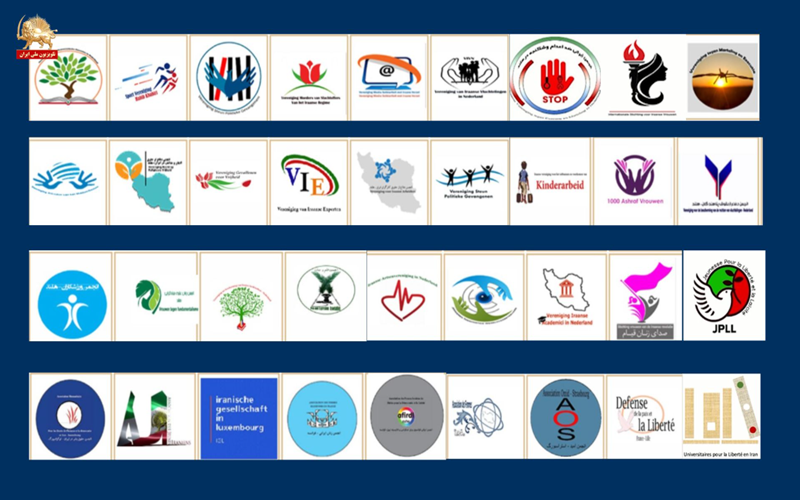
The letter was signed by 47 organizations representing Iranian communities across four European countries. The signatories included human rights and democracy associations, political refugee organizations, student and academic groups, women’s organizations, associations supporting political prisoners, and groups campaigning against torture and executions.
Their participation reflected the range of concerns behind the appeal, from the historical record of the shah’s secret police to contemporary disputes over political representation and the treatment of opposition activists abroad.
The letter’s central message was that engagement with figures seeking a role in Iran’s political future should take account of the country’s experience of dictatorship and the democratic aspirations of its people. For the signatories, the Iranian people’s struggle for a democratic republic must not be overshadowed by efforts to rehabilitate the monarchy.
The 47 signatories were:
- Association for Human Rights and Democracy in Iran, Luxembourg
- Youth Association, Luxembourg
- Iranian Committee, Luxembourg
- Iranian Women’s Association, Paris, France
- Franco-Iranian Association for Democracy and Secularism, France
- Political Refugees Association for the Defense of Human Rights, France
- Women for Freedom in Iran, France
- Omid Association, Strasbourg, France
- Peace and Freedom Association, France
- Academics for a Free Iran, France
- Youth Association for Freedom and Secularism
- Iranian Physicians Association, the Netherlands
- Future-Building Youth Association, the Netherlands
- Iranian Graduates and Specialists Association, the Netherlands
- Voice of Iranian Women’s Uprising Association, the Netherlands
- Iranian Democratic Teachers Association, the Netherlands
- Habib Khabiri Athletes Association, the Netherlands
- Association for the Support of Political Prisoners, the Netherlands
- Mothers of Martyrs for Freedom Association, the Netherlands
- Internet Campaign in Support of the Iranian Resistance, the Netherlands
- Iranian Refugee Community, the Netherlands
- Middle Eastern Peoples’ Friendship Association, the Netherlands
- Association for the Defense of Religious Rights, the Netherlands
- Association for the Defense of Martyrs of the Freedom Struggle, the Netherlands
- Iranian Experts Association, the Netherlands
- Association for the Defense of Iranian Workers’ Rights, the Netherlands
- Association for the Defense of Political Prisoners’ Rights, the Netherlands
- Association Against Torture and Execution, the Netherlands
- Iranian Athletes Association, the Netherlands
- Women Against Fundamentalism Association, the Netherlands
- Teachers’ Support Association, the Netherlands
- Pen and Expression Association, the Netherlands
- Association for the Support of Working Children, the Netherlands
- Association for the Support of Women of the Thousand Ashrafs, the Netherlands
- Association for the Defense of Refugees’ Rights, the Netherlands
- Culture and Art Association, the Netherlands
- Union of Dutch Associations
- Iranian Anti-Execution Association, the Netherlands
- International Women’s Association, the Netherlands
- Student Outcry Association, the Netherlands
- Together for Human Rights Association, Belgium
- Iranian Democratic Students Association, Belgium
- Association for the Defense of Freedom of Expression in Iran, Belgium
- Association for the Support of Iranian Political Prisoners, Belgium
- Families of the Victims of the 1988 Massacre Association, Belgium
- Iranian Democratic Women’s Association, Belgium
- Association for the Support of Ethnic and Religious Communities in Iran, Belgium