


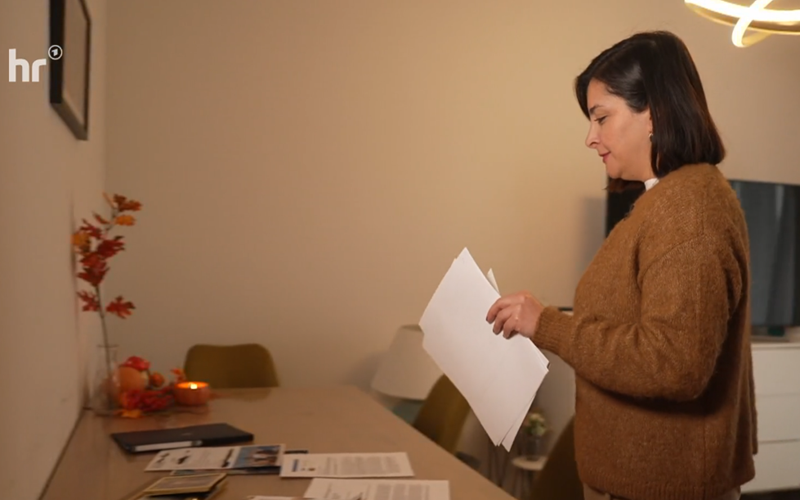

Iranian activist Sahar Sanaei recalls her family’s suffering under the Shah and questions Pahlavi’s democratic credentials as Frankfurt prepares for competing demonstrations over the Friedrich Naumann Foundation’s decision.
Sanaei, who is active in the Society of Germans of Iranian Origin and works with the United Nations Human Rights Council, argued that Reza Pahlavi is not entitled to receive a prize on behalf of an entire population whose political aspirations and historical experiences are far from uniform.
She described how her father’s family suffered from poverty and corruption during the Shah’s rule. She also maintains contact with people who were imprisoned for distributing leaflets or expressing criticism of the monarchy. According to Sanaei, some of these former prisoners still bear physical scars from the torture they endured.
Her opposition is rooted in these experiences and in the absence of a clear political break by Reza Pahlavi with his father’s record. She questions how someone who has not adequately distanced himself from the former monarchy’s repression can be presented as a representative of freedom and democracy.
Pahlavi’s democratic credentials under scrutiny
The Hessenschau report noted that Pahlavi’s supporters regard him as a possible figurehead for replacing Iran’s current ruling system. Some favor restoring the monarchy, while others advocate a parliamentary monarchy.
However, his critics question whether his political record and statements establish a credible commitment to democracy, particularly given the historical legacy of the Pahlavi dynasty and the absence of a mandate from the Iranian people to represent them.
The controversy has prompted three open letters calling on the Friedrich Naumann Foundation to reconsider its decision. The letters have reportedly attracted signatures from prominent politicians and numerous associations.
The Foundation acknowledged the suffering experienced by people under the Shah’s rule, emphasizing that torture and the killing of people defending their freedom and convictions could never be justified. Nevertheless, it defended its decision by arguing that many Iranians support Pahlavi.
Its representative also sought to distinguish Reza Pahlavi from his father, arguing that he has a different political program centered on democracy, the rule of law, and self-determination.
But this justification does not resolve the fundamental objection raised by Sanaei and other opponents: a democratic future cannot be established by assuming that a particular individual has the right to speak for the Iranian people without a freely expressed popular mandate.
Frankfurt refuses to withdraw Paulskirche as venue
Opposition has extended beyond the award itself to the decision to hold the ceremony in Frankfurt’s historic Paulskirche, a landmark associated with Germany’s democratic tradition.
The Frankfurt city council debated the controversy after the Left Party (Die Linke) called for the Friedrich Naumann Foundation to lose access to the Paulskirche for the ceremony. The proposal was rejected.
According to the Hessenschau report, Mayor Nils Kößler, who is also scheduled to deliver welcoming remarks at the ceremony, defended the decision by arguing that the purpose of the award was more important than the identity of its recipient. He maintained that Pahlavi would accept the prize only as a representative of the Iranian people and emphasized the Paulskirche’s symbolic significance for democracy, freedom, and freedom of expression.
The city therefore decided against taking measures to prevent the ceremony, despite the continuing objections.
Sanaei, meanwhile, called for a clear political signal against the event. She urged the city’s democratically elected representatives to condemn the ceremony and called for it to be boycotted. Although she recognized that the municipal authorities might have limited influence over the Foundation’s decision, she insisted that the controversy should not pass without a public response.
Demonstrations expected across Frankfurt
The Hessenschau report said Frankfurt was preparing for several demonstrations and counter-demonstrations surrounding the award ceremony. Organizers and authorities expected several thousand participants.
The largest rally was planned for the city’s Ostpark, where Reza Pahlavi was also expected to address supporters. Police were preparing a substantial security operation around the different events.
The controversy exposes a deeper political divide within the Iranian diaspora. For Sanaei and other opponents, the issue is not simply whether Pahlavi personally supports certain democratic principles, but whether his political background, his relationship with the former monarchy, and his claim to represent Iran’s population are compatible with the democratic aspirations of the Iranian people.
The Iranian people’s struggle against dictatorship cannot be reduced to a choice between the former monarchy and the current ruling system. Nor can a democratic future be built by transferring political authority from one unelected figure to another.
A genuinely democratic alternative must rest on popular sovereignty, free elections, pluralism, and the right of the Iranian people to determine their own political future. The Paulskirche controversy has brought this fundamental question into the heart of Frankfurt’s public debate.