


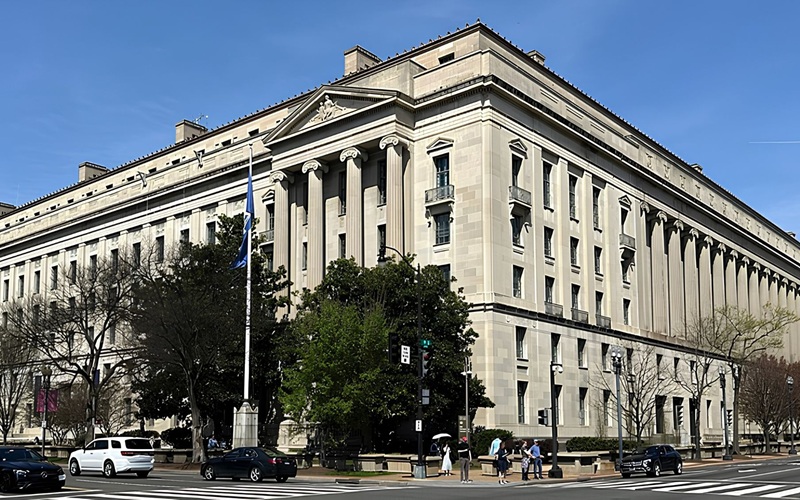

A U.S. Department of Justice indictment links operatives associated with Iran’s Islamic Revolutionary Guard Corps (IRGC) and Kata’ib Hizballah to a campaign of arson, explosives, and attacks targeting Jewish communities across Europe and the United States, as well as a September 2026 plot against a British airbase hosting American military personnel.
The indictment, unsealed on November 10, names Mohammad Baqer Saad Dawood al-Saadi, a dual Iranian-Iraqi national; Mohsen Mohajeri, an Iranian national; and Mohammad Ali al-Hassani, an Iraqi national. U.S. prosecutors accuse the three of working in support of Kata’ib Hizballah and Iran’s Islamic Revolutionary Guard Corps (IRGC), both designated by the United States as foreign terrorist organizations.
The case highlights the international reach of networks associated with Iran’s security apparatus and their alleged use of criminal associates, intermediaries, and covert communications to organize attacks abroad.
Iran-linked network accused of targeting Jewish communities across Europe
According to the indictment, the three defendants were involved in planning and coordinating a series of attacks carried out in Europe during the spring of 2026 under the name Harakat Ashab al-Yamin al-Islamiya (HAYI). U.S. prosecutors describe HAYI as a front for Kata’ib Hizballah and other designated terrorist organizations.
Of the 18 attacks claimed by HAYI in Europe during that period, seven took place in the United Kingdom, more than in any other European country. The attacks involved arson, explosives, and a near-fatal stabbing in London targeting two Jewish men, one of whom holds both U.S. and British citizenship.
The indictment alleges that Mohajeri, an IRGC operative, coordinated with al-Saadi and al-Hassani to organize the attacks with the backing of the IRGC. Al-Hassani allegedly used his contacts and criminal associates in the United Kingdom to facilitate operations on the ground.
Evidence cited by prosecutors includes video recordings of planning meetings. In one video dated around April 6, Mohajeri and al-Hassani are seen together in a room in Iraq, with a map of London displayed on a computer screen. During the meeting, al-Hassani reportedly told Mohajeri: “we need to get focused on London.”
Approximately one week later, HAYI claimed responsibility for six attacks in and around London.
The indictment also describes the alleged direct supervision of attacks through video calls. On April 17, al-Saadi, al-Hassani, and Mohajeri reportedly watched an operation in real time through a FaceTime connection projected onto a large screen. Al-Hassani allegedly instructed the person carrying out the attack on how to proceed, while al-Saadi recorded the operation.
The following day, al-Hassani allegedly participated in another video call with an individual carrying out an attack against a synagogue in London. Prosecutors say he instructed the perpetrator to “light it up like a Christmas tree.” The individual subsequently ignited and threw an improvised explosive device at the building.
Attempted attack against British airbase hosting U.S. forces
One of the most serious episodes detailed in the indictment concerns an alleged terrorist plot against RAF Fairford, a British Royal Air Force base in Gloucestershire that housed U.S. military aircraft and personnel.
According to prosecutors, al-Hassani orchestrated preparations for the operation during August and September 2026 while in Iran. He allegedly recruited and paid associates in the United Kingdom to conduct surveillance, arrange transportation, and procure materials for the planned attack.
On August 22, one associate was reportedly paid to conduct surveillance of the base’s perimeter and send videos of the surrounding area to al-Hassani.
During September, other individuals were allegedly tasked with obtaining vans, barrels of fuel, chemical accelerants, and metallic objects that could be used as explosive shrapnel. To disguise the operation, the associates commissioned custom decals designed to make the vehicles appear to belong to a fuel-delivery company and a swimming-pool supply business.
On September 26, al-Hassani allegedly directed individuals to drive three vans toward RAF Fairford. Some of the vehicles contained barrels of fuel. At least two encountered a security roadblock and were prevented from following their intended routes.
Al-Hassani allegedly remained in frequent contact with the drivers, coordinating their movements before and after they encountered the security checkpoint.
In the early hours of September 27, British law enforcement authorities recovered all three white vans, which carried the fabricated business logos, and arrested their occupants.
Operative allegedly continued coordinating attacks from a U.S. prison
Another significant aspect of the case concerns al-Saadi, who had already been arrested and transferred to U.S. custody before the RAF Fairford operation.
Al-Saadi had been charged in May 2026 over his alleged involvement in planning and promoting approximately 18 terrorist attacks in Europe, as well as an attempt to bomb a synagogue in Manhattan.
Despite being imprisoned in New York and awaiting trial, he allegedly continued coordinating terrorist activities through coded communications passed via family members and other intermediaries in Iraq.
According to the indictment, al-Saadi used telephone conversations with his mother and sister to communicate with Mohajeri and al-Hassani. He allegedly referred to terrorist operations as “work,” a term prosecutors say he had repeatedly used in previous communications and social media activity.
In one conversation, he reportedly asked his sister what was happening with their “old work” and whether it had been canceled or merely suspended. She allegedly replied that it had not been canceled.
In another call on September 24, just three days before the vans were recovered near RAF Fairford, al-Saadi asked about al-Hassani and instructed his family to give him money “so we can do it.”
Prosecutors say these communications demonstrate that the network continued operating despite the arrest of one of its principal members.
U.S. officials warn of the international threat posed by Iran-backed networks
Announcing the indictment, U.S. Attorney General Todd Blanche said that anyone involved in planning a terrorist plot against a military base housing American service members would face prosecution by the U.S. government. He added that the Justice Department would continue working to dismantle terrorist networks.
FBI Director Kash Patel described the case as evidence of Iran’s determination to carry out attacks in Europe and the United States. He emphasized that the alleged activities continued even after one of the principal suspects had been placed in federal custody.
U.S. Attorney Jamie McDonald for the Southern District of New York said the defendants had allegedly helped orchestrate a campaign targeting Jewish communities in Europe and the United States, as well as the British military base hosting American personnel.
“The threat presented by Iran and Iran-backed terrorist groups to America and our allies is not hypothetical — it is very real,” McDonald said.
The Department of Justice also emphasized that its National Security Division would pursue individuals targeting American citizens and interests, regardless of where they operate.
The indictment identifies al-Saadi, 32, as a citizen of Iraq and Iran; Mohajeri, 48, as an Iranian citizen; and al-Hassani, 35, as an Iraqi citizen.
While the charges remain allegations to be tested in court, the evidence presented by U.S. prosecutors describes an extensive network involving IRGC-linked operatives, criminal associates, covert communications, and coordinated attacks across several countries. The case also raises serious security concerns for European countries and their allies over the activities of terrorist networks operating in support of Iran’s regime.