


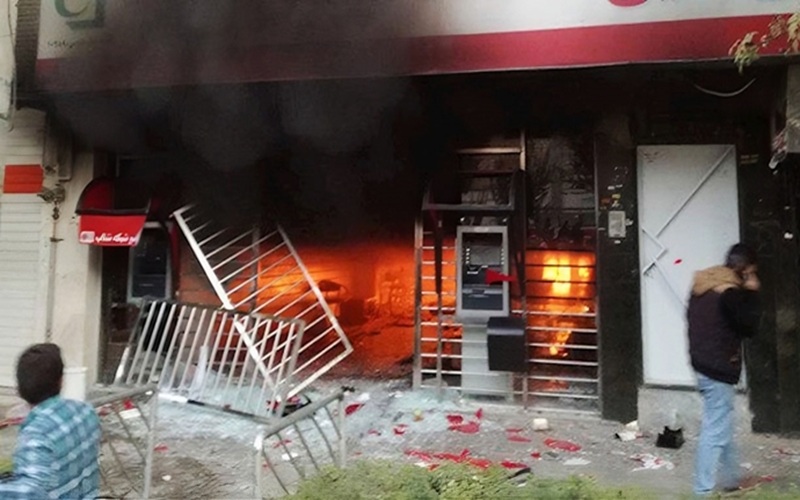

Despite attempts to project regional power through threats, interference, and intimidation, the regime faces growing restrictions on oil exports, mounting obstacles to sanctions evasion, and increasing international attention to its human rights record.
Iran’s ruling regime is facing mounting international pressure across several fronts, from restrictions on oil exports and difficulties circumventing economic sanctions to growing scrutiny of its human rights violations. While Tehran continues to project an image of regional power through threats, interference, and intimidation, developments in its economic and diplomatic relations point to increasingly constrained options.
The pressure extends beyond relations with the United States and European countries. Regional governments and international institutions are also taking positions on the regime’s conduct, including its regional activities, threats, and systematic violations of fundamental rights.
The contrast between the regime’s public posture and its actual international position is becoming increasingly apparent. Its attempts to demonstrate strength have not removed the economic and diplomatic constraints it faces.
Threats and intimidation cannot conceal the regime’s economic constraints
The regime has repeatedly sought to portray itself as an actor capable of imposing its will on other countries and disrupting regional stability. Its methods have included threats, alleged terrorist operations, regional interference, missile attacks, and other forms of intimidation.
Some of its more recent activities have also extended beyond conventional political and security pressure. Reports of interference with supermarket freezer electricity systems in France, for example, illustrate the nature of the disruptive operations attributed to the regime and its networks abroad.
However, projecting an image of power is not the same as possessing the economic and diplomatic capacity to sustain it.
The regime faces severe restrictions on its ability to sell oil and generate foreign currency. Attempts to find alternative routes for oil sales and financial transactions have encountered growing obstacles.
One route involves overland trade and financial channels through Iraq. However, pressure from Washington on the Iraqi government has complicated these arrangements. The regime has also sought to explore alternative routes through the Caspian Sea, Russia, and Central Asia to circumvent restrictions.
These routes, too, face scrutiny and limitations.
The result is an increasingly difficult environment for the regime’s efforts to maintain oil revenues and access international markets. Its economic difficulties are not simply the result of domestic mismanagement; international restrictions have further narrowed its room for maneuver.
Human rights violations are becoming a central issue in international relations
Economic pressure is only one dimension of the regime’s growing international difficulties. Its human rights record is also receiving greater attention from foreign governments and international institutions.
For decades, Iranian opposition representatives have urged foreign governments to apply the same standards to Tehran that they apply to individuals and organizations violating the law in their own countries.
The argument is straightforward: governments cannot tolerate intimidation, violence, and violations of fundamental rights within their own borders while making concessions to another government that engages in comparable conduct internationally.
The same principle applies to the regime’s treatment of its own population. Arbitrary arrests, executions, repression of dissent, and violence against protesters are not matters that can be dismissed as internal affairs.
Freedom of expression, the right to peaceful opposition, and protection from arbitrary punishment are established principles of international human rights law and the United Nations framework.
The Iranian Resistance has consistently called on foreign governments to uphold these principles in their dealings with Tehran rather than allowing political and economic considerations to override human rights concerns.
The growing attention to executions and the treatment of political prisoners has made this issue increasingly difficult to separate from broader diplomatic relations with the regime.
The central question is no longer simply how governments should manage their relations with Tehran, but how they can do so without overlooking the regime’s documented violations of international human rights standards.
A changing international approach to Tehran
The changing tone of international discussions reflects a broader debate over how to deal with the regime.
For years, Iranian opposition representatives have argued that concessions in response to threats only encourage further intimidation. They have called instead for consistent enforcement of international laws and standards, particularly when the regime threatens other countries or violates the fundamental rights of its own citizens.
This approach is increasingly relevant as the regime faces pressure over multiple issues simultaneously.
Its economic difficulties limit its ability to generate revenue and finance its activities. Restrictions on alternative trade and oil-export routes complicate efforts to circumvent sanctions. Meanwhile, its human rights record continues to attract international scrutiny.
These developments also have implications for people inside Iran. The country’s population bears the consequences of economic restrictions, corruption, repression, and the regime’s domestic and international policies. At the same time, the authorities continue to devote resources and political attention to maintaining their regional posture and suppressing dissent.
The growing convergence of economic, diplomatic, and human rights concerns means that the regime cannot easily address one area of pressure without confronting the others.
International pressure and the Iranian Resistance’s long-standing demands
The Iranian Resistance has maintained for more than four decades that the regime should be confronted consistently over its conduct, rather than rewarded with concessions whenever it resorts to threats or intimidation.
Its argument is that international standards must apply equally, whether violations occur inside Iran or beyond its borders. Governments that defend human rights and the rule of law domestically should also uphold those principles in their relations with Tehran.
The increasing prominence of these issues in international discussions represents an important development for the Iranian opposition, which has long sought to place the regime’s repression and violations of human rights at the center of international policy.
Nevertheless, economic restrictions and diplomatic pressure alone do not resolve the political crisis inside Iran. The question of the country’s future ultimately concerns the Iranian people and their right to determine their own political system.
The regime’s continued reliance on intimidation, economic circumvention, and repression highlights the limits of its efforts to project strength while facing mounting constraints abroad.
For the Iranian people, the central issue remains the establishment of a future based on freedom, accountability, and respect for fundamental rights. The Iranian Resistance argues that sustained international pressure, combined with the Iranian people’s struggle for democratic change, is essential to that objective.