


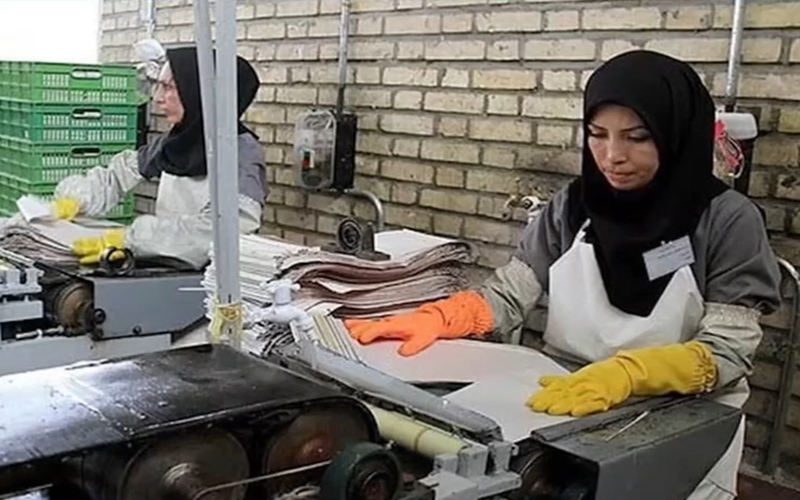

The World Economic Forum’s 2026 Global Gender Gap Report places Iran 144th out of 145 countries, exposing the scale of discrimination against women in economic and political life, despite the regime’s attempts to portray their participation as evidence of progress.
The contrast is particularly striking as the regime seeks to exploit the country’s current crises and political tensions for its own propaganda purposes. The appearance of women in government-organized demonstrations, including women dressed in burial shrouds, is used to suggest widespread female support for the authorities. Such staged displays, however, reveal little about the actual social and economic conditions facing millions of Iranian women.
The 2026 Global Gender Gap Report published by the World Economic Forum provides a more measurable picture of this reality. Iran ranks 144th among 145 countries, placing it near the very bottom of the global gender equality index.
Iran ranks 144th globally in gender equality
The World Economic Forum’s Global Gender Gap Index examines gender disparities across four principal dimensions: economic participation and opportunity, educational attainment, health and survival, and political empowerment.
Iran’s overall ranking of 144th out of 145 countries reflects the depth of the structural inequalities facing women.
The breakdown of the index is particularly revealing:
- Economic participation and opportunity: Iran ranks 144th, reflecting severe disparities between women and men in access to employment and economic opportunities.
- Political empowerment: Iran ranks 145th, the lowest position among the 145 countries examined.
- Educational attainment: Iran ranks 96th, despite the significant expansion of women’s university participation during previous decades.
- Health and survival: Iran ranks 117th.
Women’s political participation also remains extremely limited, with Iran ranking 139th in this specific dimension.
These figures expose the distance between the regime’s propaganda and the actual position of women in Iranian society. The country’s poor performance is not a temporary development caused by recent crises. Iran has consistently occupied the lowest positions in international gender equality assessments over the years.
The political system itself institutionalizes discrimination. The regime’s constitutional and legal framework subordinates women’s rights to discriminatory interpretations of religious and political authority, restricting their ability to exercise equal rights in public and private life.
Economic collapse compounds discrimination against women
The gender gap cannot be separated from the broader economic crisis affecting Iranian society. While women face additional structural barriers, the country’s economic deterioration has also undermined employment opportunities and living standards across the population.
According to figures cited in the discussion, Iran’s GDP growth for 2026 has fallen to negative 12.2 percent, even when oil sales are included.
This distinction matters because oil extraction and sales do not necessarily reflect the health of the broader productive economy. Economic activity in manufacturing, businesses, technological development, and other productive sectors provides a more meaningful picture of the country’s capacity to generate sustainable employment and income.
The employment situation is particularly severe for university graduates. The figures cited indicate that unemployment among graduates exceeds 47 percent, while the rate among female graduates reaches approximately 70 percent.
These figures point to a profound failure to translate women’s educational achievements into economic independence and employment opportunities.
The problem may be even more extensive than official statistics suggest. The regime’s employment methodology counts people as employed even if they work only one hour during a reference week. Such a definition can obscure the extent of unemployment and underemployment.
Moreover, many people survive through precarious activities such as driving private cars for passengers, online work, internet-based services, and street vending. Although these activities provide some income, they cannot necessarily be compared with stable employment offering adequate wages, security, and social protections.
For women, these conditions compound existing discrimination. Educational qualifications do not guarantee employment, and access to the labor market remains severely restricted.
State repression replaces solutions to social and economic problems
Faced with interconnected economic, social, and political crises, the regime has increasingly relied on security measures rather than addressing their underlying causes.
The expansion of social control is particularly visible in the enforcement of compulsory dress codes and restrictions on women’s presence in public spaces. Women who do not comply with the authorities’ preferred standards of dress face intimidation and coercive measures.
This security-oriented approach extends beyond the streets. Schools, universities, workplaces, and other areas of public life are also subject to state intervention and ideological control.
Rather than removing discriminatory barriers, creating employment opportunities, or improving women’s access to economic and political participation, the regime treats women’s autonomy as a matter of security and ideological conformity.
This approach is consistent with a political system that views independent social participation as a challenge to its authority.
The consequences are especially damaging for younger generations of women, many of whom have pursued higher education but encounter limited employment prospects and institutional discrimination when attempting to build independent lives.
Propaganda cannot conceal the reality of women’s rights in Iran
The regime’s efforts to showcase selected women at political events cannot change the structural realities reflected in international assessments.
Iran’s 144th-place ranking in the 2026 Global Gender Gap Report, its last-place position in political empowerment, and the severe employment disadvantages facing female graduates expose the scale of the problem.
The issue is not simply the absence of women from particular government positions or public events. It is a system of institutionalized discrimination that restricts women’s economic opportunities, political participation, personal autonomy, and fundamental rights.
As long as the regime responds to social demands with repression and security measures rather than structural change, the gap between its propaganda and the lived reality of Iranian women will remain stark.
The struggle for women’s equality in Iran is therefore inseparable from the broader struggle for democratic rights, freedom, and an end to the system of discrimination imposed by the ruling regime.