


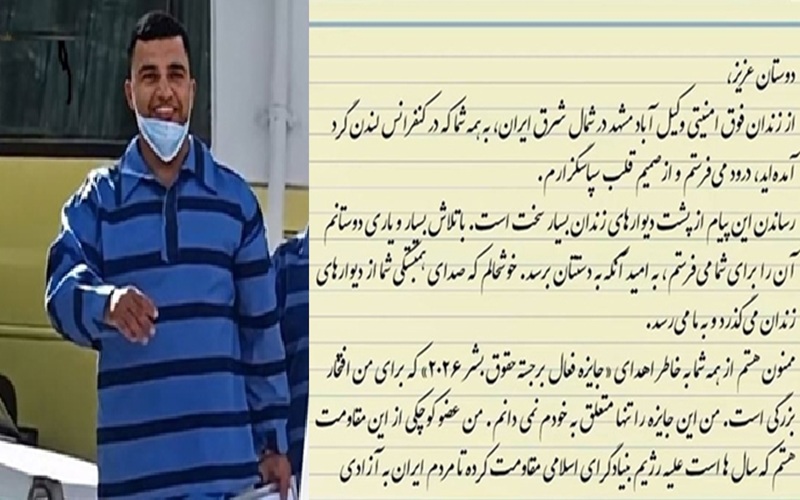

The death-row political prisoner says he will not renounce his convictions, dedicating the award to those imprisoned, tortured, or sentenced to death for seeking a free Iran.
Mohammad Javad Vafaei Sani, an Iranian political prisoner sentenced to death and held in Mashhad’s Vakilabad Prison, has dedicated his 2026 Magnitsky Outstanding Human Rights Activist Award to all those persecuted by Iran’s regime for seeking freedom and democracy.
In a message smuggled out of the high-security prison and delivered to the award ceremony in London, Vafaei Sani described the recognition as an honor belonging not to him alone, but to an entire generation of political prisoners and resistance activists who continue to defy the regime despite the threat of imprisonment and execution.
“I accept this award in the name of all those who have been imprisoned, tortured, threatened, or sentenced to death for dreaming of a free Iran; in the name of my comrades in the Resistance Units and a generation that is paying for freedom with its lives,” he said.
Expressing gratitude to those attending the ceremony, Vafaei Sani said that receiving their message of solidarity from outside prison walls gave him encouragement. He emphasized that he considered himself a small member of a broader resistance movement that has struggled for years against the regime’s religious dictatorship.
‘Today, I am sentenced to death for the same reason’
Vafaei Sani drew a direct connection between his own death sentence and the mass execution of political prisoners in the summer of 1988, when approximately 30,000 prisoners were killed, the majority of them supporters and members of the People’s Mojahedin Organization of Iran (PMOI/MEK).
He said the prisoners were executed because they remained committed to their political convictions and refused to abandon their principles.
“Dictatorship fears people who stand firm. In the summer of 1988, approximately 30,000 political prisoners, most of them supporters of the People’s Mojahedin Organization of Iran, were massacred for remaining steadfast in their ideals. Today, I too have been sentenced to death for the same reason: because I refuse to deny my integrity.”
The political prisoner also described the regime’s efforts to force detainees into submission through demands for repentance, televised confessions, and public renunciation of their beliefs.
“But our answer is clear: Hayhat minna al-dhilla (Far be it from us to accept humiliation). We will never submit to disgrace,” he declared.
His message underscores the pressure faced by political prisoners who refuse to cooperate with the regime’s propaganda apparatus, even when doing so could mean the difference between life and death.
‘Neither Shah nor Mullah’: The vision of a democratic Iran
Vafaei Sani also addressed the political future of Iran, rejecting both the ruling religious dictatorship and the restoration of monarchy.
He stressed that the Iranian people need a democratic alternative based on popular sovereignty, political pluralism, and equal rights, rather than another authoritarian system.
“We want a free and democratic Iran, an Iran ruled by neither Shah nor Mullah,” he said.
He outlined a vision in which citizens can vote freely, women and men enjoy equal rights, discrimination based on ethnicity, religion, or belief is eliminated, and no one is imprisoned or executed for political opposition.
He identified the National Council of Resistance of Iran’s (NCRI) Ten-Point Plan, presented by NCRI President-elect Maryam Rajavi, as a framework for this democratic future. The plan includes free elections, separation of religion and state, gender equality, abolition of the death penalty, and the establishment of a democratic republic.
Vafaei Sani also rejected foreign military intervention as a means of changing Iran’s political system, maintaining that change must come from within the country through organized resistance and a popular uprising.
He argued that while the regime suppresses young people and women inside Iran and conducts disinformation campaigns against the organized resistance abroad, it remains particularly concerned about movements with an active presence and organized networks inside the country.
‘We resist, therefore we exist’
Concluding his message, Vafaei Sani reaffirmed his determination not to abandon his principles, despite the death sentence hanging over him.
“I remain committed to my pledge, and until the Iranian people are free, I will not bow my head to oppression,” he said.
He invoked a statement by the Iranian Resistance’s leadership to express the determination of those continuing their struggle against the regime: “We resist, therefore we exist.”
Vafaei Sani thanked the organizers and participants of the London ceremony not only for presenting the award but, more importantly, for ensuring that Iran’s political prisoners are not forgotten.
“I sincerely thank you from the bottom of my heart. I hope that, in the near future, you will be able to visit a free Iran,” he concluded.
A message from behind prison walls
The message from Vakilabad Prison carries significance beyond the recognition of one political prisoner. It highlights the determination of prisoners facing execution for their political convictions and the continuing struggle of a generation unwilling to accept either religious dictatorship or a return to monarchy.
For Vafaei Sani, the Magnitsky Award is not a personal distinction but a tribute to those who have paid, and continue to pay, an extraordinary price for a democratic Iran.
His final words leave little doubt about his position: despite the regime’s threats, pressure, and death sentences, he has no intention of surrendering his convictions.