


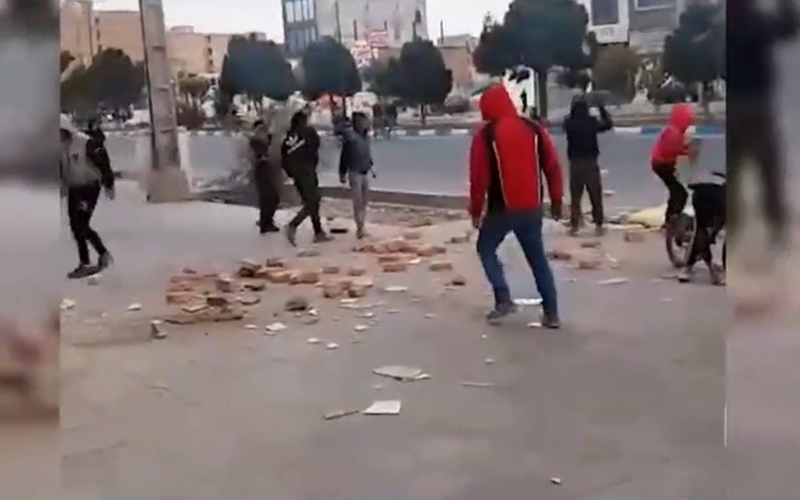

From protests in 165 cities to the role of Resistance Units, the November 2019 uprising exposed years of accumulated public anger and established a pattern that would influence subsequent waves of unrest
The November 2019 uprising marked a turning point in Iran’s protest movement. What began as a reaction to a sudden increase in fuel prices on November 15 quickly developed into nationwide protests challenging the ruling establishment. Within days, demonstrations had spread across the country, revealing the depth of public anger and the extent of social and political discontent.
According to figures cited by officials of Iran’s regime, unrest occurred in 165 cities, 25 provinces, and approximately 900 locations. Other officials acknowledged clashes in 28 or 29 provinces and hundreds of cities. Even the regime’s own accounts reflected the unprecedented geographical scale of the protests.
During the uprising, more than 1,890 facilities, including bank branches, fuel stations, and government and security centers, were targeted by protesters and rebellious youths.
But the significance of November 2019 went far beyond the number of cities involved or the immediate economic trigger. The protests rapidly moved beyond opposition to fuel prices and developed into a broader challenge to the political system. The slogans and demands demonstrated that protesters did not view the crisis as the responsibility of a single government department or administration. Rather, they directed their anger at the ruling establishment as a whole.
Years of accumulated grievances behind the November 2019 uprising
The uprising did not emerge spontaneously. It followed years of economic hardship, political repression, corruption, discrimination, and growing frustration with the absence of meaningful prospects for change.
The 2009 protests and the nationwide uprising of December 2017–January 2018 had already demonstrated the breadth of public dissatisfaction.
One particularly significant development during the December 2017 uprising was the slogan: “Reformist, hardliner, the game is over.”
The slogan reflected growing rejection of the political divisions between factions within the ruling establishment. For an increasingly vocal section of Iranian society, changing the faction in power was no longer considered a solution to the country’s fundamental problems.
By November 2019, the sudden fuel price increase provided the immediate trigger, but the underlying causes were much deeper. Years of unemployment, economic insecurity, corruption, social restrictions, and the absence of political freedoms had created widespread resentment.
Young people played a particularly prominent role. A generation that had grown up amid economic crises and unfulfilled promises of reform increasingly saw its future as being blocked by the existing system.
For many, the issue was no longer simply the rising cost of gasoline. It was the absence of a future they could realistically hope to attain.
An economic protest rapidly became a political uprising
The fuel price increase imposed additional pressure on households already struggling with declining living standards. Yet the speed with which demonstrations spread and their political character became apparent showed that the reaction was rooted in far more than a single economic decision.
When people have no effective channels to express grievances, participate in public decision-making, or influence government policies, a specific economic measure can become a catalyst for broader opposition.
That is what happened in November 2019. Protest slogans quickly moved beyond fuel prices and addressed the political structure responsible for the country’s conditions.
The distinction between the immediate trigger and the underlying causes is essential to understanding the uprising. The fuel price increase sparked the demonstrations, but years of accumulated economic and political grievances gave them their nationwide character.
Resistance Units and the organizational dimension of the uprising
Another defining feature of November 2019 was the question of organization and coordination.
The nationwide spread of protests, together with recurring patterns of action across different cities, raised the importance of the organizational networks that had developed in the preceding years.
Resistance Units, associated with the People’s Mojahedin Organization of Iran (PMOI/MEK), had been conducting activities aimed at challenging the regime’s authority. These included burning official banners and images of Supreme Leader Ali Khamenei and security personnel, writing anti-regime slogans on walls, and circulating photographs and videos of such activities through social media.
These actions helped establish visible examples of defiance in communities across the country. They also demonstrated that opposition to the regime was not confined to isolated individuals or occasional demonstrations.
According to the resistance movement’s account, Resistance Units played two interconnected roles. First, their activities helped establish a pattern of organized defiance that could be emulated by other young people. Second, members of these units participated directly in protests, helping coordinate and sustain actions in the streets.
The movement argues that areas where Resistance Units were directly active experienced more intense and sustained protests. It identifies their participation as an important factor in the organization and direction of the uprising.
From this perspective, November 2019 represented more than a spontaneous reaction to an economic decision. It demonstrated the potential for accumulated public anger to develop into a nationwide movement with an organized dimension.
How November 2019 influenced subsequent uprisings
The importance of November 2019 did not end when the demonstrations were suppressed. Its experience became part of the broader trajectory of protest in Iran.
After a period in which the regime benefited from the disruption caused by the COVID-19 pandemic, nationwide unrest returned in September 2022 following the death of Mahsa Amini in the custody of the morality police. The 2022 uprising once again demonstrated how a specific incident could become the catalyst for widespread opposition to the entire ruling system.
Subsequent unrest, including the protests and confrontations of 2025, continued to unfold against the background of unresolved economic, political, and social grievances.
The November 2019 uprising had demonstrated several recurring characteristics of Iran’s protest movement: the rapid geographical spread of demonstrations, the prominent participation of young people and women, the transformation of specific grievances into political demands, and the persistence of opposition despite severe repression.
It also exposed the limits of addressing public dissatisfaction through isolated economic measures while leaving the underlying political and social grievances unresolved.
November 2019 remains a defining chapter in Iran’s protest movement
The November 2019 uprising exposed the depth of the divide between Iranian society and the ruling establishment. A sudden increase in fuel prices brought millions of accumulated grievances into the streets, turning an economic protest into a nationwide political confrontation.
Its geographical scale, the participation of young people, and the emergence of organized resistance made it a defining episode in the country’s recent history.
The experience of November 2019 also provided an important reference point for understanding the uprisings that followed. The central grievances that drove people into the streets were not resolved, and subsequent waves of unrest continued to reflect the same underlying demands for fundamental change.
November 2019 demonstrated that an economic shock could ignite a much broader confrontation when it occurred against a background of accumulated public anger, political repression, and the absence of meaningful avenues for change.