
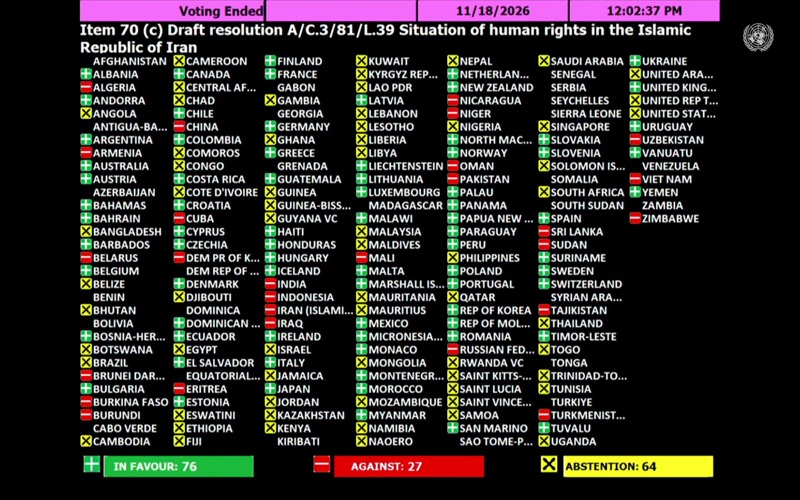

Adopted by the General Assembly’s Third Committee with 76 votes in favor and 27 against, the resolution condemns executions, mass arrests, torture, and the violent suppression of protests, while reinforcing demands for international accountability.
The United Nations General Assembly’s Third Committee adopted a resolution on November 18, 2026, strongly condemning the Iranian regime’s grave and systematic human rights violations. The resolution, A/C.3/81/L.39, received 76 votes in favor, 27 against, and 64 abstentions.
This marks the 73rd condemnation of the Iranian regime by United Nations bodies over its human rights record. The vote represents another significant international rejection of a system that relies on executions, torture, arbitrary detention, and violent repression to maintain its grip on power.
This year’s resolution gives particular attention to the regime’s violent suppression of nationwide protests that began in December 2025 and continued into 2026. It addresses mass killings and injuries, the arbitrary detention of tens of thousands of people, nationwide internet shutdowns, and the execution of protesters.
The crackdown on nationwide protests takes center stage
A particularly significant aspect of the resolution is its explicit condemnation of the regime’s response to the nationwide protests.
The text expresses grave concern over the use of lethal force against protesters, resulting in thousands of deaths and large numbers of injuries, including among children. It also addresses the arbitrary detention of tens of thousands of people and the imposition of nationwide internet shutdowns to restrict communication and suppress information.
The resolution further condemns the sentencing and execution of protesters, identifying the death penalty as an instrument of political repression.
By placing these developments within its formal assessment of Iran’s human rights situation, the UN has given international visibility to the victims of the protests, their families, and the thousands detained for challenging the ruling dictatorship.
Executions, torture, and systematic discrimination
Beyond the suppression of protests, the resolution condemns the Iranian regime’s extensive and persistent use of capital punishment, particularly for offenses related to national security.
It expresses concern over executions carried out following unfair judicial proceedings, forced confessions, and torture. It also addresses public executions and the continued application of the death penalty against individuals who were under 18 at the time of the alleged offenses.
The resolution highlights torture and other forms of cruel, inhuman, or degrading treatment, arbitrary arrests, enforced disappearances, and restrictions on freedom of expression and other fundamental rights.
It also condemns discrimination against women and girls and the persecution of ethnic and religious minorities.
The findings of the Independent International Fact-Finding Mission on Iran receive particular attention. The resolution expresses serious concern over the Mission’s assessment that many documented violations may constitute crimes against humanity.
These findings reinforce the importance of preserving evidence, investigating violations, and ensuring that those responsible cannot continue to benefit from impunity.
International scrutiny must lead to accountability
The resolution emphasizes the need for truth, justice, accountability, and effective remedies for victims and survivors. It also calls for continued investigations into serious human rights violations and cooperation with international mechanisms.
In particular, the work of the Independent International Fact-Finding Mission remains essential to documenting abuses and establishing a record that can support future legal proceedings within its mandate.
For the Iranian Resistance, however, international documentation must lead to concrete action against those responsible.
Maryam Rajavi, President-elect of the National Council of Resistance of Iran (NCRI), welcomed the adoption of the resolution, emphasizing that although it covers only a fraction of the regime’s crimes, it demonstrates that the ruling religious dictatorship cannot survive without executions, torture, repression, and mass arrests.
She called for the international community to isolate the regime, refer its dossier of crimes to the UN Security Council, and bring its leaders and those responsible for the 1988 massacre of political prisoners, crimes against humanity, and genocide before justice.
Rajavi also urged the United Nations, its member states, and human rights organizations to take immediate and binding measures to stop executions, save prisoners facing death sentences, and secure the release of political prisoners.
She further called for international fact-finding delegations to be granted access to Iranian prisons, particularly to meet political prisoners and examine their conditions of detention.
The regime cannot use external conflict to escape responsibility
The adoption of the resolution is also significant in the context of the armed conflict that has affected Iran during 2026.
The regime has sought to portray itself as a victim of external aggression, but the international assessment of its human rights record makes clear that its obligations toward its own population remain in force.
Importantly, the resolution also addresses civilian casualties during the armed conflict. Its references include the deadly strike on a school in Minab, while calling on all parties to comply fully with international law and international humanitarian law and to investigate violations.
This does not diminish the regime’s responsibility for decades of domestic repression or its violent response to popular protests. International humanitarian obligations and the Iranian authorities’ human rights obligations must both be respected.
The vote also demonstrated that the regime’s attempts to deflect international scrutiny did not prevent a substantial majority of the committee from supporting the condemnation. The 76 votes in favor, against 27 opposing votes, constitute a clear diplomatic setback for Tehran.
From international condemnation to concrete action
The 73rd condemnation of the Iranian regime by UN bodies is an important acknowledgment of the continuing human rights crisis in Iran. Its particular attention to the nationwide protests, mass arrests, executions, and systematic repression gives this year’s resolution added significance.
Nevertheless, repeated condemnations have not stopped the regime’s executions or ended its persecution of political prisoners. The challenge now is to translate international recognition into effective measures that protect prisoners, prevent further executions, preserve evidence, and hold perpetrators accountable.
For the Iranian people and the families of victims, another diplomatic resolution is not enough. The international community must move beyond expressions of concern and take practical steps to end impunity.
The regime’s record must be addressed through sustained international pressure, independent investigations, and accountability for those who order and carry out its crimes.