
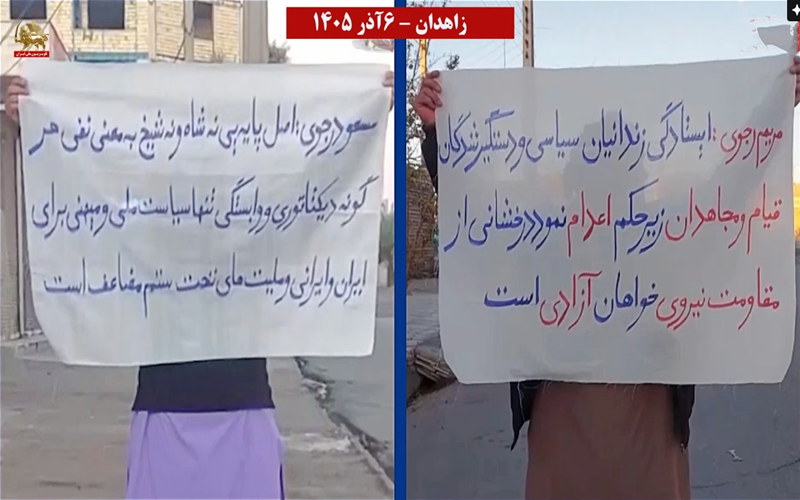

Resistance Units in Zahedan displayed messages from Massoud Rajavi and Maryam Rajavi, reaffirming the call for a democratic republic and rejecting both the clerical dictatorship and the restoration of the monarchy.
On Friday, November 27, 2026, Resistance Units in Zahedan carried out a campaign displaying messages from Massoud Rajavi and Maryam Rajavi alongside slogans rejecting dictatorship in all its forms. The activities reaffirmed the movement’s central political message: “Death to the oppressor, whether Shah or supreme leader.”
Through leaflets and handwritten messages, the activists called for the overthrow of Iran’s clerical dictatorship, rejected both monarchical and religious authoritarianism, and promoted the Third Option: democratic change brought about by the Iranian people and their organized resistance, without foreign military intervention or appeasement of the regime.
The campaign emphasized the principle of “No to Shah, No to Mullahs” as the political foundation for a free and independent Iran.
Massoud Rajavi’s messages: Rejecting every form of dictatorship
Messages from Massoud Rajavi displayed by the Resistance Units stressed the historical significance of the organized struggle against dictatorship and the need to prevent the emergence of another authoritarian system.
One message declared that reactionary forces and colonial interests seek to conceal the Resistance’s activities because they fear the emergence of an independent, democratic and revolutionary alternative capable of challenging both the Shah and the mullahs.
Other messages described the National Liberation Army of Iran as the culmination of the Iranian people’s historical struggle for freedom and emphasized the national and international significance of the sacrifices made by generations of resistance fighters.
Rajavi also underscored the fundamental principle of rejecting both forms of dictatorship:
“The basic principle of No to Shah, No to Mullahs means rejecting every form of dictatorship and dependence. It is the only national and patriotic policy for Iran, its people, and its nationalities suffering from double oppression.”
Another message stressed that the clerical regime must understand that the struggle for freedom cannot be contained through repression, declaring that the fate of both the Shah’s dictatorship and the clerical dictatorship is overthrow.
The messages concluded with confidence in the victory of Iran’s democratic revolution and the establishment of a democratic republic.
Maryam Rajavi’s messages: The Third Option and democratic change
Messages from Maryam Rajavi focused on the political crisis facing the regime, the role of organized resistance, and the prospects for democratic change.
She described the regime as weaker and more helpless than ever, lacking solutions to the mounting crises threatening its survival. She identified political prisoners, detained protesters, and resistance fighters facing death sentences as examples of the Iranian people’s determination to resist repression.
One of her messages stated:
“The greatest reality in Iran is the force seeking freedom, which is invincible—a vast force with tremendous fighting power.”
Rajavi emphasized that the key to change lies with the Iranian people and their organized resistance, which has endured decades of repression under the principle of “No to Shah, No to Mullahs.”
She called on young people to join the Resistance Units and transform every street, neighborhood, and city into a center of uprising and revolution.
A central theme of the displayed messages was the Third Option, which rejects both appeasement of the regime and foreign war as solutions to Iran’s crisis. Instead, it calls for the overthrow of the dictatorship through the Iranian people and their organized resistance, led by the Resistance Units and the National Liberation Army.
Maryam Rajavi also reiterated the National Council of Resistance of Iran’s vision for the country’s future: a democratic republic based on the separation of religion and state, autonomy for oppressed nationalities, equality between women and men, and the abolition of the death penalty.
Another message warned that as long as the velayat-e faqih system remains in power, repression, poverty, corruption, and inflation will continue to deepen. It identified popular uprising and protest as the path to ending the regime.
The displayed messages also rejected attempts to restore the Shah’s dictatorship, including efforts to revive the SAVAK torture and intelligence apparatus. They stressed that anyone seeking to reestablish such a system has no place in Iran’s future.
Zahedan slogans reject both Shah and supreme leader
Alongside the political messages, Resistance Units displayed slogans explicitly rejecting both the current clerical establishment and the former monarchy.
Among the slogans were:
- “From Zahedan to Tehran, death to the oppressor, whether Shah or supreme leader.”
- “Monarchy and velayat-e faqih: a hundred years of crimes.”
- “The people and history curse the blood-soaked Shah and Mullah.”
- “We want neither Shah nor mullahs; damn all dictators.”
- “Dictatorship is dictatorship, whether under a turban or a crown.”
The repeated slogan, “Death to the oppressor, whether Shah or supreme leader,” placed the campaign firmly within the broader rejection of hereditary monarchy and religious authoritarianism.
A democratic alternative beyond both dictatorships
The activities in Zahedan highlighted a political message that the Resistance Units have consistently sought to bring into Iran’s public space: the country’s future must not be determined by replacing one dictatorship with another.
The “No to Shah, No to Mullahs” principle rejects both the clerical regime and the restoration of monarchical rule. It instead advances a democratic republic grounded in popular sovereignty, separation of religion and state, gender equality, and the rights of Iran’s diverse nationalities.
By displaying these messages in Zahedan, the Resistance Units reaffirmed the Third Option as an alternative to both foreign military intervention and policies that allow the regime to survive through repression.
Their central message was clear: Iran’s liberation must lead to a democratic republic, not another form of dictatorship.