


In a new series titled “Clusters of the People’s Wrath,” Resistance Units targeted Basij and IRGC sites, regime symbols, and centers of repression across several Iranian cities, challenging the nightly gatherings used by the regime to project support and deter popular uprisings.
Iran’s Resistance Units have carried out a new series of 15 operations against the regime’s nightly propaganda gatherings, Basij installations, and symbols of the clerical dictatorship in cities across the country. The activities, presented as the second installment of the series “Clusters of the People’s Wrath” (November 2026), directly challenge the regime’s efforts to use nightly gatherings to demonstrate public support and establish a nationwide security shield against another popular uprising.
The campaign describes these gatherings as orchestrated displays of intimidation rather than genuine expressions of public support. It accuses the authorities of turning nighttime streets into instruments of psychological warfare against the population, disrupting the sleep and peace of ordinary residents, including sick and vulnerable people, through loudspeakers and aggressive chants.
The statement characterizes the gatherings as a desperate attempt to protect the system of velayat-e faqih from the threat of another uprising.
Resistance operations target regime infrastructure and symbols
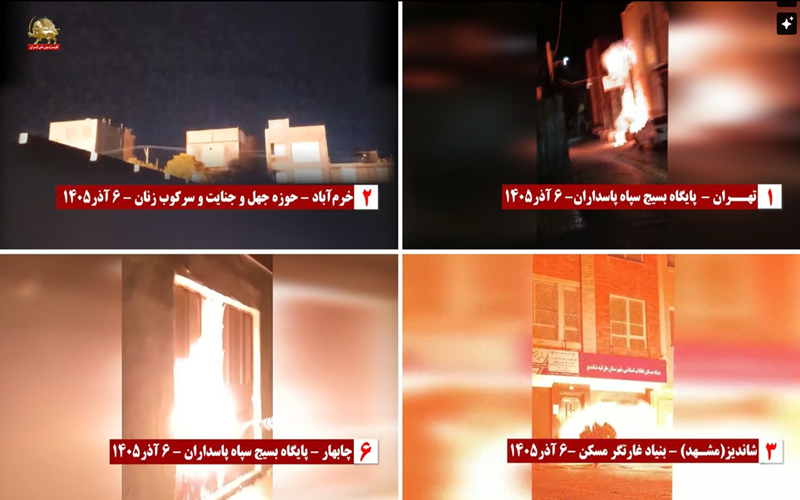
The reported 15 operations took place in several provinces and involved attacks on Basij bases, regime propaganda installations, and banners displaying images of Supreme Leader Ali Khamenei and former regime figures.
The reported activities included:
- Tehran: An explosion at an IRGC Basij base.
- Khorramabad: An explosion at a center described by the Resistance Units as an institution of ignorance, repression, and violence against women.
- Shandiz, Mashhad: An explosion at the predatory Housing Foundation.
- Sheyban, Ahvaz: Gunfire directed at an IRGC Basij base.
- Zahedan: Setting fire to a banner depicting Ali Khamenei.
- Chabahar: Setting fire to an IRGC Basij base.
- Mehrestan: Setting fire to an IRGC Basij base.
- Iranshahr: Setting fire to an anti-student Basij unit.
- Isfahan: Setting fire to a banner depicting Ruhollah Khomeini and Ali Khamenei.
- Isfahan: Setting fire to another banner depicting Khamenei.
- Zahedan: Setting fire to another banner depicting Khamenei.
- Sirjan: Setting fire to a banner depicting Khamenei.
- Iranshahr: Setting fire to a banner depicting Khamenei and Qassem Soleimani.
- Marivan: Setting fire to a banner depicting Khamenei.
- Qazvin: Setting fire to a sign directing people to an IRGC Basij intelligence-gathering headquarters.
The repeated targeting of Khamenei’s images and Basij installations reflects the campaign’s focus on challenging the regime’s symbols of authority and its local instruments of repression.
Remembering the 677-day loudspeaker torture at Camp Ashraf
The statement also draws a historical parallel between the regime’s current nightly gatherings and the psychological torture inflicted on members of the People’s Mojahedin Organization of Iran (PMOI/MEK) at Camp Ashraf in Iraq.
It recalls how the regime’s agents used 320 loudspeakers to subject PMOI members to continuous psychological harassment for 677 days, from February 7, 2010, to December 15, 2011.
The Resistance Units describe the current use of loudspeakers during nightly gatherings as a reminder of that campaign of psychological torture, arguing that the regime is once again using noise, intimidation, and organized displays of aggression to wear down its opponents and the wider population.
Challenging the regime’s manufactured displays of support
The campaign comes amid the regime’s efforts to organize nightly gatherings following its war with the United States and Israel. These events have been used to project loyalty to the ruling establishment and present an image of national unity behind the authorities.
The Resistance Units’ statement portrays the gatherings as part of a broader strategy to prevent renewed popular protests by intimidating society and maintaining a visible presence of regime supporters in public spaces.
The reported operations across Tehran, Khorramabad, Mashhad, Ahvaz, Zahedan, Chabahar, Mehrestan, Iranshahr, Isfahan, Sirjan, Marivan, and Qazvin offer a contrasting picture of continued opposition activity.
By targeting regime symbols and security installations, the Resistance Units seek to challenge the image of unquestioned authority that the nightly gatherings are intended to project.