


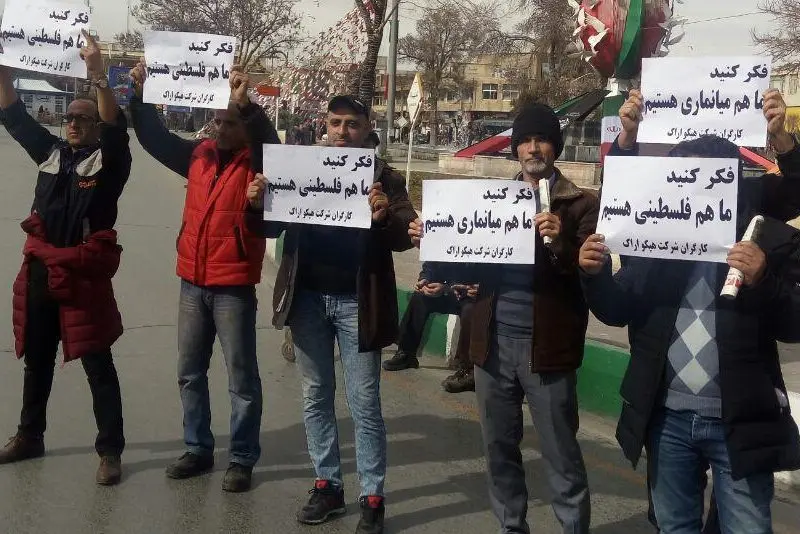

Iran’s currency crisis is intensifying pressure on workers and low-income households as the dollar trades between 265,000 and 270,000 tomans, up from approximately 155,000 tomans at the beginning of 2026. The sharp depreciation of the rial has eroded the value of wages, increased production costs, and further strained household budgets, while workers’ salaries have failed to keep pace.
The dollar’s increase of approximately 110,000–115,000 tomans in less than a year illustrates the scale of the economic deterioration. Because imports, exports, production, and many services are directly or indirectly affected by the exchange rate, currency depreciation feeds into prices throughout the economy. For households whose incomes remain largely fixed, the result is a growing inability to afford essential goods and services.
Workers’ Dollar-Equivalent Wages Fall by 41 Percent
The minimum monthly base wage for workers was set at approximately 16.6 million tomans at the beginning of 2026. At an exchange rate of around 158,000 tomans per dollar, that salary was equivalent to approximately $105 per month.
With the dollar now trading at around 265,000 tomans, the same wage is worth only about $63.
The comparison highlights the extent of the decline:
- Beginning of 2026: 16.6 million tomans, equivalent to approximately $105.
- At the current exchange rate: 16.6 million tomans, equivalent to approximately $63.
- Decline in dollar-equivalent wages: Approximately 41 percent.
- Wage needed to preserve the initial dollar equivalent: Approximately 27.8 million tomans per month.
These figures compare wages at different exchange rates; they do not measure the full change in domestic purchasing power, which also depends on the prices of food, housing, healthcare, transportation, and other essentials.
Nevertheless, the calculation demonstrates how rapidly the value of workers’ earnings has deteriorated. To maintain the same dollar-equivalent wage as at the beginning of the year, a worker earning 16.6 million tomans would now need approximately 27.8 million tomans a month.
The pressure is compounded by the failure to adjust wages in line with inflation. Although workers’ salaries were expected to be reviewed in September, the continuing depreciation of the currency has widened the gap between earnings and living costs.
Currency Depreciation Drives Prices Higher
The impact of the exchange-rate crisis extends beyond imported goods. Businesses dependent on imported raw materials, machinery, spare parts, and other inputs face higher costs, which can be passed on to consumers. Domestic producers and service providers are also affected by the broader inflationary environment.
Yet prices that rise with the dollar do not necessarily fall when exchange rates or international costs decline. This persistent upward pressure leaves households paying more even when particular costs stabilize.
The concentration of economic power among entities linked to Supreme Leader Ali Khamenei’s inner circle and the Islamic Revolutionary Guard Corps (IRGC) further compounds the problem. Extensive control over major economic activities gives regime-linked institutions substantial influence over production, trade, and access to resources, while ordinary workers have little protection against the consequences of currency depreciation.
The outcome is a widening divide between those able to profit from access to economic resources and those whose incomes lose value with every increase in prices.
Central Bank Interventions Fail to Resolve the Crisis
The Central Bank’s attempts to stabilize the foreign-exchange market have failed to prevent the dollar from reaching the 265,000–270,000-toman range.
Central Bank chief Abdolnaser Hemmati has referred to plans to inject $2 billion into the market, with an initial allocation of $1 billion, as part of efforts to manage the exchange rate and curb inflationary momentum.
However, injecting foreign currency into the market does not, by itself, resolve the structural causes of the crisis. Without sustained currency stability and changes to the economic policies driving inflation, temporary interventions are unlikely to restore workers’ lost purchasing power.
Such measures can also produce unequal benefits when access to foreign currency depends on preferential allocations. The immediate effects on the exchange rate may be temporary, while households continue to face high prices and stagnant wages.
The central question is not simply how many dollars the Central Bank can supply, but how those resources are allocated and whether interventions deliver tangible relief to the wider population.
Preferential Exchange Rates Generate Windfalls
The difference between preferential exchange rates and the open-market price creates opportunities for substantial financial gains for those able to secure cheaper foreign currency.
Consider a transaction involving $10,000 purchased at 250,000 tomans per dollar when the market rate is 265,000 tomans. The buyer would pay 2.5 billion tomans, while the same amount of foreign currency would be worth 2.65 billion tomans at the market rate—a difference of 150 million tomans.
This example illustrates the financial advantage that preferential access can confer. Those who obtain foreign currency below the market price can benefit from the gap, while ordinary workers, whose monthly wages are only a small fraction of the sums involved, have no comparable opportunity.
The disparity highlights a broader problem in Iran’s economy: the distribution of economic benefits is deeply unequal, and policies intended to manage the currency market can create substantial advantages for well-connected recipients without providing equivalent relief to the public.
Food Subsidies Cannot Compensate for Falling Incomes
The regime has also sought to ease pressure on households through increases in the electronic food-subsidy program, known as kalabarg. But additional assistance of 300,000 tomans offers limited relief against the scale of the losses caused by inflation and currency depreciation.
The government has identified approximately 40 million people for the assistance program. Even when delivered, such benefits cannot compensate for the sustained erosion of wages if the prices of essential goods continue to rise.
A subsidy may help cover part of a household’s food expenses, but it cannot replace an adequate salary or address the underlying causes of the cost-of-living crisis. When the value of wages falls while essential expenses rise, families are forced to cut consumption, postpone purchases, or sacrifice other basic needs.
The disparity between the scale of currency depreciation and the limited value of additional assistance underscores the inadequacy of temporary relief measures in the face of a deepening economic crisis.
Iran’s Workers Bear the Cost of Currency Collapse
The dollar’s rise from approximately 155,000 tomans to 265,000–270,000 tomans has exposed the vulnerability of workers whose incomes have not kept pace with the falling value of the national currency.
The decline in the dollar-equivalent minimum wage from approximately $105 to $63 a month illustrates the scale of the loss. Meanwhile, preferential currency allocations can generate substantial advantages for those with access to them, while limited subsidies offer only partial relief to households struggling with rising prices.
For Iran’s working population, the crisis is no longer simply a matter of exchange-rate fluctuations. It is the growing inability of wages to cover basic needs as currency depreciation and inflation reinforce one another.
Without meaningful wage adjustments and measures that address the structural causes of inflation and unequal access to economic resources, the burden of the currency crisis will continue to fall most heavily on workers and low-income families.