


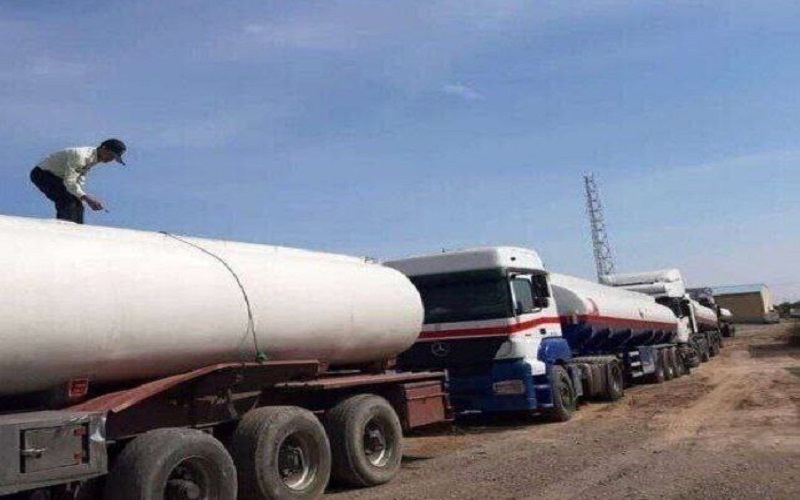

Fuel smuggling has become one of Iran’s most severe economic crises, with an estimated 20 to 30 million liters of fuel disappearing daily. However, this fuel is not simply lost—it is systematically smuggled. This massive operation is not the work of petty criminals but a well-organized network that ultimately channels its profits into the hands of powerful institutions and figures within the regime.
Acknowledging the Scale of the Problem
During an impeachment session in Iran’s parliament, the regime’s Minister of Economic Affairs and Finance acknowledged that fuel smuggling exceeds $30 billion annually. He admitted that combating this corruption is beyond the power of economic ministers, revealing that 20 million liters of diesel are smuggled daily—an amount equivalent to 320 trillion tomans per year. This figure is staggering, as it represents the annual subsidy allocation for Iran’s entire population. If redirected, this revenue could provide every citizen with four million tomans annually.
Even the regime’s president, Masoud Pezeshkian, has publicly stated that smugglers sell government-subsidized diesel, priced at 300 tomans per liter, for as much as 70,000 tomans on the black market. This means that diesel smuggling alone generates more than 500 trillion tomans in illicit profits each year. Meanwhile, the regime’s Chief Justice, Gholam-Hossein Mohseni-Eje’i, has conceded that efforts to curb fuel smuggling have yielded little success over the years.
The Hidden Beneficiaries of Fuel Smuggling
Mahamoud Khaghani, an energy expert and former director general at the Ministry of Oil, has pointed to the deep entrenchment of the smuggling network within the regime’s power structure. In an interview, he highlighted past attempts to confront this corruption, recalling a statement by former President Hassan Rouhani in 2017. Rouhani admitted that a handful of individuals control the country’s liquidity, manipulate foreign exchange markets, and obstruct economic reforms. He even sought assistance from the regime’s Supreme Leader, demonstrating the difficulty of confronting these entrenched interests.
Khaghani further noted that when the government of 2018 pursued budget transparency, it faced fierce opposition from those benefiting from illicit wealth, including the oil mafia. This resistance culminated in political turmoil, including the Mashhad protests of early 2018. Eventually, the government yielded to these forces, allowing them to dominate the foreign exchange and fuel markets.
A Parallel with Mexico’s Oil Mafia
Fuel smuggling in Iran bears striking similarities to the situation in Mexico, where powerful criminal organizations control significant portions of the oil industry. Khaghani highlighted that Iran’s oil mafia operates in an equally sophisticated manner, making it impossible for fuel to be smuggled in large quantities by mere individuals or small gangs. Instead, a complex and deeply embedded network enables the illicit trade. Even Bijan Zanganeh, the regime’s former Oil Minister, acknowledged in 2013 that a formidable mafia had infiltrated Iran’s oil industry, making it extremely difficult to combat corruption.
The scale of this crisis raises critical questions: How is it possible that Iran’s Refining and Distribution Company remains unaware of the unauthorized pipelines transporting fuel to external markets? Who within the regime is complicit in allowing such smuggling operations to flourish? These unanswered questions point to the involvement of high-ranking officials and institutions that have long benefited from the illicit trade.
A Crisis Beyond Control
Khaghani argues that Iran has reached a point where confronting the oil mafia is nearly impossible under the current regime. Even President Pezeshkian, who previously advocated exposing the so-called “hidden government” controlling Iran’s economy, now finds himself constrained. While he occasionally acknowledges the problem, he, like his predecessors, is forced to remain largely silent.
The regime’s unwillingness—or inability—to dismantle this powerful smuggling network reveals a broader reality: corruption and illicit profiteering are deeply embedded in Iran’s political and economic systems. As long as the regime’s power structure continues to rely on these hidden channels of wealth, meaningful reform will remain out of reach, and the Iranian people will continue to bear the brunt of economic mismanagement and institutionalized corruption.