


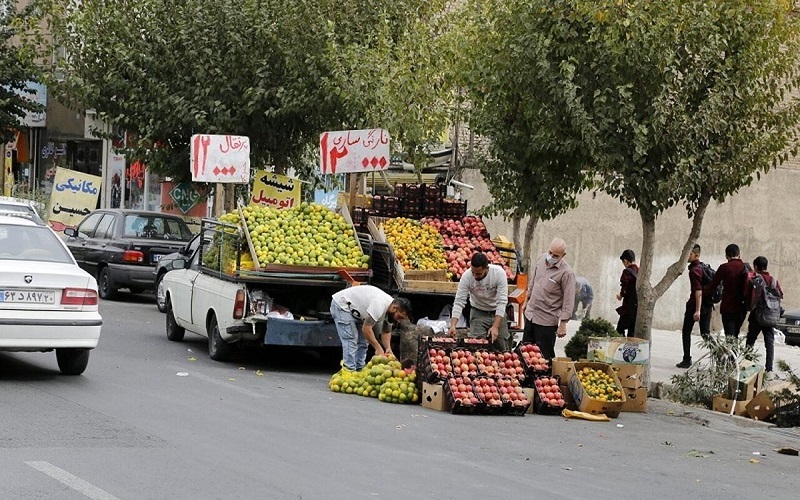

The latest report from the Iranian Statistics Center on the monthly inflation of food items in June reveals that the prices of all food items increased compared to May.
Notably, the inflation rate for fruit and dried fruit was not only higher than that of other food items but also broke a four-year record. Among non-food items and services, healthcare saw the highest monthly inflation.
Monthly inflation refers to the percentage change in the price index compared to the previous month.
In June 2024, the monthly inflation rate for Iranian households was 2.8%, with ‘food, beverages, and tobacco’ experiencing a 4.2% increase and ‘non-food goods and services’ seeing a 2.1% rise.
Two years ago, Iran’s Statistics Center changed the inflation base year from 2016 to 2021, aiming to present lower monthly and annual inflation rates under President Ebrahim Raisi’s administration.
Despite this adjustment, the reported inflation rate for June, based on the new base year, was slightly over 36%.
The report indicated that in June, the household consumer price index exceeded 249, marking a 2.8% increase from the previous month and a 31% rise from the same month the previous year.
This means that Iranians spent, on average, 31.9% more in June 2024 compared to June 2023 to purchase the same goods and services.
Point-to-point inflation in June 2024 increased by 0.09 percentage points compared to the previous month.
Despite the intermittent calculations by institutions such as the Iranian Statistics Center, even official data shows that the upward trend in prices persists, contradicting the claims and promises of regime authorities.
While government officials deny the rising inflation rate, the Iranian people continue to experience it in their daily lives.
Compared to the previous year, fruit and vegetable prices in Iran have increased by 50%, meat prices by 70%, and public transportation costs have doubled.
As presidential candidates promise solutions to economic problems, the general public continues to struggle, often turning to risky financial behaviors.
Many Iranians previously sought refuge in Bitcoin cryptocurrency and, following the U.S. withdrawal from the nuclear agreement, many withdrew their money from banks, converting it into gold, dollars, vehicles, property, and other tangible assets.
Amirhossein Ghazizadeh Hashemi, the head of the Foundation of Martyrs and Veterans Affairs, recently claimed that ‘food poverty’ was ‘eradicated’ under the 13th government, asserting that all Iranians received between 1,900 and 2,100 calories over the past three years.
However, even official data from government institutions like the Parliament Research Center contradicts this claim, showing that all income deciles in Iran have reduced their calorie intake to cover other expenses like housing rent, with middle deciles being most affected.
The regime’s demised president Ebrahim Raisi had promised during his election campaigns to create one million jobs, build one million houses, and eradicate poverty within a year.
Nearly three years into the 13th government, Iranians face more economic hardships, yet regime-backed presidential candidates claim Raisi has fulfilled his promises and pledge to continue his policies if elected.
Iran’s current inflation rate is significantly higher than most other countries in the region, making it an outlier in terms of price instability.
In April 2024, Iran’s inflation rate was reported at 30.9%, still extremely elevated despite being lower than in previous months. Among neighboring countries, only Turkey experiences similarly high inflation, with both nations struggling with annual rates around 50%.
Iran’s inflation rate is much worse than that of other regional countries. For context, the global average inflation rate in 2022 was estimated at 9.4% by the OECD, while Iran’s rate was over five times higher at 52.2% in the second half of that year, ranking it 10th highest worldwide.
Some economists, including Steve H. Hanke from Johns Hopkins University, suggest that Iran’s actual inflation rate might be more than double the official figures.
The persistently high inflation in Iran is attributed to several factors: ongoing U.S. sanctions, economic mismanagement and ineffective policies, depletion of water resources and environmental challenges affecting agriculture and other sectors, and high government spending and budget deficits.
In contrast, many other countries in the Middle East and North Africa region have more stable prices and lower inflation rates, making Iran’s inflation problem stand out as a regional anomaly, reflecting the country’s unique economic challenges and policy choices.