


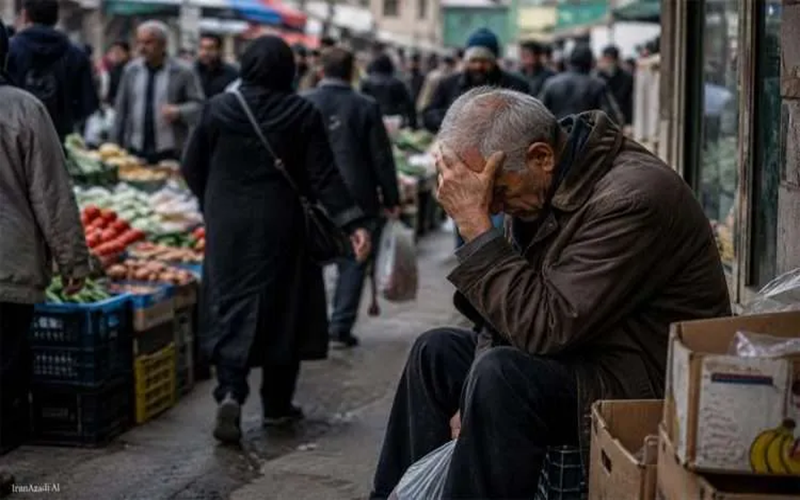

With minimum monthly wages below 25 million tomans and inflation devastating household budgets, millions of Iranian workers are falling further below the poverty line.
The gap between income and the cost of living in Iran has reached unprecedented levels, exposing the growing economic hardship faced by millions of workers and low-income families. New figures reported by the state-run ILNA news agency reveal that the poverty line in Iran has surpassed 70 million tomans per month, while the minimum monthly income of workers, including benefits, remains below 25 million tomans.
These figures underscore a stark reality: for a large portion of Iran’s workforce, monthly earnings do not even cover one-third of the income required to remain above the poverty threshold.
A Widening Gap Between Wages and Living Costs
According to labor activists cited by ILNA, the actual monthly cost of living for a working-class family has reached nearly 90 million tomans. This means that workers receiving the minimum wage face a monthly deficit of approximately 65 million tomans.
For many families, bridging such a gap is impossible. Workers are increasingly forced to take multiple jobs, reduce essential consumption, accumulate debt, or accept a steady decline in living standards. Even holding two or three jobs is no longer sufficient to provide a minimum standard of living.
The scale of the crisis becomes clearer when comparing wages with poverty indicators:
| Economic Indicator | Estimated Amount |
|---|---|
| Poverty line | Over 70 million tomans |
| Monthly cost of living for a worker’s family | Around 90 million tomans |
| Minimum monthly worker income (including benefits) | Less than 25 million tomans |
| Monthly income gap | About 65 million tomans |
This widening disparity reflects not merely low wages, but a structural economic crisis in which household expenses continue to rise far faster than incomes.
Inflation Hits Low-Income Families Hardest
Inflation remains one of the main drivers of worsening poverty.
Reports indicate that point-to-point inflation in August reached 89 percent, while food inflation climbed to an alarming 127.5 percent. Essential goods that form the basis of household consumption have become increasingly unaffordable for millions of families.
The burden of inflation falls disproportionately on lower-income groups. Annual inflation for the second income decile was reported at 78.3 percent, compared to 67.6 percent for the wealthiest tenth decile.
This disparity means that poorer households spend a larger share of their income on basic necessities such as food, housing, transportation, and healthcare—items that have seen the sharpest price increases.
As a result, many working families are eliminating essential goods from their consumption baskets. Meat, dairy products, healthcare services, educational expenses, and even adequate housing have become increasingly difficult to afford.
Currency Collapse and New Economic Pressures
The continuing depreciation of Iran’s currency has further intensified the crisis. The free-market exchange rate for the U.S. dollar has reached approximately 235,000 tomans, driving up the cost of imported goods, industrial inputs, medicine, and basic consumer products.
Additional economic pressures are also emerging. Discussions over fuel price increases and reductions in subsidies threaten to increase transportation costs and create new inflationary waves. Previous fuel price hikes have often triggered broader price increases across the economy, placing additional burdens on wage earners.
Economic experts have repeatedly warned that inflation in Iran is no longer limited to temporary market fluctuations. Instead, it reflects deeper structural problems, including budget deficits, monetary expansion, currency instability, corruption, and policies that have failed to protect workers’ purchasing power.
Workers Demand Fair Wages, Not Temporary Assistance
Labor activists argue that government support programs, including subsidies and limited welfare payments, cannot compensate for the dramatic loss of purchasing power.
Workers have repeatedly stressed that they need wages tied to the real cost of living rather than temporary aid measures. When the poverty line exceeds 70 million tomans and actual family expenses approach 90 million tomans, incomes below 25 million tomans leave millions trapped in chronic poverty.
This situation helps explain the growing wave of labor protests seen across Iran in recent years. Workers, retirees, teachers, nurses, and other wage earners have increasingly taken to the streets to demand higher wages, timely payments, and better living conditions.
Poverty as a Consequence of Economic Policies
The crisis facing Iran’s workers is not solely the result of inflation or currency depreciation. It is also the product of economic policies that have steadily widened the gap between incomes and living costs.
Today, even multiple jobs cannot guarantee a minimum standard of living for many households. The contrast between a poverty line above 70 million tomans and minimum monthly earnings below 25 million tomans offers a clear picture of the dramatic decline in purchasing power and the deepening poverty affecting Iran’s working class.
As living costs continue to rise and wages remain far behind, millions of Iranian families are confronting a difficult reality: economic survival itself has become an increasingly unattainable goal.