


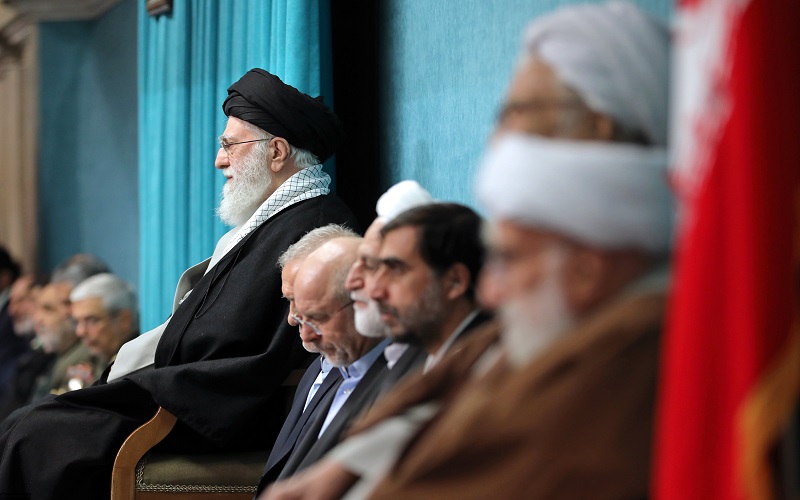

The recent statement by Iran regime’s Supreme Leader, Ali Khamenei, asserting that he does not interfere in the government’s economic planning, has sparked widespread reactions.
This declaration stands in stark contrast to his extensive history of direct involvement in economic decisions—ranging from banning South Korean household appliance imports to implementing adventurous, sanctions-inducing policies. At a time when the country’s economy is nearing bankruptcy, Khamenei appears to be distancing himself from the crisis, attempting to absolve himself of responsibility.
Contradictions in Khamenei’s Statement
Khamenei’s claim contradicts his well-documented authority over both macroeconomic and microeconomic policies. In a recent meeting, he stated:
“Some people have solutions; they write to me and suggest them. Well, the Leader does not interfere in economic planning; that is, he does not have the right to interfere. This is one of the duties of the government. The government must do this.”
However, under Iran regime’s political structure, the responsibility for defining and communicating the country’s general policies lies squarely with Khamenei. His directives serve as the foundation for government policies and economic plans.
During the presidential elections, Iran’s current president, Masoud Pezeshkian, emphasized that macroeconomic policies were already defined, and his role was merely to implement the guidelines set forth by Khamenei and the Seventh Development Plan.
This document, which requires Khamenei’s approval, further underscores that he holds the final say in economic decision-making. The Expediency Discernment Council is mandated to ensure that all government plans align with Khamenei’s policies, further solidifying his influence.
Expanding Khamenei’s Economic Authority
Khamenei has expanded his control over economic planning by requiring the parliament to submit bills and plans to the Expediency Discernment Council before they are reviewed.
This procedural change enhances his authority in shaping economic policy. Furthermore, he has granted unprecedented powers to the Supreme Council of Economic Coordination, effectively stripping other constitutional institutions of their ability to monitor and oversee the sale and transfer of government assets.
His influence extends to international negotiations as well. Khamenei has played a decisive role in discussions about lifting sanctions and approving the remaining Financial Action Task Force (FATF) bills—measures crucial for improving Iran’s economic indicators, including economic growth, inflation control, and liquidity reduction.
The Economic Power of Institutions Under Khamenei’s Supervision
Experts have consistently argued that effective economic planning in Iran is impossible without lifting sanctions and increasing foreign investment. Yet another factor that contradicts Khamenei’s claim of non-interference is the extensive economic power wielded by institutions under his direct supervision. These monopolistic entities dominate Iran’s economy while remaining opaque and unaccountable.
Organizations such as the Execution of Imam Khomeini’s Order (EIKO), the economic branches of the Islamic Revolutionary Guard Corps (IRGC), the Khatam al-Anbiya Headquarters, the Mostazafan Foundation, and Astan Quds Razavi control vast economic assets.
Analysts estimate that these entities collectively account for over 65% of Iran’s economy. Additionally, institutions like the Endowment and Charity Organization and the Islamic Development Organization oversee significant economic activities and real estate, all under Khamenei’s direct supervision.
Beyond these entities, the National Development Fund, Iran’s primary foreign exchange reserve, is also under Khamenei’s control. Governments must seek his approval for any withdrawals, a practice not outlined in the constitution or the fund’s official statutes.
Khamenei’s Role in Budget and Economic Policies
Khamenei has, on multiple occasions, called for reforms in Iran’s budget structure. Combined with the budget allocations to institutions under his control, this further highlights his deep involvement in economic planning. His claim of non-interference contradicts his direct influence over financial matters.
An Attempt to Evade Responsibility
Considering these facts, Khamenei’s recent statement appears to be a strategic attempt to distance himself from the country’s worsening economic crisis. With inflation soaring and prices skyrocketing, public dissatisfaction with the regime is at an all-time high. Rather than accepting responsibility, Khamenei is shifting blame to the government, portraying the economic downturn as a result of inadequate adherence to his directives.
Ultimately, the economic crisis in Iran is largely attributable to the dominance of government-affiliated cartels controlled by Khamenei. His attempt to absolve himself of responsibility is unlikely to convince a public that has long witnessed his extensive influence over the country’s economic trajectory.