


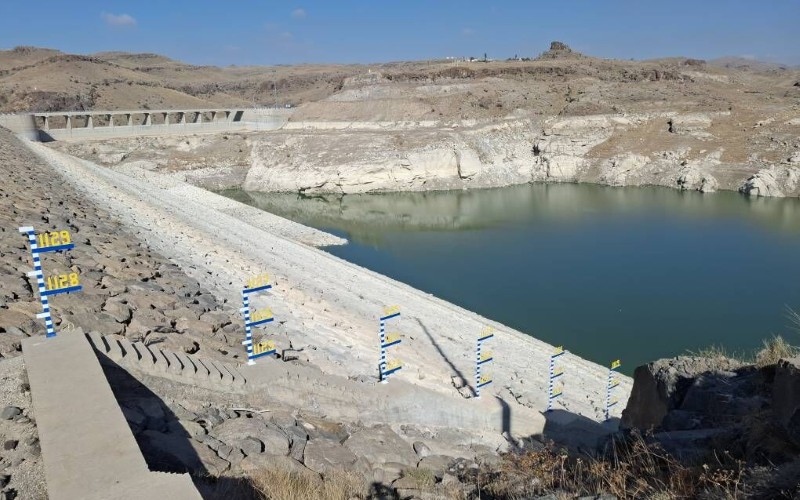

Official data shows dam inflows and reserves collapsing nationwide, exposing years of regime mismanagement as Iran enters another high-risk water year.
As heavy snowfall and seasonal rainfall sweep across several provinces in Iran, official data once again contradicts regime narratives that portray precipitation as a solution to the country’s chronic water crisis. The latest figures reveal that Iran’s water resources remain in a fragile and alarming condition, underscoring years of structural mismanagement, short-sighted policies, and systemic neglect by the ruling establishment.
Contrary to public expectations that autumn rainfall would quickly replenish depleted reservoirs, water inflows into Iran’s dams during the current fall season have not only failed to recover but have dropped significantly compared to last year—raising serious questions about the regime’s water governance and long-term planning.
According to official statistics, from the beginning of the water year in late September through December 20, total inflow into the country’s dams reached just 4.09 billion cubic meters. This represents a 19 percent decline compared to the 5.04 billion cubic meters recorded during the same period last year. Even episodes of intense rainfall have been insufficient to offset the accumulated deficit created by years of drought, over-extraction, and policy failure.
Reservoir Levels Collapse Despite Seasonal Rainfall
This decline in inflow has directly translated into shrinking reservoir volumes. By the end of autumn, the total storage of Iran’s dams was estimated to be 22 percent lower than at the same point in 2023. While dam reserves stood at 22.53 billion cubic meters at the end of last autumn, current levels fall far short of that benchmark.
As Iran enters winter, total stored water across the country’s dams stands at just 17.46 billion cubic meters—meaning only 34 percent of total reservoir capacity is filled, while 66 percent remains empty. This imbalance serves as a stark warning ahead of the spring and summer months, when water demand for both households and agriculture reaches its annual peak.
Tehran on the Brink
Nowhere is the regime’s failure more visible than in Tehran. Data from the capital’s water-supply dams shows that conditions remain firmly entrenched in crisis mode, with no signs of sustainable recovery.
The Karaj Dam, one of Tehran’s primary sources of drinking water, currently holds a mere 7 million cubic meters of water. At the same time last year, its reserves stood at 58 million cubic meters—a catastrophic annual decline of 51 million cubic meters that alone illustrates the severity of the crisis.
A similar situation is unfolding at Latian Dam, which now holds only 7 million cubic meters, leaving more than 92 percent of its capacity empty. This compares to 22 million cubic meters during the same period last year. Other key dams supplying Tehran—Taleghan, Mamloo, and Lar—are also facing steep declines, with reductions of 108, 16, and 12 million cubic meters, respectively.
Collectively, these figures paint a bleak picture of Tehran’s surface water resources and expose the regime’s inability to secure long-term water stability for a city of more than ten million people.
Emergency Measures Mask Structural Failure
One of the most alarming indicators is that water outflows from Tehran’s dams continue to exceed inflows, even after recent rainfall. This imbalance shows that short-term weather events cannot reverse a crisis rooted in decades of poor planning.
Regime officials point to a reported 12 percent reduction in household consumption, leak-detection projects, and the installation of water-saving devices as evidence of action. In reality, these measures have merely delayed system collapse rather than addressing the underlying causes. They prevent some dams from being taken offline, but they do not resolve the structural depletion of resources.
Mohsen Ardakani, CEO of Tehran Province’s Water and Wastewater Company, has acknowledged that Iran is now in its sixth consecutive year of drought. He stated that supplying 16,382 liters per second from groundwater—through emergency well drilling and rehabilitation—has helped maintain limited network stability. However, the regime’s continued reliance on groundwater extraction is itself a major driver of land subsidence and long-term environmental damage.
A Nationwide Crisis, Not a Local Exception
The water crisis extends far beyond Tehran. According to the Office of Basic Water Resources Studies, from the beginning of the water year through December 20, storage levels have declined in 57 of Iran’s 64 major dams. Only seven have seen any increase.
In Hormozgan Province, the Shamil and Nian dams have suffered a 100 percent decline in reserves compared to last year. Sefidrud Dam in Gilan has recorded a 77 percent drop. While recent flooding in Hormozgan may provide temporary relief, its effects have yet to appear in official data and offer no long-term solution.
In Razavi Khorasan, Doosti Dam and Torogh Dam have lost 82 percent and 53 percent of their reserves, respectively. Dams such as Karkheh, Esteghlal, Delvari, Taham, Nesa, Rudbal-e-Darab, and Nahrein have all experienced storage declines exceeding 50 percent compared to last year.
The heavily politicized Zayandeh-Rud Dam remains in dire condition, holding just 113 million cubic meters—only 9 percent of its capacity and 31 percent less than last year. Even heavy snowfall in recent days is unlikely to reverse this trend in any sustainable way, according to water experts.
A Crisis of Governance, Not Nature
The regime consistently attributes Iran’s water crisis to drought and climate conditions. However, the data tells a different story—one of reckless dam construction, uncontrolled groundwater extraction, misallocation of water to regime-linked industries, and the absence of transparent, science-based planning.
As reservoirs continue to empty and officials offer recycled reassurances, Iran’s water crisis stands as yet another example of how systemic mismanagement under the Islamic Republic has turned natural stress into national emergency—placing millions of citizens at risk in the months ahead.