


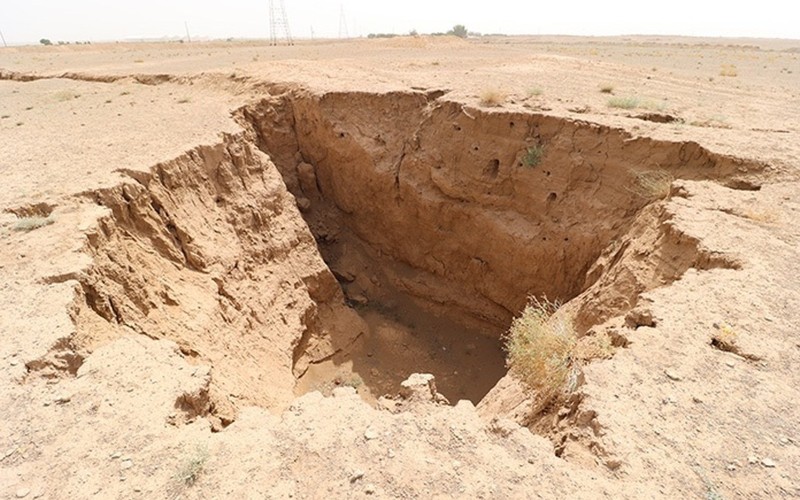

Officials admit parts of Tehran and major provinces are sinking at rates up to ten times global warning levels, with experts warning of a “silent earthquake.”
Classified Report Exposes Dangerous Levels of Land Subsidence
The head of Iran’s National Cartography Organization has confirmed the existence of a classified “Atlas of Land Subsidence in Iran,” a report detailing alarming levels of ground sinking across the country. According to officials, some figures are so severe that municipal authorities in Tehran have described them as “terrifying.”
Eskandar Seidayi, speaking to Mehr News on August 31, revealed that the highest subsidence rates are recorded in Bahreman Plain in Kerman Province at 31 centimeters, and in certain areas of Tehran at nearly 30 centimeters per year.
By comparison, international standards regard subsidence of more than 3 centimeters annually as a critical warning threshold. This means Iran’s sinking land levels are exceeding global danger levels by up to ten times.
Experts warn that such figures pose a grave threat to national infrastructure, urban development, and even cultural heritage sites.
Secrecy and Denial Amid Escalating Risks
While acknowledging the scale of the disaster, Seidayi declined to explain why the data has been classified. He stated only that the findings were being shared with government bodies in “confidential reports, correspondence, and files with full transparency in quantity and quality.”
The organization attributes the subsidence to over-extraction of groundwater, warning that if the practice continues, buildings, energy transmission lines, and historic monuments could face irreversible damage.
“Subsidence has no instant solution,” Seidayi stressed. “The only sustainable remedy is to stop excessive withdrawal of underground water.”
Tehran and Other Provinces Under Severe Strain
Officials acknowledge that Tehran, along with major cities such as Isfahan and Tabriz, faces acute subsidence. In Tehran, where data has been concealed, city council member Mohammad Aghamiri admitted on August 28:
“The subsidence figures for Tehran are classified, and I cannot disclose them. What I can say is that they are terrifying.”
He cited one example in District 18 of Tehran, where overuse of aquifers has caused 20 centimeters of annual sinking.
The situation is worsened by water shortages, which have led to widespread tree die-offs in city streets, further destabilizing the urban environment.
A “Silent Earthquake” Threatening National Security
In 2022, Tehran’s then-head of municipal environmental affairs, Heliasadat Hosseini, declared Tehran the world’s subsidence capital, labeling the phenomenon a “silent earthquake” and “the cancer of the earth.”
Multiple provinces—including Tehran, Alborz, Fars, Kerman, Hamedan, Semnan, Qazvin, Razavi Khorasan, North Khorasan, and Yazd—are officially categorized as being in crisis. Among them, Isfahan remains one of the most vulnerable regions.
The previous head of the National Cartography Organization, Ali Javedaneh, had already warned that land subsidence was advancing into urban areas and infrastructure, describing it as a “time bomb” threatening the country.
Growing Fears Over Regime’s Silence
Despite the mounting evidence and warnings, the Iranian regime authorities continue to classify crucial information rather than openly addressing the crisis. Experts and local officials warn that without decisive action, land subsidence could become one of the most severe threats to Iran’s future—undermining cities, crippling infrastructure, and endangering millions of lives.