


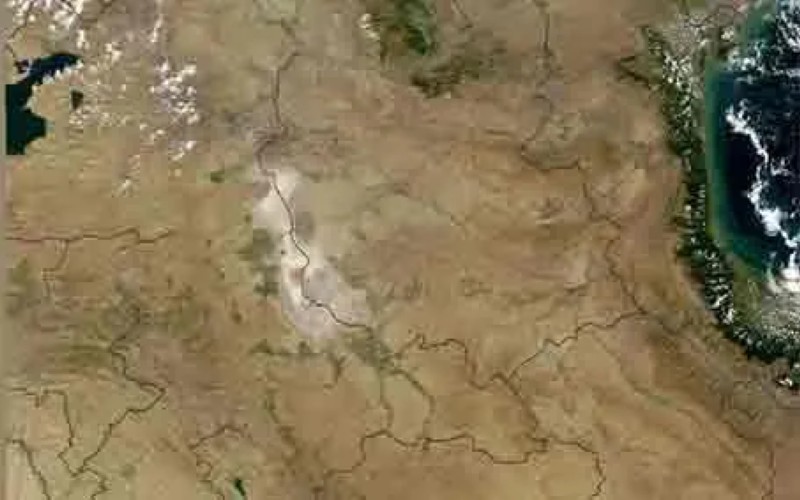

Mismanagement, corruption, and destructive water policies have dried up Lake Urmia, destabilized ecosystems, and created an environmental and social catastrophe.
A Civilization Undermined by Mismanagement
Iran, home to one of the world’s oldest civilizations, is facing a severe collapse rooted in a man-made water crisis. For millennia, its survival in deserts and mountains was sustained through intelligent resource management. Today, however, decades of destructive policies driven by corruption, short-term interests, and the so-called “water mafia” have devastated the nation’s vital resources and endangered its cultural heritage.
Lake Urmia, once the largest saltwater lake in the Middle East and a jewel of northwest Iran, has now completely dried up. Recent satellite imagery from NASA shows no trace of water, confirming the lake’s disappearance. Experts attribute this collapse directly to regime mismanagement and reckless decision-making, sacrificing the future for temporary political and economic gains.
The Roots of the Water Crisis
Iran’s crisis reflects a sharp contradiction between rising urbanization and the collapse of water availability. With agriculture consuming around 90% of national water, mismanagement has amplified the disaster. Outdated irrigation, inappropriate crop choices, excessive groundwater extraction, and unregulated dam construction have depleted reserves and accelerated land subsidence, threatening both rural and urban infrastructure.
Deforestation and overgrazing have reduced natural water retention, while climate change has compounded the problem by disrupting rainfall and raising temperatures. Yet, experts stress that human mismanagement, not nature alone, is the decisive factor.
Lake Urmia: A Symbol of Disaster
Lake Urmia illustrates how corruption and failed policies have destroyed ecosystems. Decades of damming, digging thousands of illegal wells, and transferring water to other provinces slowly strangled the lake. Shifts in agriculture—away from traditional low-water crops like grapes and barley toward water-intensive apples and sugar beets—exacerbated the crisis.
Former regime agriculture minister Issa Kalantari warned that Iran’s natural resources had not faced such extreme pressure in 7,000 years. He highlighted the devastating impact of short-term policies, which left millions of tons of salt accumulating in farmland and rendered once-fertile soils barren. Between 1979 and 2013, cultivated land in the Urmia basin nearly doubled, with much of the expansion consuming the lake’s allocated water.
The shutdown of industries like Pakdis, which once absorbed grapes for winemaking, pushed farmers toward high-water crops. Driven by immediate profits and absent long-term planning, these choices sealed the fate of the lake.
Broken Promises and Failed Restoration
Efforts to reverse the crisis have consistently failed. During Rouhani’s administration, the regime launched the “Lake Urmia Restoration Headquarters,” which proposed reducing cultivation by 50,000 hectares annually and compensating farmers. But under pressure from local representatives and vested interests, the plan collapsed. Subsequent governments abandoned restoration altogether.
Kalantari has repeatedly warned that Lake Urmia is nearing “death.” Its disappearance will generate salt storms over a 100-kilometer radius, threatening six million lives, damaging agriculture, spreading disease, and even destroying honeybee populations vital for pollination.
Unlike other lakes such as Jazmourian and Gavkhouni, Urmia’s location near dense populations amplifies its destructive impact, creating a regional and international crisis.
A Domino Effect of Catastrophes
The collapse of Lake Urmia is only part of a broader pattern. Zayandeh Rud, Gavkhouni, and other key water bodies have suffered similar fates, placing Iran in the category of “extreme water stress.” Officials warn that rainfall may decline by 40% in the coming years, rendering even water-tanker supply impossible for many towns.
The chain reaction is clear: reduced agricultural production, rising food inflation, declining hydroelectric power, mass rural-to-urban migration, and escalating social unrest. Already, satellite images confirm salt storms sweeping across Urmia’s basin, endangering health and livelihoods.
A Civilization in Peril
Ultimately, the water crisis represents more than an ecological failure—it signals the collapse of a 7,000-year-old civilization that once thrived on balance with nature. Lake Urmia, now reduced to history, stands as a monument to how corruption, mismanagement, and authoritarian rule have destroyed Iran’s natural heritage.
Kalantari’s warning of “unprecedented pressure” underscores a disaster that is dismantling Iran’s environment, society, and economy. Experts argue that under the rule of absolute clerical power, the regime has not only broken the natural balance but has also condemned millions of Iranians to poverty, displacement, and despair.