


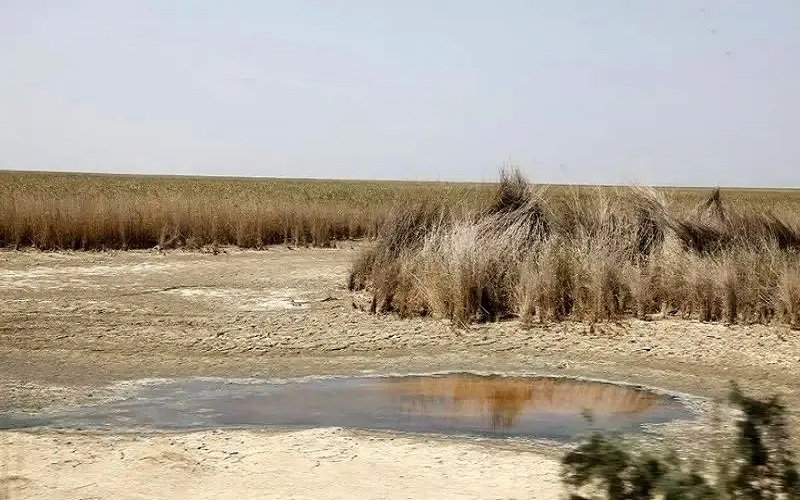

The Fars News Agency, affiliated with Iran’s Islamic Revolutionary Guard Corps (IRGC), reported on Wednesday, September 18, the complete drying up of nine wetlands across Iran due to extreme heat. Citing “record-breaking air temperatures” in many parts of the country, particularly in the eastern, southeastern, and central regions, the agency claimed that these wetland losses occurred during the summer season.
According to the report, wetlands such as Anzali, Bamdej, Hamun, Jaz Murian, Tashk, Bakhtegan, Gavkhouni, Maharloo, Hoz-e Sultan, Shimbar, and Namak Lake have dried up in recent months. Forecasts suggest this trend is expected to continue into the fall.
However, the IRGC-linked media placed the blame solely on unprecedented heat and a lack of rainfall, avoiding any mention of poor water management. Despite this narrative, environmental experts argue that the drying of Iran’s wetlands is largely due to ineffective governance and a lack of comprehensive watershed management strategies.
Sheena Ansari, the head of Iran’s Environmental Protection Organization, previously acknowledged that the lack of sufficient water resources has contributed to the drying up of these critical ecosystems. According to Ansari, over 40% of the country’s wetlands have already become sources of dust, worsening the environmental crisis.
Iran has 25 wetlands registered under the Ramsar Convention, but joint research conducted by Tehran University and the Science and Technology University on 20 of these wetlands reveals that their water levels have decreased by 60% over the past four decades. This degradation has caused an estimated annual economic loss of around one billion dollars.
Additionally, data from Iran’s Natural Resources and Watershed Management Organization show that one million hectares of land are being converted into desert each year. Alarmingly, 90 million hectares of Iran’s lands now require watershed operations to prevent further degradation.
Vahid Jafarian, Director General of the Office of Desert Affairs at the Forests, Rangelands, and Watershed Management Organization, has warned that of the 30 million hectares affected by wind erosion, approximately 13.5 million hectares—encompassing vital infrastructure like roads, factories, airports, farmlands, and villages—are now classified as “crisis zones.” Desertification and dust storms are wreaking havoc on Iran’s infrastructure, causing an estimated three trillion tomans in damages annually.
While regime and state-controlled media continue to attribute the drying of wetlands and desertification to natural causes like extreme heat and low rainfall, experts maintain that poor management of water resources and the failure to implement sustainable watershed practices are at the heart of Iran’s growing environmental crisis.