


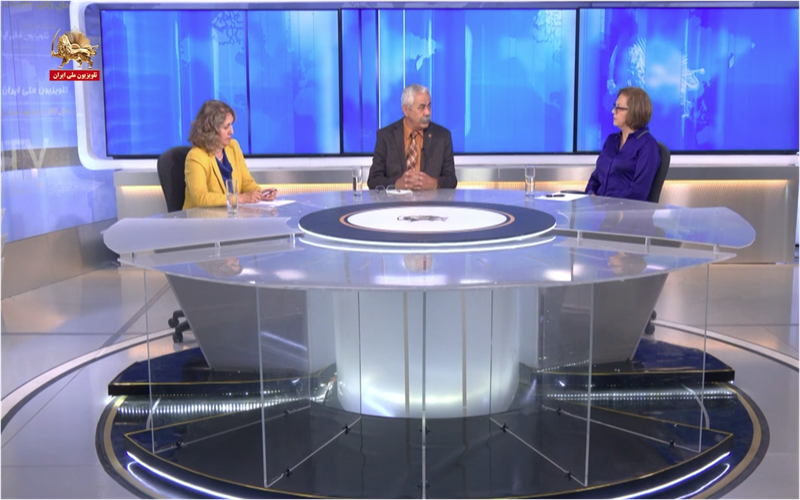

Former political prisoners recount the torture, executions, and extraordinary resistance they witnessed in Iran’s prisons during the 1980s.
The testimonies of former political prisoners offer a firsthand account of the systematic repression that took place in Iran’s prisons during the 1980s. Speaking on Iran National Television (INTV), former prisoners Mina Entzari, Shila Ninavaei, and Amir Borjkhani recalled years spent in Evin, Qezel Hesar, and Gohardasht prisons, describing torture, executions, overcrowding, and the resistance of prisoners who refused to surrender.
Their accounts also show that the brutality inside the prisons was accompanied by a determination among political prisoners to preserve their dignity and beliefs.
A 15-Year-Old’s First Night in Evin
Shila Ninavaei was only 15 when she was arrested in November 1981. She spent several years in prison, including periods in Evin, Qezel Hesar, and the Joint Committee detention center.
She recalled that arrests were exceptionally widespread when she first arrived at Evin.
“When we entered the courtyard of Evin, arrests were extremely widespread,” Ninavaei said. “The interrogators and executioners were congratulating each other, saying that we had all come back with our hands full.”
The scale of the arrests was so large that she remained waiting for hours before anyone even began questioning her.
But it was the sounds coming from the interrogation rooms that remained permanently etched in her memory.
“The sound of the whip was mixed with the screams of prisoners being tortured,” she recalled. “The smell of blood filled the entire corridor.”
She heard prisoners crying out for help while being beaten. For a teenager who had just entered prison, the experience was overwhelming.
Yet that same night she witnessed something else: the resistance of prisoners.
A severely tortured prisoner lying beside her showed her his swollen, bandaged and bloodied feet. When she asked whether the torture had been painful, he replied that the pain would eventually pass.
Ninavaei later heard another prisoner describe a similar encounter. A tortured detainee had told him: “The pain of the whip lasts two days, and then it is your honor that remains.”
According to Ninavaei, that prisoner was executed the following day after enduring torture.
“The Brutality Was Beyond Human Endurance, but So Was the Resistance”
Amir Borjkhani was arrested in 1982 and spent approximately nine years in the regime’s prisons, including Evin, Qezel Hesar, and Gohardasht.
He said that political imprisonment had become an integral part of the regime’s response to organized opposition following the 1979 revolution and the June 1981 crackdown.
“When I entered Evin, the scenes were exactly as Shila described,” Borjkhani said. “Although the regime’s brutality was beyond human endurance, the resistance was equally beyond what one could imagine.”
He emphasized that this resistance was not limited to the early years.
“We saw these things with our own eyes,” he said. “Throughout all the years that I was in prison, this oppression, torture, and brutality never ended—and it continues today.”
Borjkhani pointed to political prisoners who have endured years and even decades of imprisonment as evidence that the struggle has continued despite repression.
He also recalled the courage of prisoners immediately after torture.
“One woman had apparently been beaten throughout the morning,” he said. “They brought her outside the interrogation room and left her there. The interrogator was exhausted and was cursing at her. But despite everything they had done to her, she remained defiant.”
Although the prisoners were blindfolded and could not see one another, he said, her manner conveyed extraordinary strength.
“She looked as though she had come back from a place of rest,” Borjkhani recalled.
From Torture to the 1988 Massacre
The former prisoners emphasized that what they witnessed in Evin and Qezel Hesar was part of a broader pattern that ultimately culminated in the mass execution of political prisoners in the summer of 1988.
Borjkhani said that the years of torture and repression prepared the ground for what became one of the darkest episodes in the history of Iran’s prisons.
The testimony of former prisoners is consistent with other documented accounts of the 1988 massacre, including evidence of systematic interrogation, separation of prisoners according to political affiliation, and executions in Evin and Gohardasht.
For those who survived, however, the memory of prison is defined by two realities that existed side by side: the regime’s systematic brutality and the determination of prisoners to resist it.
As Ninavaei’s testimony makes clear, even inside the interrogation corridors of Evin, where the sound of torture filled the air, prisoners sought to pass courage from one generation to another.
Their memories remain an essential part of documenting Iran’s history of political repression—and of preserving the voices of those who endured it.