As the regime escalates executions of protest-linked detainees, a wave of retaliatory unrest signals that repression is intensifying resistance rather than containing it.
The ink had barely dried on reports of the execution of Sasan Azadvar—referred to by supporters as the “hero of Isfahan”—when, in the early hours of May 3, Iran regime’s judiciary carried out another execution. Mehrab Abdollahzadeh, a young man associated with the 2022 uprising, was hanged in Urmia Prison.
By May 4, the pattern had repeated itself. Authorities once again executed individuals linked to protests—this time connected to the January 2026 unrest—underscoring what appears to be an accelerating campaign of capital punishment targeting dissent.
According to judiciary-affiliated media, three more individuals—Mehdi Rasouli, Mohammadreza Miri, and Ebrahim Dowlatabadi—were executed on charges related to the deaths of Basij militia members in Mashhad. State sources claimed that Rasouli and Miri were involved in “violent acts” in January 2026 and played a direct role in the killing of a Basij member identified as Hamidreza Yousefinejad. Dowlatabadi, meanwhile, was described as a “main leader of unrest” in the Tabarsi district, allegedly linked to the deaths of several Basij forces.
These executions come at a moment of heightened political fragility. The regime—facing sustained unrest and fearing renewed nationwide protests—appears to be relying on executions as a deterrence mechanism. Yet the immediate aftermath suggests the opposite effect: rather than suppressing dissent, the executions are triggering a new phase of confrontation.
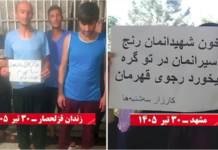
Reports indicate that protest-linked groups and networks have responded with coordinated acts of defiance across multiple cities. These actions have included attacks on symbols and facilities associated with the state’s security and ideological apparatus.
In Dezful, an explosion reportedly targeted a religious-propaganda center. In Ahvaz, a Basij-affiliated educational facility was attacked. Similar incidents were reported in Kermanshah, Buin Zahra, and Hamedan, where Basij bases linked to the Islamic Revolutionary Guard Corps (IRGC) were set on fire.
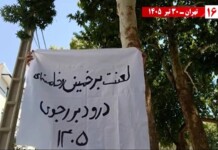
Additional acts of symbolic resistance were reported in Kerman, where images associated with Supreme Leader Ali Khamenei were burned, and in Hafshejan (Chaharmahal and Bakhtiari province), where a banner bearing Ruhollah Khomeini’s image was set ablaze. In Cheram (Kohgiluyeh and Boyer-Ahmad province), individuals reportedly destroyed signage linked to a Basij intelligence office.
These developments point to a widening cycle: executions followed by retaliatory unrest, which in turn may provoke further crackdowns. The regime has attempted to control the narrative and the environment—reportedly through internet restrictions and heightened street-level security—but these measures have not prevented the spread of unrest.
What is emerging is not merely a sequence of isolated incidents, but a structural dynamic. The state’s reliance on capital punishment as a tool of political control is increasingly met with decentralized, often symbolic, acts of resistance. For many participants, these actions are framed not only as retaliation, but as a continuation of a broader struggle.
The messaging accompanying these acts reflects this shift. Slogans circulating among protesters emphasize retribution and continuity, framing executed individuals as symbols of resistance rather than deterrents. In this framing, executions do not close chapters—they open new ones.
From a strategic standpoint, the situation raises critical questions about the efficacy of repression in the current Iranian context. While executions may impose immediate costs on opposition networks, they also appear to generate mobilizing narratives that sustain and even expand dissent.
The geographical spread of recent incidents—from Ahvaz to Dezful, and from Kermanshah to Hamedan—suggests that unrest is not confined to a single region but is instead diffused across multiple regions with varying social and political dynamics.
Ultimately, the current trajectory indicates a deepening crisis of governance. The state’s tools of repression remain intact, but their political returns appear to be diminishing. At the same time, opposition dynamics are becoming more adaptive, decentralized, and symbolically charged.
If this pattern persists, Iran is likely entering a phase of sustained and intensifying confrontation in which the regime’s reliance on executions and coercion further erodes its authority, while fueling broader and more determined resistance. Recent reports already indicate a sharp rise in executions and mass arrests linked to protests, drawing international condemnation and reinforcing the perception that repression is deepening instability rather than restoring control.