The executions of Pouya Ghobadi and Babak Alipour expose escalating state violence and intensify calls for international accountability
Contemporary Iranian political history has once again entered a dark yet defining chapter. The execution of two political prisoners, Pouya Ghobadi and Babak Alipour, in the early days of the Iranian year 1405 (March 2026), reflects the continuation of a longstanding struggle between the will for freedom and the machinery of state repression.
This tragic development underscores not only the continuation of systemic violence within the ruling establishment, but also the persistence of resistance rooted in awareness and sacrifice.
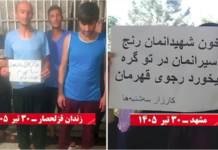
These executions follow earlier hangings carried out on March 30, 2026, when two other political prisoners, Mohammad Taqavi and Akbar Daneshvar Kar, were executed in Ghezel Hesar Prison.
Rather than demonstrating strength, this wave of executions reveals a deepening crisis of legitimacy and growing fear within the regime—particularly in response to the expansion of organized resistance networks and dissent among educated segments of society.
Pouya Ghobadi, a 33-year-old electrical engineer, and Babak Alipour, a 34-year-old law graduate, represented a generation that consciously chose resistance despite professional opportunities and social standing.
The charges brought against them—such as “armed activity” and “acting against national security”—reflect a politicized judicial framework in which legitimate demands for sovereignty and freedom are reframed as existential threats. In such a system, even peaceful dissent is treated as a security challenge.
Notably, references by judiciary-affiliated media to Babak Alipour’s family background and his father’s political activities in the 1980s inadvertently highlight the historical continuity of this struggle. Contrary to official claims that opposition movements have been eradicated, the ideals of resistance have been passed from one generation to the next, now embodied by young individuals unwilling to submit to repression.
Pouya Ghobadi, who had been arrested twice prior to his final detention in March 2024, symbolized this continuity. His reported slogan—“we stand until the end”—captured the regime’s ideological deadlock. Both he and Alipour, in their final communications from Evin and Fashafuyeh prisons, reaffirmed their commitment to those executed before them, including Behrouz Ehsani and Mehdi Hassani. These acts of defiance demonstrate that imprisonment, rather than silencing dissent, has served as a platform for strengthening political conviction.
The international coverage of these executions has been significant. Reporting by major outlets such as Reuters, Associated Press, and The Washington Post, along with prior warnings from Amnesty International about unfair trials conducted under torture, reflects growing global awareness. Yet a critical question remains: are statements of concern and documentation of abuses sufficient in the face of systematic executions?
Iranian opposition groups have repeatedly called on international bodies, including the Office of the UN High Commissioner for Human Rights and the UN Human Rights Council, to take decisive action. However, limited and largely symbolic responses from the international community have, in practice, emboldened authorities to continue such repressive measures with minimal consequence.
The executions of Pouya Ghobadi and Babak Alipour should not be viewed as isolated judicial acts, but as part of a broader strategy aimed at suppressing dissent through fear. At the same time, they have intensified calls for a shift from rhetorical condemnation to concrete measures—such as accountability mechanisms and targeted sanctions—against those responsible for potential crimes against humanity.
Both men reportedly approached execution with remarkable resolve, reinforcing the idea that the right to life is inseparable from the right to freedom. Their deaths, while intended to intimidate, may instead contribute to further mobilization within Iranian society.
Images said to show the two prisoners smiling during Nowruz 1404 inside Evin Prison have circulated widely, offering a powerful counter-narrative to state repression. Rather than demonstrating control, such images suggest a deeper moral and psychological failure on the part of the authorities.
Ultimately, the legacy of Pouya Ghobadi and Babak Alipour is likely to endure beyond their execution. Their names join a growing list of individuals whose sacrifices continue to shape the trajectory of resistance in Iran—serving both as symbols of defiance and as catalysts for future change.