


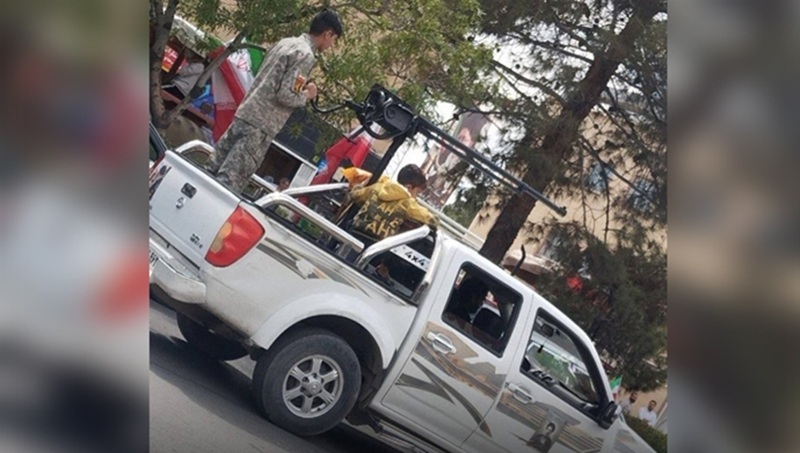

Lowering the age of patrol participation to 12 exposes a long-standing policy of exploiting children for repression and regime preservation
On March 26, a senior cultural official of the Islamic Revolutionary Guard Corps (IRGC) announced a deeply alarming policy shift: the minimum age for participation in patrol units has been reduced to 12. Shortly thereafter, reports emerged of an 11-year-old boy killed at a checkpoint—an incident that has intensified scrutiny over the regime’s use of minors in security operations.
The contradiction is stark. In a system where individuals under 18 are legally barred from basic civic responsibilities such as obtaining a driver’s license, children are now being deployed in high-risk military and paramilitary roles. The death of the 11-year-old underscores the human cost of this policy.
According to the child’s mother, speaking to the state-run newspaper Hamshahri, the tragedy was the result of severe personnel shortages. She explained that on the night of the incident, the boy’s father—unable to meet operational demands—took his son with him to a checkpoint. This admission provides rare insight into the structural deficiencies driving the regime’s reliance on child recruits.
International human rights organizations have condemned the practice unequivocally. Amnesty International and other advocacy groups have denounced the use of children in repression. Bill Van Esveld, director of children’s rights at Human Rights Watch, stated that there is no justification for involving 12-year-olds in military or security activities, emphasizing that Iranian authorities are endangering children’s lives to offset manpower deficits.
However, this is not an isolated or recent development. The mobilization of children has been embedded in the ideological and operational framework of the Iranian regime since its inception. During the Iran–Iraq War, thousands of schoolchildren were sent to the frontlines, often under religious or ideological coercion.
Statements from senior regime figures over the years reflect this institutionalized approach. Ruhollah Khomeini declared that participation in war was a religious obligation regardless of parental consent. Ali Khamenei later praised the extension of a “culture of martyrdom” into schools, explicitly celebrating the presence of war ideology among even elementary students.
Former IRGC minister Mohsen Rafiqdoost acknowledged that in 1983, a majority—57 percent—of combatants in Operation Kheibar were students. Additional figures cited by IRGC-affiliated sources indicate that over 33,000 students were killed during the war.
These are not merely historical anomalies or legal violations—they point to a deliberate and enduring strategy. The use of children serves as a mechanism to compensate for manpower shortages while simultaneously targeting a generation perceived as resistant to ideological conformity.
By pulling minors into security and military roles, the regime is not only risking their lives but also undermining the social fabric and future stability of the country. These children are not participants by choice; they are casualties of a system that prioritizes survival over fundamental human rights.
At a structural level, this policy reflects a regime under pressure—one that increasingly relies on coercive and unsustainable measures to maintain control. The deployment of children into such roles is not just a humanitarian crisis; it is indicative of deeper institutional fragility.
The image that emerges is both tragic and revealing: a system consuming its own future in a bid to prolong its present.