


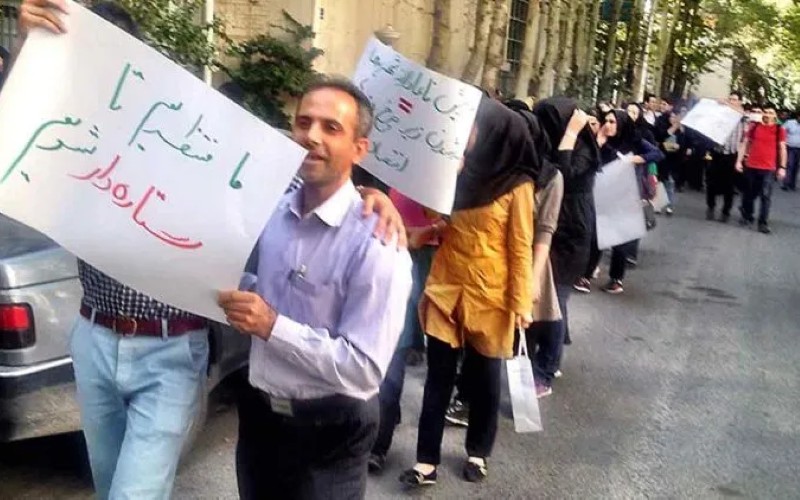

Despite claims of reform, thousands of Iranian students remain suspended, expelled, or under psychological pressure amid growing reports of suspicious deaths
For nearly three years, Iranian universities have been subjected to an escalating campaign of repression targeting politically active students. The term “starred students,” assigned by the regime to identify and punish student activists, has become emblematic of the system’s tightening grip over academic spaces. Since 2022, more than five thousand students have faced disciplinary rulings, expulsions, and bans from education, and the situation has only deteriorated under the Pezeshkian government.
From autumn 2022 to the end of summer 2024, university disciplinary committees registered over 5,200 official cases against active or protesting students. Human-rights groups believe the real number is far higher. Many students were permanently expelled, and many others were suspended for periods ranging from one to four semesters. Others lost academic years, were forced to relocate to remote campuses, or were subjected to financial penalties that made continuing their studies nearly impossible. These measures were accompanied by broader restrictions, including the denial of dormitory access and exclusion from key courses needed to complete their degrees.
The Pezeshkian administration repeatedly promised to mitigate the damage, but none of the disciplinary rulings were annulled, and lost academic years were not restored. Instead, a number of suspended students were issued temporary “return letters,” documents that carry no legal value and must be renewed each semester. Students continue to face the same administrative barriers and remain vulnerable to renewed expulsions at any moment. In practice, the disciplinary sentences remain fully active.
This pattern can be observed across major universities. At Khajeh Nasir al-Din Tusi University, student Sepehr Rathi completed a two-semester suspension only to confront a new barrier when administrators claimed his academic years had “expired.” Officials first dismissed the issue as a misunderstanding, then reframed the renewal of his years as a special favor. Students at Tehran University, Allameh Tabataba’i University, Sharif University, and Amirkabir University have reported similar experiences. Even those permitted to return to campus describe being denied dormitory accommodation, refused access to specialized courses, or prevented from completing degree requirements. Despite official claims of leniency, more than 70 percent of the heavy disciplinary sentences remain fully enforceable.
University disciplinary committees function under the direct guidance of security units and intelligence agencies. Students are not allowed legal representation, and there is no meaningful avenue for appeal. Rulings are often issued without clear justification. In his October 2025 report, the UN Special Rapporteur on Human Rights described these committees as tools of systematic deprivation of educational rights.
The continued enforcement of these rulings has taken a severe psychological toll. Starred students describe a daily reality shaped by constant fear, administrative uncertainty, financial pressure, and the possibility of permanent expulsion. This oppressive atmosphere has also coincided with a disturbing rise in suspicious student deaths, raising urgent questions about the conditions on Iranian campuses.
The death of Saba Fayegh, a puppet-theatre student, is one example that has shaken the academic community. Authorities labeled her death a suicide, but her friends strongly dispute this claim. They describe her as an energetic and cheerful person, making the official account difficult to believe. Several individuals who attended her funeral reported seeing marks on her body, creating widespread suspicion and fear among students. No clear explanation has been provided, leaving the community with grief and unanswered questions.
Another tragic case occurred on November 16, 2025, when Fatemeh Kamali, a master’s student of inorganic chemistry at Shiraz University, died in her dormitory. Students at the university immediately pointed to the intense pressures imposed by university security and administrative bodies, holding officials responsible for creating the conditions that led to her death. No transparent investigation has taken place.
These deaths are part of a broader pattern reflecting the severe psychological and social consequences of systematic repression. Students describe universities as environments shaped by surveillance, intimidation, and relentless pressure. Many say the campus environment resembles a controlled space designed to suppress dissent rather than a place of learning.
Until disciplinary rulings are revoked, academic years restored, and security-driven disciplinary committees dismantled, Iranian universities will continue to function as institutions of coercion. Thousands of young Iranians—punished simply for demanding freedom and justice—remain deprived or semi-deprived of their right to education, with long-term consequences for their careers, mental health, and lives. The growing number of suspicious deaths underlines the urgency of international attention to the situation of Iran’s starred students.