A national tragedy exposing the moral collapse of Iran’s ruling system
A Day That Exposed an Exceptional Reality
On January 11, 2026—the country was confronted not with a routine political crisis, but with a stark and exceptional reality. The announcement by the People’s Mojahedin Organization of Iran (PMOI/MEK) that more than 3,000 protesters had been killed in 195 cities was not merely a statistical disclosure. It revealed the terrifying scale of a rupture between a society and a ruling structure that now relies on mass death to sustain itself.
What unfolded in the cold, damp corridors of Kahrizak, on the outskirts of Tehran, and in front of grieving families searching for their loved ones, went far beyond private mourning. It marked a moment in which the right to life itself became collateral for the survival of a collapsing regime.
Bodies in Black Shrouds
Despite widespread internet disruptions and repeated nationwide shutdowns, images leaked from Kahrizak showed scenes that defy normalization. Rows of bodies wrapped in black plastic shrouds lined hallways and open areas—human beings stripped not only of civil rights, but even of the dignity of proper burial.
Political philosopher Giorgio Agamben described this condition as “bare life”: a state in which individuals are reduced to biological existence without legal or moral protection. Kahrizak has become a physical manifestation of this concept. Parents searching desperately among the shrouds were not only looking for their children; they were attempting to reclaim identities that the ruling system seeks to erase through silence and anonymity.
Kahrizak today is no longer merely a detention center or morgue. It has become a geography of crime, where the boundary between life and death is arbitrarily redrawn by security forces acting in the name of regime preservation.
Internet Blackouts as a Tool of Repression
The complete shutdown of the internet reveals another critical dimension of the crime. By severing communication links, the authorities attempt to create an information vacuum—a controlled darkness in which the true scale of the killings can be concealed.
This imposed silence is not a side effect of repression; it is an integral part of it. The goal is clear: to prevent the cries emerging from Kahrizak and the grief of families across 195 cities from reaching the global conscience.
Within this isolation, the regime has attempted to replace documented reality with fabricated narratives, including state media broadcasts that cynically display victims’ bodies while attributing their deaths to opposition forces. This inversion of truth represents not only political manipulation, but a profound moral degradation.
Accountability and the Horizon of Justice
Maryam Rajavi has described these events as “a major crime against humanity,” a characterization that carries precise legal implications. Under international law, systematic mass killing of civilians constitutes a crime that does not expire with time and is not subject to political negotiation.
The commitment of the Iranian Resistance to hold the planners and perpetrators accountable is not a rhetorical gesture. It is an effort to restore what has been violently damaged: the collective moral conscience of a nation.
The suffering concentrated today in Kahrizak has already transformed into a force for irreversible change. A society that identifies the bodies of its children in such conditions can no longer share any moral or political ground with a system built on crimes against humanity. National mourning is rapidly evolving into a determination to construct a new order—one in which human life is the foundation of dignity, not expendable material.
Mourning as an Act of Resistance
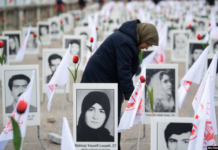
The presence of families at Kahrizak is not an expression of helplessness. It is a form of living testimony to the ethical collapse of a system that hides behind religious language while practicing organized brutality.
Iran has witnessed this pattern before: during the November 2019 massacre, the 1988 mass executions of political prisoners, and other episodes of state violence. History suggests that such crimes do not vanish into silence.
This one will not either.
Despite internet blackouts and concrete walls, truth has a persistent trajectory. The blood of more than 3,000 victims has not been buried in the ground—it has taken root in the collective awareness of a people who have decided not to turn back.
From this immense national grief, a determination is emerging: to build a democratic, accountable Iran, grounded in justice, human dignity, and the rule of law. Dictatorships rely on forgetting. Societies in resistance rely on memory—and Iran has chosen to remember.