


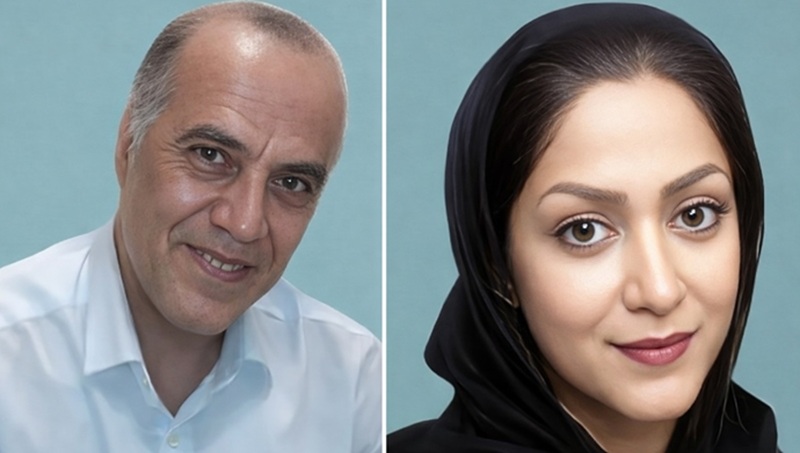

Shahrokh Daneshvar Kar, a political prisoner on death row in Qezel Hesar Prison, and Parisa Kamali from Yazd Prison warn of crimes against humanity, secret detentions, and escalating repression, while urging international action and steadfast resistance.
In February 2026, two political prisoners held in Iran’s prison system—one under a death sentence—issued powerful messages from behind bars, describing the regime’s repression, warning of escalating abuses, and expressing unwavering confidence in the ultimate victory of the Iranian people.
“The Main Earthquake Is Still Ahead”
From Qezel Hesar Prison, political prisoner Shahrokh Daneshvar Kar, currently under a death sentence, wrote that the nationwide uprising was neither spontaneous nor concluded.
“It had been completely clear for months that an uprising in Iran was on the way,” he stated. Referring to the January events, he described them as “only a pre-earthquake,” adding: “The main earthquake that will bring down the throne of Khamenei’s rule lies ahead of us and is inevitable.”
Daneshvar Kar accused the regime of attempting to manipulate and redirect the uprising after it had begun. According to him, once the movement gained momentum, certain actors sought to attach what was “entirely an internal uprising” to external forces in order to serve the interests of the ruling establishment.
Orders to Crush, Labels of “Terrorist”
He directly blamed Supreme Leader Ali Khamenei for ordering the crackdown.
“Khamenei, the executioner, ordered that the protesters be put in their place,” he wrote. “The repression apparatus labeled freedom-seeking people as ‘terrorists’ and, with full brutality, began killing, committing ‘crimes against humanity,’ and carrying out mass arrests.”
While images of shootings and street violence have circulated widely, Daneshvar Kar emphasized that many abuses remain hidden from public view.
“Young people and many citizens have been arrested, and there is no news or trace of them,” he warned, noting that detainees range “from minors under 18 to elderly women and men” now held in secret detention centers or official prisons.
Torture, Coerced Confessions, and Fabricated Cases
Drawing on his own experience within Iran’s judicial and security system, Daneshvar Kar described what he says is currently happening to arrested protesters.
He wrote of “brutal physical torture,” “false promises,” and “repeated threats by interrogators” aimed at breaking detainees psychologically. The purpose, he said, is clear: “All this pressure is solely aimed at extracting forced confessions and fabricating cases to justify unjust and baseless sentences.”
As a political prisoner facing execution, he appealed directly to the international community.
“I call on awakened consciences, human rights institutions and international bodies responsible for protecting human dignity and preventing human rights violations and genocide to move beyond verbal ‘condemnations’ and mere ‘expressions of concern’ and take concrete and decisive action.”
He urged immediate steps for the release of detainees, prison inspections, and accountability measures against the ruling authorities. “Even today is late,” he warned. “Many lives are in danger.”
Daneshvar Kar also addressed families of detainees, urging them not to succumb to threats or deceptive promises by intelligence agents and to publicize arrests and deaths “as quickly as possible and with details.”
“Remember,” he wrote, “the very foundation of solitary confinement is to cut the detainee off from the outside world so that they imagine there is no option but to believe the interrogators. With the silence of families, the hand of repression becomes freer and the solitary cell tighter.”
His message was dated February 2026 from Qezel Hesar Prison.
“We Are the Change We Have Been Waiting For”
In a separate message from Yazd Prison, political prisoner Parisa Kamali honored those killed in the struggle for freedom and expressed defiant hope.
“Greetings to the martyrs of the path of freedom and their families,” she began.
Reflecting on years of repression, she wrote: “For years we have mourned the absence of justice and freedom. But for our sisters and brothers—our daughters and sons—who gave their lives like butterflies on this path, we do not wail or despair. We take pride in them.”
Kamali declared that the struggle would continue until liberation.
“We will never let this flag fall to the ground until the day our homeland Iran is free,” she wrote. “We believe that this blood-stained path will end in victory, and that this blood will cleanse our homeland of these sinister criminals.”
In one of the most striking lines of her message, she affirmed collective responsibility and agency:
“We are exactly the ones we have been waiting for. We are the change we are seeking.”
Her message was issued on February 15, 2026 from Yazd Prison.
Together, these statements from inside Iran’s prison system depict a regime escalating repression in the face of unrest, while also revealing a resilient current of resistance among political prisoners. One warns of imminent danger and calls for urgent international intervention. The other affirms faith in a historic transformation driven by the people themselves.
Both converge on a single message: repression may intensify, but the demand for freedom endures.