


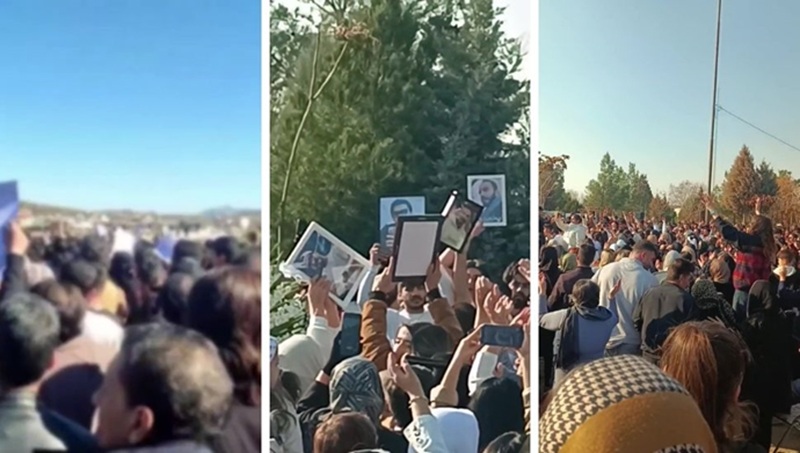

From Tehran to Abdanan, Protesters Honor Fallen Uprising Victims as Security Forces Open Fire and Impose Internet Blackouts
In recent days, cities across Iran have witnessed renewed waves of anti-regime protests marking the 40th day of the martyrs of the January uprising. Demonstrations spread from Tehran to Arak, Kazerun, Marvdasht, and Mamasani, culminating on February 16 with powerful chants of “Death to Khamenei” filling the streets of Abdanan in Ilam Province.
Despite internet shutdowns, heavy security deployments, and live fire by regime forces, the streets did not empty. Instead, the defiance intensified.
A Nationwide Echo of Resistance
The coordinated timing of these protests—aligned with the traditional 40-day mourning ceremonies—was no coincidence. In Iranian culture, the 40th day after a martyr’s death holds deep symbolic significance. This year, that tradition has transformed into a political statement.
Across multiple cities, demonstrators openly challenged the regime’s supreme leader, chanting slogans such as:
- “Death to Khamenei”
- “We did not give our lives for compromise, nor to praise a murderous leader”
- “By the blood of our comrades, we stand until the end”
- “For every one killed, a thousand will rise behind them”
In Abdanan, protesters returned to the streets for a second consecutive day. According to reports, units of the Islamic Revolutionary Guard Corps (IRGC) opened fire on unarmed civilians and youth. Yet the gatherings persisted.
At Tehran’s Behesht-e Zahra cemetery, young demonstrators assembled in small groups, invoking the names of the fallen and reiterating their commitment to continue the struggle. Their slogans rejected decades of repression and declared that tanks, bullets, and machine guns would no longer silence them.
Heavy Security in Mashhad and Beyond
In Mashhad, regime security forces and plainclothes agents reportedly sealed off Vakilabad Boulevard and surrounding neighborhoods from early morning. Nevertheless, protesters formed small clusters, merging into larger groups as the day progressed.
Similar chants were heard in Hashtgerd, Lahijan, and Najafabad in Isfahan Province, signaling that the unrest is not confined to isolated areas but reflects a broader national current.
The regime’s response—internet blackouts, armed patrols, and direct gunfire—underscores its concern over the momentum of these commemorations. Yet the repeated return of demonstrators to the streets indicates that fear barriers are breaking down.
“Courage Became Collective”: A Protester’s Account
A letter written by a young participant in the January uprising from Tehran offers a vivid account of how collective resistance has evolved.
He recalls the first night of protests, when two of his friends were shot—one wounded, the other killed. Returning home covered in blood—his own and that of his fallen companions—he realized that the streets had transformed into arenas of confrontation between unarmed citizens and a heavily armed state.
Despite his injuries, he could not remain at home. After witnessing such sacrifice, retreat felt like denial.
In another passage, he describes how solidarity reshaped the balance of power:
The streets taught them that strength does not lie solely in weapons, but in connection. When security forces charged, no one was left alone. Hands reached out, escape routes opened, doors unlocked. Strangers leaned on one another. If one person fell, several others lifted them up. Fear was individual, but courage was collective—and that collective courage forced the security forces to retreat.
According to this account, when people stand together, intimidation loses its effectiveness. Courage multiplies; fear becomes isolated.
A Message Flowing Across Iran
From Tehran to Marvdasht, from Kazerun to Abdanan, one message is resonating: the Iranian people are moving ahead of repression.
These protests suggest that the uprising is not a fleeting moment but an ongoing trajectory—sustained by each slogan, each gathering, and each act of defiance. As courage passes from hand to hand, the regime’s attempts to silence the streets appear increasingly ineffective.
What began as mourning has evolved into renewed mobilization. And as the chants continue to echo across cities, it is clear that the call for change remains alive.


