



How enforced silence enabled mass murder in Iran—and why accountability now demands the end of clerical rule
They closed the prison gates.
They cut the phones.
They shut down all channels of communication.
In that terrifying silence—absolute, deliberate, and total—more than 30,000 political prisoners were systematically executed in Iran. This was the massacre of the summer of 1988, one of the gravest crimes against humanity of the late twentieth century. Many of the victims were young men and women whose only “crime” was loyalty to freedom, dignity, and political belief.
The world did not hear their screams. Or worse, it heard—and chose to look away.
Families were never told where their loved ones were buried. To this day, many do not know which mass grave holds the remains of their children, siblings, or parents. Silence was not merely a byproduct of the crime; it was its central instrument. Silence protected the perpetrators. Silence preserved foreign interests. Silence normalized atrocity.
Only fragments of this genocide surfaced decades later, during the trial of Hamid Nouri in a Swedish court, where survivors and witnesses revealed a small portion of what had taken place behind Iran’s prison walls. But for Iranians who lived through it, the truth has never faded. This crime is neither forgiven nor forgotten.
And it did not end in 1988.
Across more than four decades of the regime’s rule, the same pattern has repeated itself—after protests, uprisings, and moments of collective defiance. Each time, the regime has relied on the same formula: isolation, information blackouts, extreme violence, and mass killing, followed by denial.
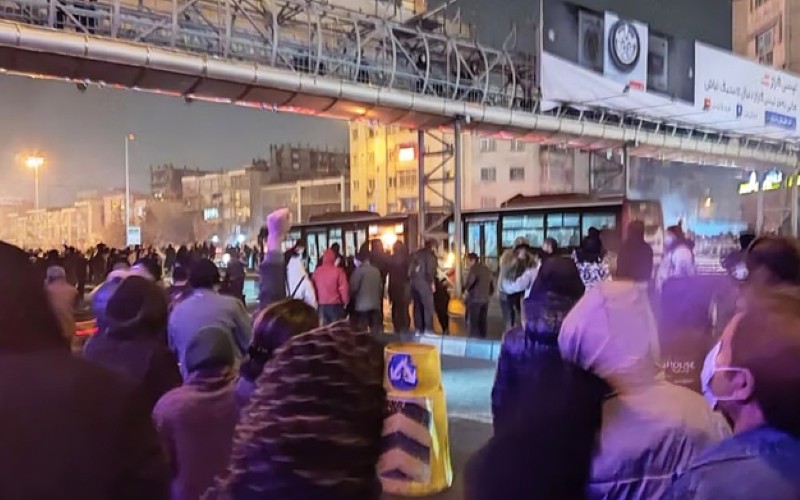
In January 2026, during a nationwide uprising, that pattern returned on a new scale. Once again, communication networks were cut. Once again, the streets were plunged into enforced silence. And once again, mass killing followed. Thousands of protesters—unarmed civilians demanding freedom—were slaughtered across cities throughout Iran.
This was not an aberration. It was continuity.
Today’s protesters are the living continuation of those massacred over the past forty years. They are the heirs of the generation of 1979 who rose against dictatorship and refused to submit to any form of tyranny. They have paid in blood—again and again—for political, social, and civil freedom. And this time, they have made a conscious decision: to end the Mullahs regime permanently and consign it to the dustbin of history.
They seek no compromise with a system built on mass murder. They demand not a reshuffling of power, but its dismantling.
What outcome could possibly satisfy a people who have endured repeated genocidal violence, if not the complete overthrow of the Mullahs regime and the prosecution of all those responsible—starting with its chief architect, Supreme Leader Ali Khamenei?
This struggle is not symbolic. It is final. Those who have taken on this responsibility understand its risks and its cost. They fight not for revenge, but for a future founded on freedom, equality, and independence. They fight so that no Iranian family will again be forced to search for truth in unmarked graves.
These fighters and freedom seekers know their enemy well. They do not need foreign military intervention—neither bombs nor imposed solutions. Any such interference serves only to derail the people’s struggle and protect opportunists. What they demand from the international community is far simpler, and far more just: stop supporting the regime.
Remove political cover. Designate the regime’s military and repression apparatus as terrorist organizations. Strip the regime of legitimacy at the United Nations. Let the Iranian people confront their oppressors without foreign complicity sustaining the machinery of murder.
This is a struggle for justice—dadkhahi—not for elite power transfer. And after the fall of the Iranian regime, the goal is clear: a democratic republic where every criminal of this regime faces a fair and public trial.
Silence once enabled genocide in Iran.
Today, silence is no longer neutral—it is complicity.