


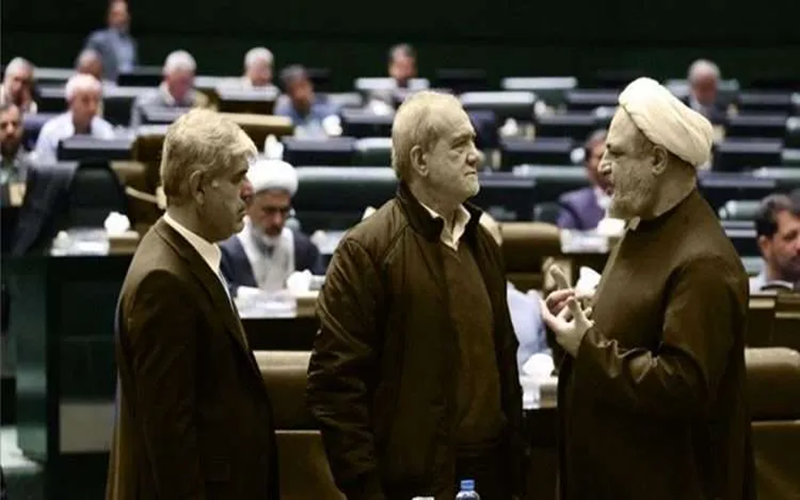

Escalating social unrest, factional conflict, and a contested leadership transition have exposed structural weaknesses that the Iranian regime is increasingly struggling to contain.
The increasingly visible divisions within Iran’s regime are not merely the result of personal rivalries or factional competition. Rather, they reflect a deeper structural crisis that has been building for years and has intensified amid mounting economic, social, and political pressures.
As disagreements among senior officials become more public, two fundamental questions emerge: Why has the regime become so vulnerable to internal fragmentation, and why has it proved unable to contain these divisions?
Two interconnected factors help explain the current situation. The first is the growing readiness of Iranian society to resume nationwide uprisings. The second is the erosion of the Supreme Leader’s traditional dominance over the political system—an issue that has become even more acute following the disputed succession of Mojtaba Khamenei.
A Society in Persistent Conflict with the Regime
The roots of today’s instability lie in the long-standing conflict between Iranian society and the regime. Decades of political repression, widespread human rights abuses, and unresolved economic grievances have created structural tensions that continue to deepen.
Successive governments have failed to address the political and economic demands of broad segments of society. At the same time, fundamental civil liberties have remained tightly restricted, while economic decline, corruption, inflation, unemployment, and environmental degradation have intensified public frustration.
Rather than easing these pressures during his decades in power, Ali Khamenei presided over policies that many critics argue compounded them. The result has been a society that increasingly resembles what observers describe as a “social volcano”—one capable of erupting whenever political or economic pressures reach a critical point.
The nationwide uprisings of 2017, 2019, 2022, and more recent waves of protest have demonstrated that public discontent has not subsided. Instead, it has evolved into recurring nationwide movements encompassing workers, teachers, pensioners, students, and other sectors of society.
Officials Acknowledge Mounting Public Discontent
Significantly, senior regime officials themselves have repeatedly acknowledged the growing gap between society and the state.
Regime President Masoud Pezeshkian has warned that failure to address citizens’ problems could trigger serious social crises. Likewise, Parliament Speaker Mohammad Bagher Ghalibaf has argued that economic imbalances and worsening living conditions have eroded the regime’s social capital.
Such statements underscore that concerns about rising public dissatisfaction are no longer limited to outside observers or opposition groups. They are increasingly being voiced from within the establishment itself.
Meanwhile, organized opposition networks, including the PMOI’s Resistance Units, have continued to expand their activities inside Iran. Regime-affiliated media and security institutions have repeatedly warned that these networks are helping transform scattered protests into more organized and politically focused challenges to the state.
A Leadership Divided Over Survival
Public pressure is only one side of the crisis.
The regime’s leadership is increasingly divided over how to preserve its grip on power.
One faction argues that stabilizing the collapsing economy and easing social tensions are essential to preventing another nationwide uprising. Another insists that any meaningful reform would only encourage further protests and weaken the regime’s authority.
According to this view, continued repression and the maintenance of a wartime security atmosphere remain the only reliable means of preventing renewed unrest.
These opposing approaches have contributed to growing disagreements over broader strategic issues, including the regime’s regional policies and its response to mounting domestic crises.
Even newspapers aligned with different factions have reflected this divide. While some have called for rebuilding the regime’s diminishing social legitimacy, hardline outlets continue to argue that any concession would embolden opponents and accelerate instability.
Succession Has Intensified Internal Tensions
Another source of division concerns the leadership transition following Ali Khamenei’s death.
According to reports circulating among opposition sources, Mojtaba Khamenei assumed the position of Supreme Leader under emergency wartime conditions despite significant reservations within the Assembly of Experts.
Some reports have claimed that dozens of members opposed the appointment and questioned the legitimacy of the selection process. Accounts from individuals allegedly familiar with the proceedings have suggested that votes were not formally counted before the outcome was announced.
Although these accounts have not been independently verified, they have fueled persistent debate regarding the legitimacy of the succession and highlighted underlying disagreements within the regime’s highest institutions.
The Three Pillars of the Regime Are Under Pressure
For nearly five decades, the regime’s authority has rested on three interconnected pillars:
- Domestic repression.
- Pursuit of its nuclear ambitions.
- Export of regional conflict and support for militant proxies.
Today, however, disagreement over these core policies has become increasingly visible.
Hardline factions maintain that retreat in any of these areas would fatally weaken the regime and hasten its collapse. Others argue that continuing the same confrontational strategy—particularly amid growing international pressure and domestic dissatisfaction—has itself become a catalyst for instability.
This debate extends far beyond tactical disagreements. It reflects fundamentally different assessments of what is required for the regime’s survival.
Structural Crisis Rather Than Ordinary Factionalism
The current fragmentation should therefore not be viewed simply as another episode of factional competition within the political establishment.
Instead, it reflects a convergence of multiple crises: economic deterioration, persistent nationwide protests, declining public legitimacy, uncertainty over succession, and disagreements over the regime’s long-term strategy.
These overlapping pressures have made internal divisions increasingly difficult to manage. Rather than functioning as a source of resilience, factional competition has become another driver of political instability.
An Uncertain Future
Whether the regime can continue governing through its traditional reliance on repression, external confrontation, and political centralization has become one of the defining questions facing Iran today.
The growing divergence among senior officials suggests that consensus over the regime’s future direction is weakening. At the same time, recurring waves of public protest continue to demonstrate that the underlying social grievances fueling unrest remain unresolved.
As these pressures converge, the debate is no longer whether internal fractures exist within the regime. The more consequential question is whether the political structure built around the doctrine of Velayat-e Faqih still possesses the capacity to contain them—or whether these fractures will continue to widen as Iran enters an increasingly uncertain political landscape.