


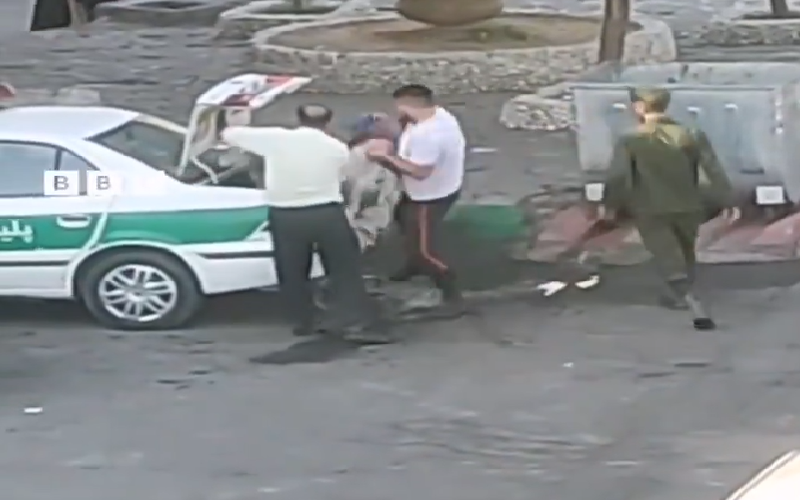

The recent killing of Mohammad Mirmousavi in a detention center in Lahijan, with clear signs of torture and physical abuse on his body, is the latest in a series of violent acts committed by the Iranian police. This tragic incident highlights the unchecked brutality of officers who, under the sanction of high-ranking commanders, have been given tacit approval to use violence against ordinary citizens.
A Culture of Violence
Mirmousavi’s death occurred shortly after a chilling statement made by Ahmadreza Radan, the commander of the regime’s police force, on July 24. Radan made a stark threat, warning that anyone who insulted police officers would be met with lethal force: “If anyone in any part of the country dares assault an officer, the least we can do is to walk over his dead body.” This statement aligns with the police force’s narrative in the Mirmousavi case, where officers claimed they “lost control” after being insulted by the victim. This defense mirrors a broader trend of justifying violence under the guise of maintaining order.
But the violence of Iran’s police force is not limited to this case. Other incidents have surfaced in recent months, such as images of the morality police violently arresting two teenage girls and footage of an individual being forced into the trunk of a police car. These are just a few of the documented instances of police brutality captured by civilians.
Historical Precedents of Repression
Police violence in Iran is deeply rooted in the country’s history. Since the regime’s establishment, various repressive apparatuses—including the Basij, the Islamic Revolution Committees, the Ministry of Intelligence, and the Islamic Revolutionary Guard Corps (IRGC)—have operated with impunity, often using torture and violence in their detention centers. These centers have long been notorious for the inhumane treatment of detainees, with many cases of abuse never officially reported, leaving the extent of the brutality concealed within the oral histories of survivors.
The regime’s violent repression of dissent is not a new phenomenon. During the 1980s, the government conducted a brutal campaign against political dissidents. In his report, Professor Javaid Rehman, the former UN Special Rapporteur on human rights in Iran, described these actions as some of the most extensive and brutal atrocities of modern times. The regime systematically targeted political and religious dissidents, committing mass murder, torture, rape, enforced disappearances, and other inhumane acts.
Police Brutality During Popular Protests
Iran’s violent suppression of dissent has continued into recent decades. The 1999 student protests provide a stark example of police brutality. Students reported being severely beaten, and two young individuals, Fereshteh Alizadeh and Saeed Zeinali, were arrested and subsequently disappeared. The regime’s plainclothes forces and the Basij militia played a significant role in these brutal crackdowns, often operating in unofficial detention centers where the police could deny responsibility for the disappearance and death of detainees.
The protests of 2009, 2017, 2019, and most recently 2022, further underscore the regime’s willingness to use lethal force against its own citizens. In these instances, police officers have been recorded shooting directly at protesters, using batons and electric shock devices, and deploying tear gas indiscriminately. The 2009 protests, in particular, saw the deaths of several detainees—such as Mohsen Ruholamini, Mohammad Kamrani, Amir Javadifar, and Ramin Gahremani—under torture at the Kahrizak Detention Center, sparking widespread outrage.
Despite overwhelming evidence of police brutality, including footage of officers driving over protesters with police vehicles, the regime has consistently shielded its officers from accountability. The police, with the support of the regime, have continued to execute violent crackdowns with impunity.
The Death of Sattar Beheshti and Other Cases of Police Violence
One particularly prominent case was the murder of Sattar Beheshti, a young blogger who was killed in 2012 while in police custody. Political prisoners in Evin Prison revealed that Beheshti had been tortured, with visible marks of abuse all over his body. According to witnesses, Beheshti was hung from the ceiling, beaten severely, and kicked in the head and neck by police officers. His death became a symbol of the regime’s relentless cruelty.
Similarly, the brutal repression of the Gonabadi Dervishes protesters in 2018 demonstrated the severity of police violence. At least 180 dervishes required medical attention after being beaten by the regime’s forces during peaceful protests.
The Death of Mahsa Amini and the 2022 Protests
Perhaps the most notable recent example of police violence was the death of Mahsa Amini in September 2022. Amini, a 22-year-old woman, was arrested by the morality police for allegedly violating the country’s strict dress code. She died while in police custody, with credible reports indicating that she had been beaten. Amini’s death sparked nationwide protests, with citizens demanding justice not only for her but for the countless others who had suffered at the hands of the Iranian police.
The regime’s response was predictably brutal. The police force, along with other security forces, was given the green light to use lethal force against demonstrators. Directly shooting protesters, especially in the head, became a common tactic. In Zahedan, during what became known as Bloody Friday, police were responsible for the deaths of at least 58 children under the age of 18. The police were also directly involved in the murder of Mehran Samak, who was shot in the head during a protest on November 29, 2022.
The Systemic Nature of Police Violence
The violence perpetrated by Iran’s police force is not the result of a few rogue officers but is part of a broader systemic issue. The regime has consistently used the police and other security forces as tools of repression, giving them wide-ranging powers to suppress dissent and intimidate the population. The use of direct gunfire, including targeting protesters’ eyes with pellet bullets, has become a hallmark of the regime’s response to demonstrations.
Moreover, the police force has been involved in numerous other acts of violence, including the killing of cargo porters and the violent arrest of Afghan immigrants. These incidents, along with the parading and public beating of accused individuals to humiliate and intimidate them, further illustrate the brutality of the regime’s police force.
Conclusion: A Legacy of Impunity
The Iranian police force has a long and documented history of violence, repression, and impunity. From the early days of the regime to the present, police officers have been responsible for the deaths, torture, and disappearance of countless individuals. The regime’s leadership has not only tolerated but actively endorsed this violence, as evidenced by the continued use of lethal force during protests and the lack of accountability for those responsible.
The death of Mahsa Amini and the subsequent 2022 protests have once again brought the issue of police violence to the forefront of public discourse. But unless there is a fundamental change in the regime’s approach to law enforcement and accountability, the cycle of violence is likely to continue, with devastating consequences for the Iranian people.