


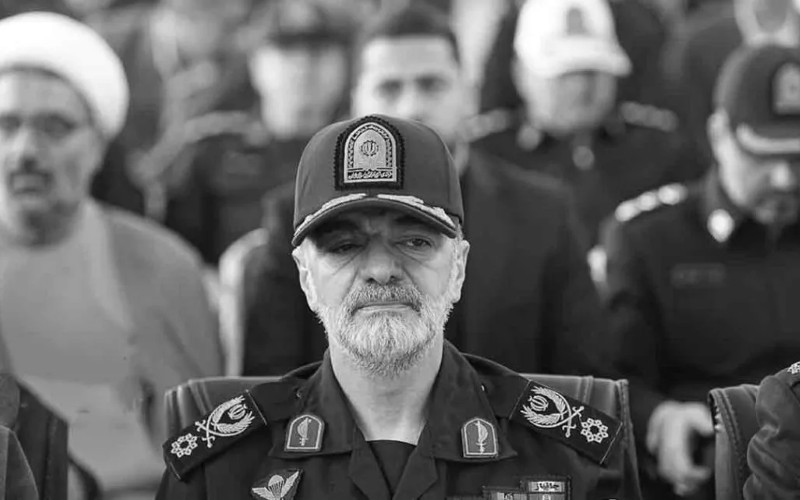

As nationwide protests persist, Iran regime’s security commanders revert to intimidation, exposing anxiety rather than authority.
As Iran’s nationwide uprising enters its second week, the regime has once again reached for a familiar tool: threats from the top of the security apparatus. Recent statements by Ahmad-Reza Radan, commander of the regime’s Law Enforcement Forces and a long-standing figure in protest suppression, underscore not confidence, but mounting fear within the regime.
Radan’s remarks, delivered in an openly menacing tone and amplified by state-run media, were issued against the backdrop of expanding protests and visible cracks in the regime’s ability to maintain control.
“Decisive Dealing”: A Recycled Language of Repression
On January 6, 2026, the regime-affiliated Mizan News Agency quoted Radan declaring that police had taken “decisive action” against what he labeled “rioters.” According to the police chief, security forces had separated “peaceful protesters” from “violent elements” before carrying out mass arrests—both on the streets and through subsequent intelligence operations.
Radan insisted that this process would continue and vowed that those targeted would be pursued “to the very last person.” This phrase, long embedded in the regime’s security lexicon, has been repeated across decades of repression. Yet the reality on the ground increasingly contradicts such claims of control.
Threats Disguised as Justice
In the same remarks, Radan warned that “no time or place will be safe” for protesters—an explicit threat intended to instill fear. Simultaneously, he spoke of the regime’s supposed “clemency,” reviving a well-worn propaganda tactic: pairing intimidation with hollow promises of mercy.
This dual narrative—threatening punishment while claiming compassion—has long been a cornerstone of the regime’s coercive strategy. In practice, it serves only one purpose: psychological warfare against society.
Radan’s labeling of protesters as “misled” follows another decades-old pattern. Every wave of dissent is attributed to manipulation by external enemies, absolving the ruling system of responsibility for economic collapse, political repression, and social despair.
An Insult to a Conscious Generation
Public reaction to Radan’s statements was swift and overwhelmingly negative. Many Iranians viewed his remarks as a direct insult to a politically aware and defiant generation that has taken to the streets demanding basic human rights.
Describing protesters as “misled” is not merely dismissive—it is an attempt to delegitimize legitimate grievances. Over the past four decades, every call for freedom in Iran has been met with the same accusations. The invocation of a vague, ever-present “enemy” has functioned as a cover for systemic corruption and governance failure.
The Myth of Clemency vs. the Reality of the Gallows
While Radan spoke of restraint, the regime’s record tells a starkly different story. In the past year alone, more than 2,000 executions were recorded in Iran—many carried out during the current administration. These figures point to an escalation, not moderation, of state violence.
In this context, talk of mercy rings hollow. The regime’s so-called clemency consistently ends at the gallows. Radan and other security commanders are integral components of a system that relies on fear as a survival mechanism.
Authority or Panic?
The central question remains: do these threats signal strength—or desperation?
The answer is increasingly clear. The harsh rhetoric emanating from Iran’s security leadership reflects fear of a society no longer deterred by intimidation. A generation demanding freedom, dignity, and basic rights has demonstrated that neither promises nor threats can force it back into silence.
History shows that repression does not extinguish such demands; it radicalizes them. With every escalation in threats, the gap between state and society widens, accelerating the very process the regime fears most.
The Echo of a Failing System
Radan’s statements represent a tired and collapsing script—one built on denial, intimidation, and contempt for social reality. But Iran has changed. The language of fear no longer commands obedience.
What is heard today in official threats is not authority, but the echo of panic at the summit of a system that, after four decades, has produced economic ruin, mass repression, torture, and executions.
A regime remembered primarily as a symbol of dictatorship and public resentment has reached a point where intimidation no longer conceals decline. The growing volume of threats is itself an admission: the end of fear-based rule is approaching, and the ruling structure sees no path forward except escalation.
In that sense, Radan’s words are not a warning to the people—but a confession of a regime confronting its own unraveling.