


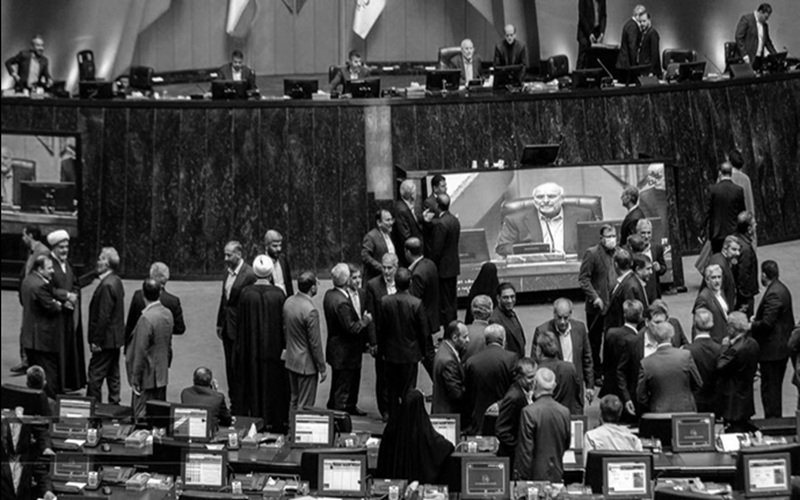

Disputes over negotiations with the United States, economic mismanagement, and competing power centers reveal mounting fractures inside the clerical regime as officials increasingly warn of disunity.
Cracks in the Regime Are Becoming Impossible to Conceal
More than three months after the end of the 40-day war that intensified external pressure, economic turmoil, and regional instability, divisions within Iran’s regime are becoming increasingly visible.
What once remained hidden behind closed doors is now openly surfacing in state-controlled media, parliament, and official platforms. Disagreements over negotiations with the United States, economic policy, military strategy, and institutional authority have revealed a leadership struggling to maintain cohesion amid mounting crises.
As these disputes deepen, senior regime figures have repeatedly warned about the dangers of internal discord, suggesting growing concern over the stability of the system itself.
Repeated Calls for “Unity” Reflect Growing Anxiety
The regime’s leadership has increasingly emphasized the need for unity, a message that many observers interpret as evidence of concern over widening internal fractures.
In a message delivered on June 4, 2026, marking the anniversary of the death of Ruhollah Khomeini, Mojtaba Khamenei warned that the regime’s enemies seek to spread “doubt, despair, fear, mistrust, and division.” He further argued that any action contributing to public disappointment or distrust effectively serves hostile interests.
Such warnings come at a time when state officials and government-affiliated media are themselves publicly exposing new disagreements almost daily, highlighting the extent to which tensions have spread throughout the political establishment.
Negotiations with the United States Become a Major Fault Line
One of the most contentious issues dividing the regime is the question of negotiations with the United States.
Hardline factions continue to oppose diplomatic engagement and advocate a more confrontational approach. The Revolutionary Guard-affiliated newspaper Javan recently described negotiations as a “diplomatic trap” and portrayed ongoing regional developments as part of a broader threat to the regime’s strategic position.
The publication went even further by promoting an aggressive regional posture, arguing that threats against neighboring countries should become part of an official deterrence doctrine. Such rhetoric reflects the determination of hardline elements to resist compromise and prioritize military confrontation over diplomacy.
The same faction increasingly portrays negotiations not as a means of resolving tensions but as a path toward weakening the regime’s regional influence and strategic objectives.
Parliamentary Figures Demand an End to Talks
Opposition to negotiations is not limited to state media. Several members of parliament have publicly called for the complete abandonment of diplomatic efforts.
Among them, lawmaker Qasem Ravanbakhsh argued that the regime should permanently withdraw from negotiations, particularly following disputes over ceasefire arrangements and regional developments.
These statements reflect a broader camp within the regime that believes compromise with Washington would signal weakness and undermine the ideological foundations of the Islamic Republic.
Others Defend Diplomacy as a Necessity
At the same time, another faction within the establishment continues to advocate engagement and dialogue.
Senior cleric Jafar Sobhani publicly called for support of negotiations, arguing that national unity is essential if the regime hopes to overcome its current crises. His emphasis on speaking “with one voice” underscores growing concerns that internal disputes are becoming increasingly difficult to manage.
The existence of such competing narratives demonstrates that the leadership remains deeply divided over how to respond to mounting international and domestic pressures.
Economic Failures Fuel Further Disagreements
Political disputes are also being intensified by worsening economic conditions.
Some regime officials have openly acknowledged the economic consequences of Tehran’s confrontational policies. Parliament member Mohammad Reza Samosami recently admitted that government decisions are contributing directly to inflation and increasing pressure on ordinary citizens.
Such remarks are significant because they represent rare public acknowledgments from insiders that the regime’s own policies are worsening economic hardship. Rising prices, declining purchasing power, and persistent instability continue to fuel public dissatisfaction, adding another layer of tension to existing political conflicts.
Power Struggles Extend Beyond Foreign Policy
The divisions are not confined to foreign affairs. Intense disputes are also emerging over governance, institutional authority, and control of state affairs.
Lawmaker Hamid Rasaei recently challenged the legality of the interim leadership of the Defense Ministry, arguing that critical decisions were being made without proper legal authority. He also criticized the suspension of parliamentary activities and called for intervention from higher authorities.
Similarly, parliamentarian Ahmad Rastineh accused the administration of President Masoud Pezeshkian of violating constitutional principles through the creation of new administrative structures that allegedly encroach upon the powers of other state institutions.
These disputes reveal an increasingly fragmented system in which rival factions are openly contesting authority and legitimacy.
Former Revolutionary Guard Commanders Warn About Economic Costs
Even former military officials have entered the debate.
Hossein Alaei, a former senior commander in the Revolutionary Guards, argued that economic development should have been prioritized decades ago. He suggested that many of Iran’s current difficulties could have been avoided had the regime focused more on economic growth rather than pursuing costly strategic and ideological objectives.
His comments also highlighted the continuing role of the nuclear issue as a central source of international pressure, emphasizing that decisions in this area carry significant economic consequences.
A Regime Increasingly Divided
Taken together, these contradictory positions paint a clear picture of a regime grappling with deep internal divisions.
One faction advocates ending negotiations and escalating confrontation. Another insists that diplomacy remains necessary. Some officials warn about the economic costs of existing policies, while others focus on power struggles and constitutional disputes within the state apparatus.
Against this backdrop, the leadership’s repeated calls for unity appear less like demonstrations of strength and more like signs of concern over growing fragmentation. As external pressures intensify and domestic dissatisfaction continues to rise, the increasingly public nature of these conflicts suggests that the regime faces not only challenges from society but also mounting tensions from within its own ranks.
The expanding visibility of these divisions offers a revealing glimpse into a system struggling to maintain coherence at a time of unprecedented political, economic, and social pressure.