


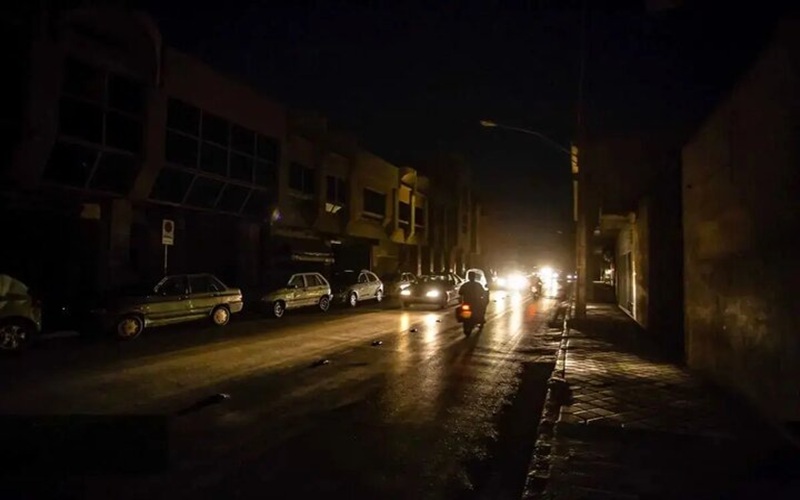

As daily blackouts spread across Iran, leaving millions without electricity and water during extreme summer heat, the crisis exposes years of neglected infrastructure and political priorities that have consistently placed ideology above public welfare.
Iran’s nationwide electricity crisis has become far more than a seasonal inconvenience. Across the country, millions of people now organize their lives around scheduled blackouts that have evolved into a permanent feature of daily existence. During one of the hottest summers in recent years, the consequences extend well beyond the loss of electricity. In many areas, power outages also disable water pumps and distribution systems, leaving households without running water for hours at a time.
The Iranian regime has attempted to portray the crisis as an unavoidable consequence of recent regional conflict. Yet the evidence points to a much deeper problem—one rooted in decades of economic mismanagement, chronic underinvestment, and political choices that consistently prioritized the regime’s strategic ambitions over the basic needs of its citizens.
Blackouts Become the New Normal
According to published electricity schedules for Tehran, the capital’s 22 districts have been divided into eight groups subject to rotating power cuts. While outages in Tehran generally last between two and four hours each day, reports from northern, western, eastern, and central provinces indicate that many cities experience four to six hours of daily blackouts.
For ordinary families, these prolonged outages have become a daily struggle. Air conditioning systems fail during extreme heat, food spoils in refrigerators, businesses suspend operations, and household routines are repeatedly disrupted. For millions of Iranians, electricity is no longer a reliable public service but an uncertain commodity.
The simultaneous interruption of water supplies has further compounded the crisis. In numerous regions, electricity outages shut down pumping stations, depriving entire neighborhoods of both electricity and running water. What might once have been viewed as an energy shortage has now evolved into a broader infrastructure emergency.
A Crisis That Endangers Lives
The human cost of these blackouts extends well beyond inconvenience.
Arash Najafi, head of the Energy Commission at Iran’s Chamber of Commerce, acknowledged that despite government promises to shield industry from electricity shortages during August and September, power cuts remain unavoidable. More alarmingly, he warned that patients relying on life-sustaining medical equipment—including home oxygen concentrators—face potentially life-threatening situations whenever electricity is interrupted.
Such admissions illustrate that the crisis is no longer simply an economic issue. It has become a matter of public safety.
Healthcare systems, vulnerable patients, and elderly citizens bear disproportionate risks, while authorities continue to present the outages as temporary or unavoidable.
Industry Pays the Price
Iran’s productive economy is also suffering.
Domestic media have warned that the continuing energy shortage has created serious uncertainty for manufacturers, while concerns are growing over potential natural gas shortages during the coming months.
Some industries operate continuous high-temperature furnaces that require uninterrupted electricity. Even a brief outage can halt production for hours, damage equipment, and generate significant financial losses.
Rather than addressing the structural causes of the crisis, officials and labor representatives have increasingly focused on mitigating its consequences. Discussions reported by domestic media have centered on compensating for production lost during blackouts by requiring employees to work Fridays or extend working hours on other days.
Such proposals effectively shift the burden of the crisis onto workers—many of whom lack sufficient job security to challenge altered work schedules or additional compulsory hours.
The War Is a Convenient Excuse
In recent weeks, state media and some regime officials have sought to link the widespread blackouts to the recent conflict and U.S. military strikes.
That explanation does not withstand scrutiny.
No official reports have indicated that Iranian power plants were targeted during those operations, nor have responsible authorities claimed that damage to generating facilities caused the current shortages.
More importantly, Iran’s electricity crisis predates the recent conflict by many years.
Long before military tensions escalated, the Ministry of Energy repeatedly acknowledged severe imbalances between electricity supply and demand. Official estimates over recent years placed Iran’s power deficit between 13,000 and 25,000 megawatts, forcing regular electricity rationing for households and industry alike.
Summer blackouts have become a recurring feature of life across Iran, demonstrating that today’s crisis is the culmination of long-term structural failures rather than the product of recent military events.
Infrastructure Neglected While Other Priorities Flourished
Energy specialists have repeatedly pointed to the same underlying causes.
Iran’s electricity infrastructure has failed to keep pace with population growth, rising consumption, and aging equipment. Investment in power generation, transmission networks, storage capacity, and grid modernization has lagged for years despite repeated warnings from experts.
Critics argue that this neglect reflects broader political priorities.
Rather than investing national resources in essential infrastructure—including electricity, water management, healthcare, education, environmental protection, and transportation—the regime has devoted enormous financial resources over decades to its military programs, missile development, nuclear activities, and support for proxy organizations across the region.
Whether viewed through economic or political lenses, the result is increasingly visible inside Iran itself.
The country now faces deteriorating infrastructure, declining industrial productivity, worsening water shortages, mounting pressure on healthcare systems, and a steadily declining quality of life for ordinary citizens.
A Crisis Created by Political Choices
Iran’s energy emergency did not emerge overnight, nor can it be resolved by adjusting blackout schedules or blaming recent geopolitical events.
It is the predictable outcome of decades of policy decisions that consistently deferred investment in the country’s most essential infrastructure.
Today, millions of Iranians spend hours each day without electricity, running water, or cooling systems during dangerous summer temperatures. Businesses lose productivity, patients face life-threatening interruptions to medical care, and workers shoulder the economic burden of failures they did not create.
The blackouts illuminating Iran today are not simply evidence of an electricity shortage. They are a stark reminder that when a government’s priorities consistently diverge from the needs of its people, even the most basic public services eventually begin to fail.