


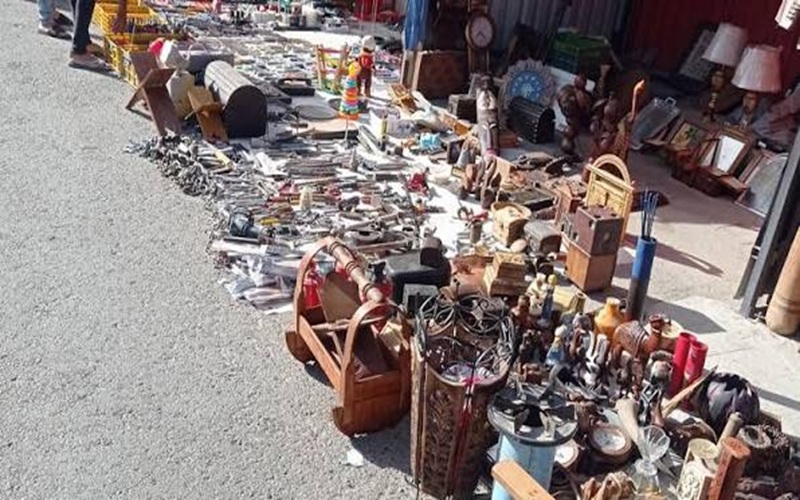

From renting basic laptops to selling hair and empty perfume bottles, Iran’s growing second-hand marketplace reflects how economic collapse has forced millions to monetize every remaining possession.
For years, the Iranian regime has insisted that economic hardships are temporary, externally imposed, or exaggerated by its critics. Yet one of the clearest indicators of the country’s worsening poverty does not come from official statistics.
It appears instead in the online marketplaces where ordinary Iranians increasingly attempt to survive. Ironically, even the state-run news website Eghtesad News recently acknowledged this reality, documenting the proliferation of advertisements for rented laptops, used goods, empty perfume bottles, natural hair, and even rented property deeds and salary certificates—an unintended snapshot of the country’s deepening economic distress.
What was once a platform for buying and selling used cars, furniture, or mobile phones has evolved into something far more revealing. Online classified advertisements now document an economy where almost anything—from worn-out shoes and empty perfume bottles to human hair, salary slips, and property deeds—has become a potential source of desperately needed cash.
These advertisements are more than isolated curiosities. Together, they paint a stark portrait of a society where financial survival increasingly depends on converting every personal possession, every credential, and even every fragment of social trust into money.
Poverty Is Redefining Ownership
One of the most striking developments is the growing market for renting ordinary laptop computers.
Around the world, businesses routinely rent expensive professional equipment such as cameras, lighting systems, or high-performance computers for specialized projects. That is not unusual.
What is unusual is the number of Iranians seeking to rent inexpensive laptops simply to perform basic tasks such as typing documents, using Microsoft Word or Excel, attending online classes, submitting job applications, or completing administrative paperwork.
The message behind these advertisements is unmistakable.
For a growing segment of Iranian society, even the most basic digital tools required for education and employment have become financially unattainable.
A laptop is no longer merely a consumer product. It is an essential gateway to employment, higher education, freelance work, and participation in the modern economy. When people cannot afford to own even these basic tools and instead must rent them by the hour or day, it reflects a widening digital divide driven not by internet access but by economic deprivation.
Every Possession Has Become a Financial Asset
The second-hand market has likewise undergone a profound transformation.
Used clothing has always existed as a commercial category. Today, however, advertisements increasingly feature bundles of heavily worn shoes, clothing, handbags, and miscellaneous household items packaged together simply to increase the likelihood of making a sale.
These are not examples of vintage fashion or environmentally conscious recycling.
They are evidence of families attempting to generate immediate cash from belongings that once would have been discarded.
Products are no longer valued primarily for their usefulness. Instead, they are evaluated according to one question: Can this still be sold?
This represents a significant shift in consumer behavior. Items remain in circulation until every possible economic value has been extracted, regardless of age or condition.
Even Luxury Waste Has Monetary Value
Among the most revealing advertisements are those offering empty bottles of luxury perfume for sale.
While collectors around the world occasionally purchase rare or antique perfume bottles, the growing visibility of such listings in Iran reflects a different reality.
The value no longer lies in the perfume itself—which has already been consumed—but in the residual prestige associated with the brand or in the possibility that even an empty container can generate income.
When empty packaging becomes a tradable asset, it illustrates how deeply economic pressures have penetrated everyday life.
Similarly, advertisements offering natural human hair for sale have become increasingly common. Long hair has always possessed commercial value within the beauty industry for wigs and hair extensions. Yet its increasing prominence on online marketplaces suggests that more individuals are turning personal physical assets into sources of emergency income.
In an economy under severe financial strain, even one’s appearance can become capital.
Survival Extends Beyond Personal Property
Perhaps the most disturbing advertisements involve neither consumer goods nor personal belongings.
Increasing numbers of listings offer to rent property deeds, salary certificates, or official employment documents for use as legal guarantees, bail collateral, or financial security.
These advertisements reveal an entirely different level of economic distress.
When official employment records and legal documents become commodities available for temporary rental, the market has expanded beyond physical possessions into institutional credibility itself.
For families attempting to secure the temporary release of imprisoned relatives or meet judicial bail requirements, such services may appear to offer one of the few remaining options.
At the same time, they expose how economic hardship increasingly intersects with legal vulnerability, creating markets built upon desperation and risk.
The Rise of a Survival Economy
Taken together, these advertisements reveal more than changing consumer habits.
They illustrate what might best be described as a survival economy.
In this environment, ownership gives way to temporary access. Durable goods remain in circulation until every possible exchange value has been exhausted. Even documents representing trust, employment, and legal standing become marketable assets.
None of these developments reflects voluntary minimalism or environmentally conscious consumption.
Instead, they represent adaptive responses to persistent inflation, declining purchasing power, stagnant wages, unemployment, and the steadily rising cost of everyday life.
Families are no longer simply reducing expenses. They are redefining what constitutes an asset.
The Marketplace Speaks More Honestly Than Official Statistics
The examples discussed above are not drawn from opposition reports but from a feature published by the state-run website Eghtesad News. While the article described them as unusual online advertisements, the listings collectively reveal something far more significant: a society where millions of people are forced to monetize virtually every possession in order to cope with relentless economic pressure.
An advertisement seeking to rent a basic laptop for word processing says more about declining purchasing power than many official reports.
An advertisement selling an empty perfume bottle demonstrates how even the remnants of luxury consumption have become financially significant.
An advertisement offering a salary certificate or property deed for rent reveals a society where economic insecurity has reached beyond consumer markets into legal and financial institutions.
These listings are not amusing internet oddities. They are fragments of a much larger picture.
A Mirror of the Regime’s Economic Failure
The rapid expansion of Iran’s second-hand economy is not simply a story about online commerce. It is a reflection of decades of economic mismanagement, corruption, inflation, and policies that have steadily eroded the purchasing power of ordinary citizens.
As living standards continue to decline, millions of Iranians are forced to monetize belongings that once held little or no market value. In many cases, survival now depends not on earning more, but on selling more—one possession, one document, or one personal asset at a time.
The advertisements filling Iran’s online marketplaces may lack the language of economists, but they reveal something official statistics often obscure: the depth of the country’s economic crisis and the daily struggle of ordinary people living under a regime whose priorities have consistently failed to meet their most basic needs.