


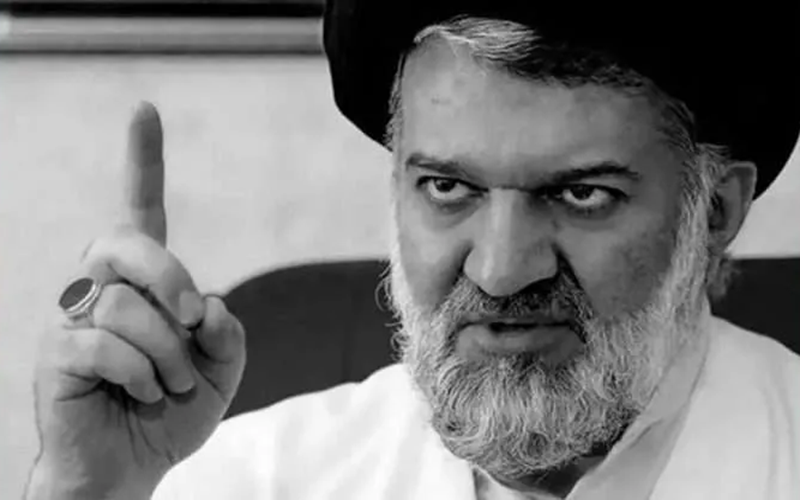

A senior regime cleric’s extraordinary public remarks reveal deep factional divisions, questions over Mojtaba Khamenei’s authority, and growing anxiety about the regime’s ability to maintain internal cohesion.
Authoritarian systems often appear strongest just before their internal fractures become impossible to conceal.
For decades, the Iranian regime cultivated an image of unity, discipline, and centralized control. Public disagreements among senior officials were carefully managed, while power was portrayed as flowing unquestioningly from the Supreme Leader through a loyal and disciplined political establishment.
That image has become increasingly difficult to sustain.
The latest example comes from cleric Bagher Kharazi, a longtime regime insider whose remarkable public comments have exposed not only bitter factional rivalries but also what appears to be a growing crisis of authority surrounding Iran’s new Supreme Leader, Mojtaba Khamenei.
Although Kharazi’s remarks were intended to defend Mojtaba Khamenei, they inadvertently revealed something far more significant: a leadership struggling to command loyalty within its own ranks.
Defending the Leader by Exposing His Weakness
Kharazi described himself as someone who has known Mojtaba Khamenei personally for more than four decades.
His objective was to portray the new Supreme Leader as ideologically committed and more uncompromising than his father.
Yet in attempting to defend him, Kharazi repeatedly acknowledged the very weakness he sought to deny.
According to the cleric, Mojtaba Khamenei has repeatedly found himself isolated inside the regime. Kharazi claimed that influential figures surrounding the office of the former Supreme Leader had previously marginalized Mojtaba, limiting his access and influence within the leadership structure.
More revealing was Kharazi’s repeated insistence that Mojtaba simply lacks dependable allies.
At one point, he argued that if the new Supreme Leader could demonstrate the backing of roughly 250,000 organized supporters willing to mobilize in Tehran, many current political obstacles would disappear.
The implication was unmistakable.
Power within today’s Iranian regime no longer rests solely on formal authority. It increasingly depends on demonstrating the ability to mobilize competing political networks.
For a Supreme Leader whose authority is supposed to be unquestioned, such an admission speaks volumes.
Public Unity, Private Warfare
Kharazi’s remarks also offered an unusually candid glimpse into the increasingly open conflict between rival factions.
He launched attacks against the regime’s President Masoud Pezeshkian, describing him as politically incapable and questioning why he had ever been approved to run for office.
He denounced senior advisers, criticized influential political figures, accused elements within the establishment of advancing reformist influence, and attacked parliamentary leaders and government officials alike.
Such language is extraordinary not because political rivalries exist—they always have—but because they are now being aired publicly by individuals who remain firmly within the regime’s ideological camp.
Rather than presenting a united front during a period of heightened domestic and international pressure, competing factions increasingly appear preoccupied with undermining one another.
Fear of the Street
Perhaps the most revealing aspect of Kharazi’s comments concerned public unrest.
He argued that the authorities are obsessed with preventing even relatively small public gatherings because they fear such assemblies could rapidly grow into much larger movements.
His repeated references to organizing hundreds of thousands of supporters were framed as advice for strengthening Mojtaba Khamenei’s position.
Yet they also exposed the regime’s own calculations.
The leadership clearly recognizes that organized public mobilization remains one of the greatest threats to its stability.
This fear is hardly surprising.
Over the past decade, Iran has witnessed repeated nationwide uprisings driven by economic hardship, political repression, and growing public frustration. Each wave of protests has demonstrated that the regime’s greatest vulnerability lies not on foreign battlefields but within Iranian society itself.
Kharazi’s comments inadvertently confirm that this concern remains central to the leadership’s thinking.
A Leadership Without Consensus
The transition following Ali Khamenei’s death was intended to project continuity.
Instead, it appears to have intensified competition among entrenched power centers.
Unlike his father, who spent decades consolidating authority across the Revolutionary Guards, intelligence services, clerical institutions, and the broader political establishment, Mojtaba Khamenei inherited formal power without necessarily inheriting the same degree of personal legitimacy or institutional consensus.
Kharazi’s account suggests that influential factions continue to compete for influence while questioning one another’s competence and loyalty.
Such dynamics are characteristic of political systems entering periods of succession uncertainty.
The office of Supreme Leader may remain intact, but the networks that sustain it appear increasingly fragmented.
Crisis Behind Closed Doors
Kharazi’s interview is noteworthy not because every allegation can be independently verified, but because it reflects the language now being used by insiders themselves.
In previous decades, such disputes would likely have remained confined to private meetings.
Today, they are unfolding in public view.
The intensity of the accusations—targeting figures across multiple branches of the regime—suggests that factional conflict has reached a level where internal discipline is becoming increasingly difficult to maintain.
For outside observers, this matters because authoritarian regimes rarely become vulnerable through electoral competition.
They become vulnerable when internal cohesion begins to erode.
The Real Challenge Comes From Below
Despite the fierce competition among ruling factions, Iran’s long-term political future is unlikely to be determined by whichever insider prevails in these power struggles.
The deeper challenge confronting the regime comes from a population that has repeatedly demonstrated its rejection of authoritarian rule through nationwide protests, labor strikes, student activism, and organized resistance.
The significance of Kharazi’s remarks therefore lies less in the personal attacks themselves than in what they reveal about the regime’s underlying condition.
When senior loyalists begin publicly acknowledging that the Supreme Leader lacks dependable allies, when they openly attack presidents, advisers, parliamentary figures, and rival factions, and when they repeatedly emphasize fears of mass mobilization, they inadvertently expose a leadership increasingly preoccupied with its own survival.
The Iranian regime has long projected an image of monolithic strength.
Comments like these suggest a different reality: a system consumed by internal rivalries, uncertain leadership, and growing anxiety that its greatest challenge is no longer managing its factions—but containing a society that has repeatedly shown it no longer accepts either its authority or its future.