


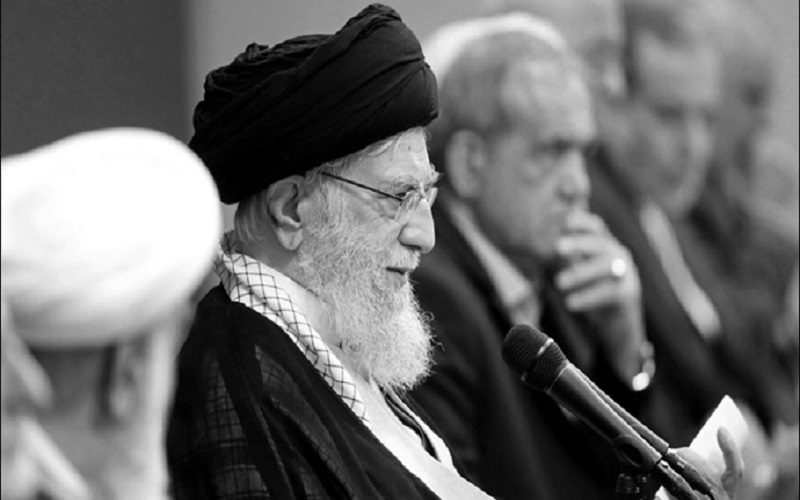

In his Eid al-Fitr sermon, the Iran regime’s Supreme Leader, Ali Khamenei, once again voiced his deep concern over the possibility of renewed anti-regime protests, warning officials of what he termed a “new sedition.”
This term, frequently used by Khamenei and other regime officials, is their standard label for public uprisings, branding protestors as seditionists. However, the crucial question remains: Who is the real seditionist?
The Iranian people, who rise in protest against deteriorating conditions, or Khamenei, who has held absolute power for more than three decades?
The widespread dissatisfaction that has fueled these protests stems directly from the regime’s governance. Iran now teeters on the brink of total collapse across multiple sectors, a situation that Khamenei refuses to acknowledge as a product of his own leadership.
Instead, he consistently dismisses the legitimacy of these uprisings, labeling them as riots orchestrated by foreign enemies. This pattern was evident in the nationwide protests of 2017, 2019, and 2022, where demonstrators took to the streets in dozens of cities, voicing their anger against the regime.
To claim that these protestors—chanting anti-regime slogans for months—are foreign mercenaries is absurd. Khamenei’s refusal to recognize their grievances only underscores his fear of the people’s power.
A Nation in Decline
If Khamenei now fears another wave of protests, he should recognize that this fear is self-inflicted. The economic, social, and political crises driving public anger are the direct result of 36 years of his rule, preceded by a decade of Khomeini’s reign.
In the 46 years since the regime seized power, Iran has fallen drastically behind other nations. While countries like China have emerged as global economic powerhouses and Gulf states like the UAE and Qatar have seen remarkable development, Iran remains mired in stagnation.
The regime has squandered four decades, sacrificing three generations in pursuit of its ideological agenda, leaving the country in ruin.
One stark indicator of this decline is Iran’s currency. When Khamenei assumed leadership in 1989, the U.S. dollar was valued at 120 tomans. Today, that figure has skyrocketed to 104,000 tomans—a catastrophic 870-fold depreciation of the rial. In just the past four years, the exchange rate has surged fivefold, from approximately 20,000 to 104,000 tomans.
Some experts even predict that under continued mismanagement and warmongering policies, the dollar could reach one million tomans. Former head of the Planning and Budget Organization, Masoud Roghani Zanjani, estimates a more “conservative” projection of 200,000 tomans for this year—still a disastrous prospect.
Regime Officials Acknowledge the Crisis
Even Khamenei’s own loyalists admit to the country’s dire economic state. Mohammad Reza Bahonar, former deputy speaker of parliament, acknowledged that Iran has faced consistent 40% inflation for the past seven years.
Inflation, a silent theft from the people, erodes purchasing power overnight, leaving citizens impoverished while the regime enriches itself.
Even Hassan Rouhani, a longtime security official and former president, has conceded that public dissatisfaction is widespread.
Given these realities, how can Khamenei continue branding protestors as seditionists? Many regime insiders, including those who previously helped suppress the 2017 and 2019 protests, now warn of the likelihood of fresh uprisings. If change is necessary, it is not among the people—it is within the ruling elite.
The Cost of Sanctions and Corruption
While Iran’s citizens bear the brunt of economic hardship, the Revolutionary Guard Corps (IRGC) and its commanders have profited immensely. The regime’s policies, especially in circumventing sanctions, have inflicted enormous damage on the country.
Former Central Bank head Mohammad Hossein Adeli revealed that in just one year, Iran lost $50 billion due to these so-called “sanction circumvention” tactics—wealth that largely ended up in the hands of IRGC commanders and oil-smuggling networks.
While these corrupt elites continue to enrich themselves, the Iranian people suffer under deteriorating living conditions and economic uncertainty.
The Inevitability of More Protests
Iran now stands at a critical juncture. The people’s anger toward the regime’s economic mismanagement, corruption, and repressive policies is undeniable.
No amount of rhetoric from Khamenei can suppress the truth: the country is in crisis, and public discontent is growing. The regime can no longer ignore the mounting frustration, and another wave of protests seems inevitable.
The fundamental question remains: In a country where the people’s dissatisfaction is evident and even acknowledged by regime officials, who are the true seditionists?
The citizens demanding their rights, or Khamenei and his inner circle, who have looted the nation while silencing dissent? History will provide the answer, but the signs are already clear—the Iranian people will not be silenced forever.